The price of your stay, as shown on the booking screen. When you arrive, there may be a little more to pay on top of it. In some cities, that’s Accommodation Tax (宿泊税); in onsen (温泉, hot spring) towns, bathing tax (入湯税).
Most of the confusion about money at places to stay clears up once you split the money into two groups. Taxes are set by the city. Cancellation fees and how you pay are set by the place you stay. In Tokyo, for example, the place you stay collects the tax from its guests and pays it to the Tokyo Metropolitan Government. That’s why tax amounts differ from city to city, and cancellation fees and ways to pay differ from place to place.
1 The numbers on the booking screen — what’s included
We covered whether you pay per person or per room in Places to Stay in Japan Come in 4 Types. Here, we look at what’s inside that number.
The price of your stay is subject to a 10% consumption tax. Service charges are handled differently from place to place. At high-end hotels, there may be a service charge of 10–15%. At some places, such as Mikawaya (三河屋), a ryokan (旅館, a traditional Japanese inn) in Hakone, the service charge is included in the accommodation charge.
Once you know what the lines on your bill are called, you can read what you’re paying for when you check out.
2 Accommodation Tax — a city tax. Check whether it’s “included” on the booking screen
Accommodation Tax is a tax that a city sets and charges people who stay there. Whether there’s a tax at all, and how much it is, is decided by each prefecture, city or town.
First, check whether it’s “included” on the booking screen
In Kyoto City, you pay Accommodation Tax to the place where you stay. But it may also be included in what you paid a booking site or travel agency, and if you’ve already paid the Accommodation Tax there, you don’t have to pay it at the place you stay.
In Osaka Prefecture, the price you paid in advance on a booking site or elsewhere may not include Accommodation Tax.
So there’s just one thing to do.
- On the booking screen, check whether Accommodation Tax is included. If it isn’t, pay it at the place you stay
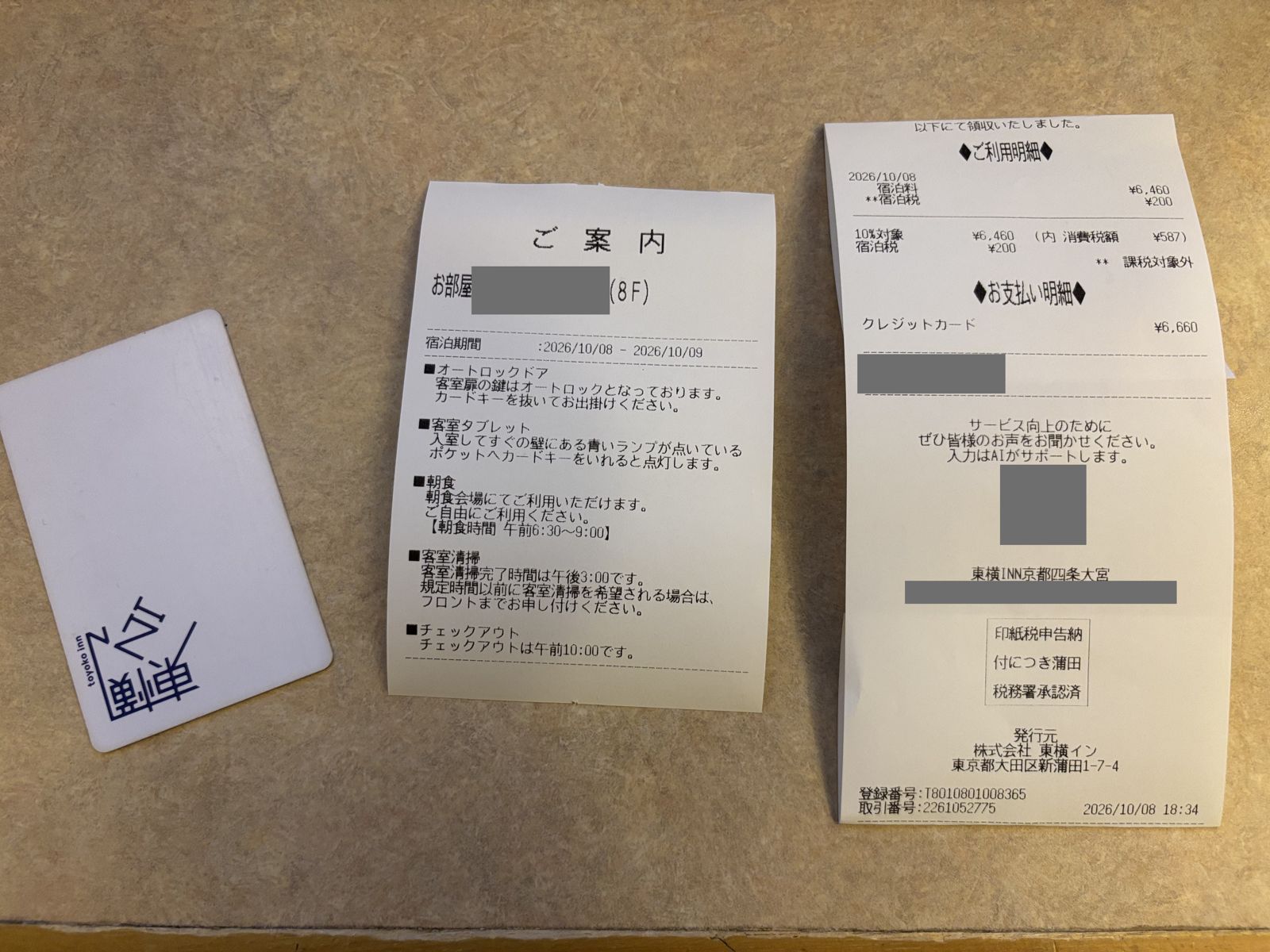
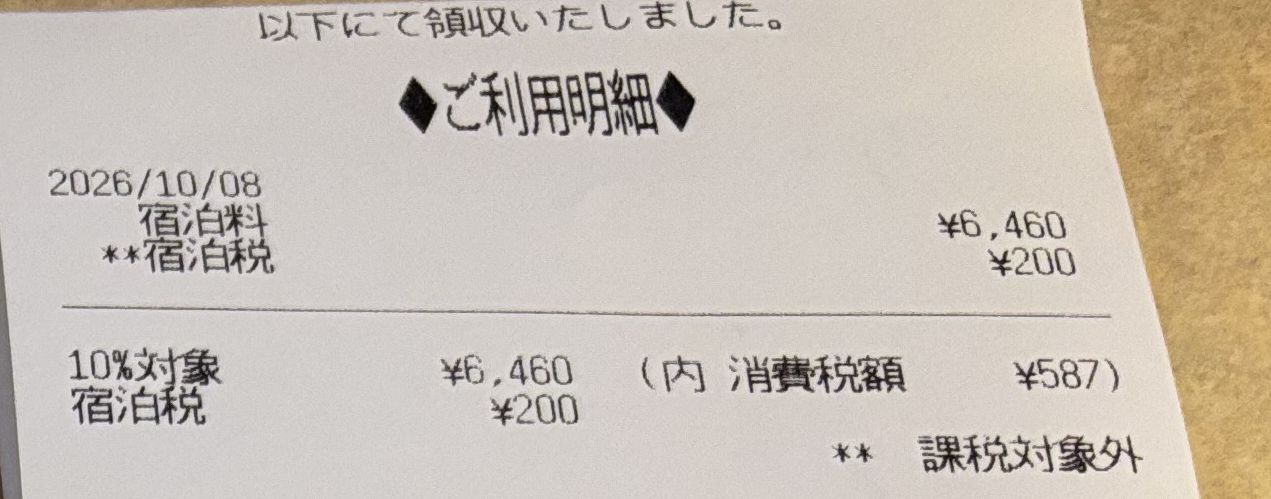
The bill you get at the place you stay may also show Accommodation Tax on a separate line. In Tokyo, when you pay Accommodation Tax where you’re staying, you pay it in whatever way that place accepts.
How the amount is set differs by city
How the amount is set also differs from city to city. In Kyoto City, for example, it’s 200 yen if the accommodation charge is under 6,000 yen per person per night, and 10,000 yen if it’s 100,000 yen or more (for stays from March 1, 2026). In Kyoto City, regardless of age, children pay it too if they’re charged for their stay.
Some cities don’t charge it on cheaper stays, while others, like Kyoto City, charge it at every place to stay. For the current amount, the city’s own information for where you’re staying is the most up-to-date source (you’ll find links to the cities’ information under “Sources” below).
In Sapporo, even if you booked before the Accommodation Tax started, the tax applies to stays from April 1, 2026. It’s decided by the date you stay, not the date you booked.
In Tokyo, the way it’s set will change for stays from April 1, 2027. For stays where the accommodation charge is 13,000 yen or more per person per night, the tax will be 3% of that charge.
The Accommodation Tax you pay goes toward the cities that welcome travelers.
3 Bathing tax — one more tax in onsen towns
Towns with hot springs have one more tax: bathing tax. It’s a local tax on people who bathe in the hot springs, and the law (the Local Tax Act) states that the standard rate is 150 yen per person per day. The amount differs from town to town.
In onsen towns, you may be charged both Accommodation Tax and bathing tax. For example, Ichinomatsu (一の松), a ryokan in Yunokawa Onsen, Hakodate, lists them side by side in its English guide: bathing tax at 100 yen per adult per night (from April 2026), and Accommodation Tax at 200 yen per night for guests sleeping on futons (up to 400 yen depending on the season and room).
The same law states that bathing tax is used for managing hot spring sources, for the town’s sanitation and firefighting facilities, and for promoting tourism. It’s money that also goes toward protecting the source of the water in your morning bath.
4 Cancellation fees — each place decides how many days before they start
The rules on cancellation fees are set by each place you stay. A model set of accommodation terms published by the Japan Tourism Agency includes a table of cancellation fees, but leaves blank how many days before and at what percentage they apply. Each place fills those in when it writes its own terms.
That’s why, even within Japan, when the fees start varies widely from place to place. Some places charge 0% if you cancel by noon on the day of your stay (for example, Toyoko Inn (東横イン); after noon, you pay the full amount), while others start charging from 7 days before (for example, Mikawaya, a ryokan in Hakone).
If you booked through a booking site, check the conditions on that site’s screen too. Online bookings sometimes come with conditions like “a 100% cancellation fee applies,” so check them once before you finish booking.
If you can’t make it, contact the place you’re staying. The model terms say that if you don’t arrive by the set time and haven’t been in touch, the place may treat it as you having canceled your booking.
If you know how many days before your stay it’s still 0%, you know how long you can change your travel plans. Check it once on the booking screen, and you can get back to planning your trip.
5 At the front desk — your passport, and when you pay
Your passport
At check-in, you show your passport. If you’re a foreign national with no address in Japan, the law requires the guest register to record your nationality and passport number, in addition to your name and address. The Japanese government also asks for your passport to be shown and for a copy to be taken.
When you pay
When you pay also differs from place to place. Under the model terms, you pay at the front desk either when you leave or when the place asks you to. At Toyoko Inn, you pay at the front desk when you arrive (see Business Hotels).
How you pay
International-brand credit and debit cards are generally accepted throughout Japan. Large hotels in cities usually accept them.
On the other hand, the Japan National Tourism Organization (JNTO) writes that, especially in rural areas, there are places, even hotels, that only take cash. It says that when you head to rural or less-populated areas to enjoy nature, you should check with the place you’re staying beforehand and have cash ready.
Some places to stay in onsen towns do accept cards and other payment methods. For example, Ichinomatsu in Yunokawa Onsen, Hakodate, accepts cash as well as credit cards, transit IC cards (交通系ICカード, rechargeable train cards), and QR code payments such as PayPay, Alipay+ and WeChat Pay.
On days you head into the countryside, carry a little cash, and you won’t have to choose where you stay based on how you can pay.
To work out how much cash you’ll need during your trip, see “How Much Cash Do You Need in Japan?”.
6 Tipping — just the numbers on your bill
In Japan, tipping at places you stay isn’t common. As for ryokan, Mikawaya, for example, says that tips and kokorozuke (心付け, a thank-you gift) aren’t necessary.
That said, JNTO writes that a very small number of top-end ryokan are the exception.
Japan also has a custom called kokorozuke, a gift given to show your thanks. That isn’t expected either. If you do give one, do it discreetly, in an envelope.
What you pay is just the numbers on your bill. Usually, you can leave without working out a tip.
For now, just this
- On the booking screen, check whether Accommodation Tax is included. If it isn’t, pay it at the place you stay
- Check how many days before your stay cancellation fees start, on the booking screen too. If you used a booking site, check that site’s conditions as well
- At places to stay in onsen towns, there’s also bathing tax
- On days you head into the countryside, carry a little cash. Keep your passport ready to show at the front desk
- Tipping isn’t common at places to stay in Japan
Once you know what’s inside the numbers, all that’s left is to choose where you want to stay.


