Before you go
This is based on official information from rental car companies and booking sites, as of September 2026.
You’re coming to Japan on a trip and renting a car. Which company should you go with?
It’s a question we hear a lot.
But if you start by picking a company, you’ll go around in circles.
What you decide first is the shape of your trip.
Once these three things are settled, the choice of company narrows down on its own.
1 Where you’ll pick up the car
2 Where, and at what time, you’ll return it
3 Where you’ll book it
1 Where you’ll pick up the car
First, decide whether to pick up the car on the day you arrive.
Both pickup and return happen within the rental office’s business hours (Times Car Rental, Nippon Rent-A-Car, Nissan Rent a Car). Business hours differ from office to office.
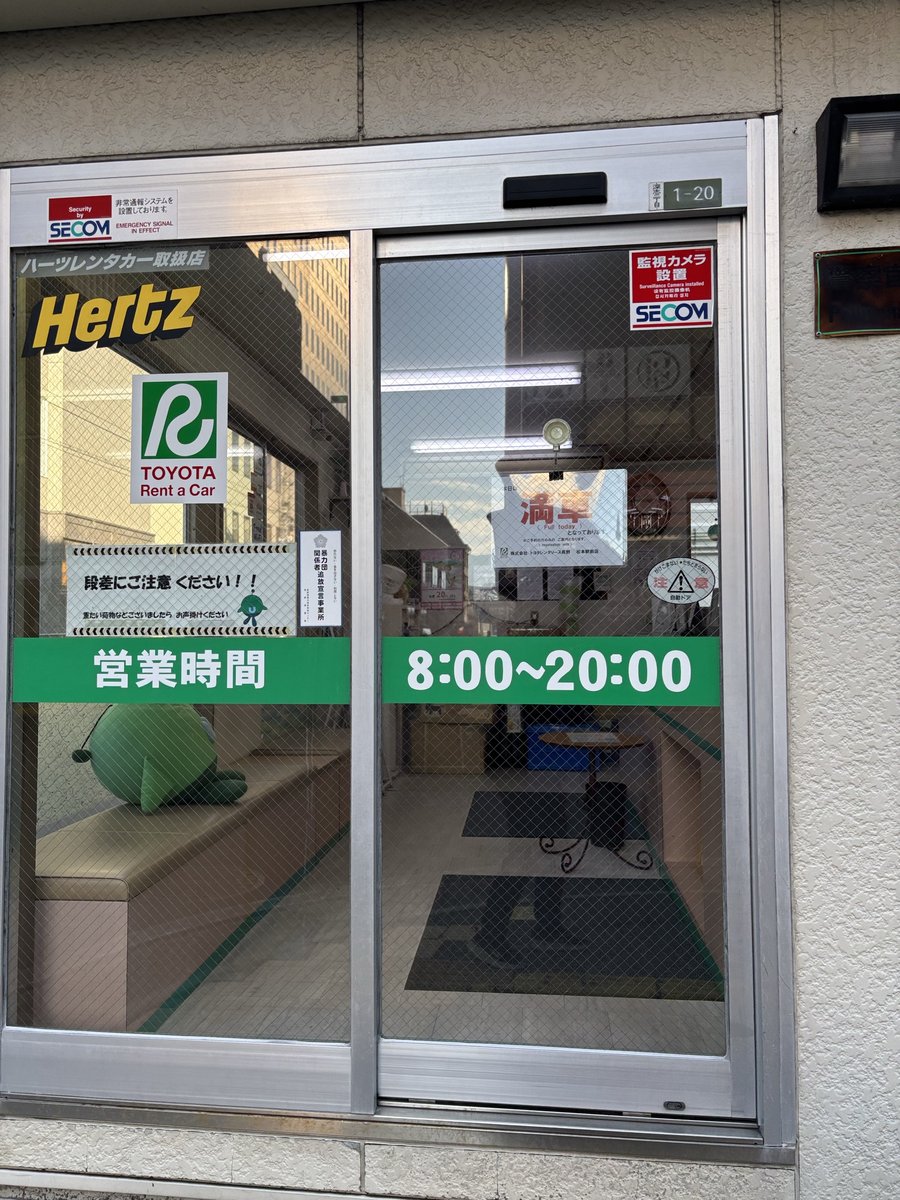
If your flight lands outside business hours, book the car from the day after you arrive.
On the night you arrive, take the train to your hotel.
Pick up the car the next morning, once it’s light, and you won’t have to drive Japan’s roads for the first time at night.
Check where the office is, too. Times Car Rental has offices at major airports and major shinkansen stations, and offices far from the airport pick you up for free. Whether there’s a shuttle from the airport depends on the office (at Nippon Rent-A-Car and Nissan Rent a Car, only some airport offices have one).
If you’re picking up at an airport, check for a shuttle when you book, and you won’t have to hunt for one after you land.
2 Where, and at what time, you’ll return it
You don’t have to use the car for your whole trip
Returning the car to a different office from the one you rented it at is called 乗り捨て (a one-way rental).
For example, you can use it like this.
Use the car only to get to a big station or an airport.
You’ll have more luggage on the way back, so rent a car just for the trip home.
The car can be just one part of your trip. You can also plan to rent only for the stretches that are hard to reach by train.
You can take trains in the cities and use a car only in rural areas. If you’re still unsure, “Train or Rental Car in Japan?” will help you decide.
Decide on a one-way rental when you book
It’s safest to request a one-way rental when you book. Toyota Rent a Car and Budget Rent a Car ask you to request it in advance, and on Tabirai, once you’ve booked, you can’t switch to one on the day of your rental.
Some offices and car models don’t accept one-way rentals (Toyota Rent a Car, Nissan Rent a Car), and Budget Rent a Car says a one-way return may not be possible even if you requested it when you set off. On booking sites, the one-way fee may not be included in the price shown (Tabirai).
If your trip only goes one way, check when you book that the one-way rental has gone through, and what the one-way fee is.
For trips between Hokkaido or Okinawa and the rest of Japan, many companies don’t allow one-way rentals (Toyota Rent a Car, Times Car Rental, ORIX Rent a Car, Nissan Rent a Car). One-way rentals between islands are covered in “Japan Rental Car Q&A — Booking, Pickup, Return, Accidents and More.”
The time you return it
You also return the car within business hours. ORIX Rent a Car only takes one-way returns between 8:00 and 20:00 (except in Hokkaido and Okinawa).
If your flight home leaves outside business hours, book the car only up to the day before you fly out. At Nippon Rent-A-Car, too, if you want to return the car before the office opens, you return it the day before.
On your last morning, you can head to the airport without thinking about the car.
Returning the car is covered in “Returning a Rental Car in Japan: The Hour Before — Work Back from Closing Time and Traffic.”
3 Where you’ll book it
You can book in two places: the rental car company’s official site, or a booking site.
Where you booked changes who you contact if something goes wrong later. A booking made on another site may not be something the rental car company can change on its end (Nippon Rent-A-Car, Nissan Rent a Car).
One more thing: the cards you can pay with differ by company, too. Some companies don’t accept debit cards or prepaid cards (Toyota Rent a Car, Nissan Rent a Car). Before you book, check that the card you have will work.
How the booking routes differ is covered in “Japan Rental Car Prices — Why the Same Car Has Several Prices, and How to Read the Booking Screen.”
For actual research on how displayed prices and coverage differ by booking site, see “Where Should You Book a Rental Car in Japan? How Much Is the Total?“.
Language support, and the language of the website
Nippon Rent-A-Car, Times Car Rental, Toyota Rent a Car and ORIX Rent a Car have lines where you can get help in English and other languages. Nippon Rent-A-Car handles English, Chinese, Korean and Thai at offices nationwide, and Times Car Rental’s accident and breakdown line runs 24 hours in 10 languages. Toyota Rent a Car has an English reservation center and 24-hour multilingual support you can use if you register in advance, and ORIX Rent a Car connects you to an interpreting center (BeBorn).
Check the phone numbers on the paperwork you get when you pick up the car.
Toyota Rent a Car, Times Car Rental, Nippon Rent-A-Car, ORIX Rent a Car and Budget Rent a Car also have websites in Korean and Traditional Chinese.
Book on a page you can read in your own language, and it’ll be easier to look back at the rules later.
For now, just these three
Where you’ll pick up the car / where, and at what time, you’ll return it / where you’ll book it.
Write these three down before you open the companies’ pages, and you’ll know exactly where to look.
The license documents are covered in “Driving in Japan as a Tourist — Your Own License, Plus an International Driving Permit (IDP) or a Japanese Translation, Depending on Your Country,” and coverage in “Rental Car Insurance in Japan (CDW and NOC) — Three Tiers So the Booking Screen Doesn’t Stop You.”
※ Business hours, airport shuttles, whether one-way rentals are allowed and what they cost, the cards you can pay with, and language support differ by company and by office, and they can change. When you actually book, check the latest information from the company you’re booking with.


