Before you go
This site offers information based on guidance from the police, national government bodies and others, to help you prepare before you drive in Japan (as of September 2026; it isn’t an explanation of the law). How signs are written and the hours restrictions apply differ from place to place, and they can change. When you drive, follow the signs on site and the official information listed at the end of this article.
What if the signs are only in Japanese? You may be worried about that.
This article goes through these three things in order.
- The white plate underneath, with times, days and vehicle types
- Directions to destinations in rural areas
- When you come across a sign you can’t read
Times, days and vehicle types are on the white plate under the sign
Sometimes there’s a small white plate under a sign.
It’s called a supplementary sign, and it shows when, and to which vehicles, the rule on the sign above applies. Things like times, days and vehicle types.
It’s written in black characters on a white background.
Some of the signs above also have Japanese or numbers in them. But when and to which vehicles the rule applies is usually written on this plate below.
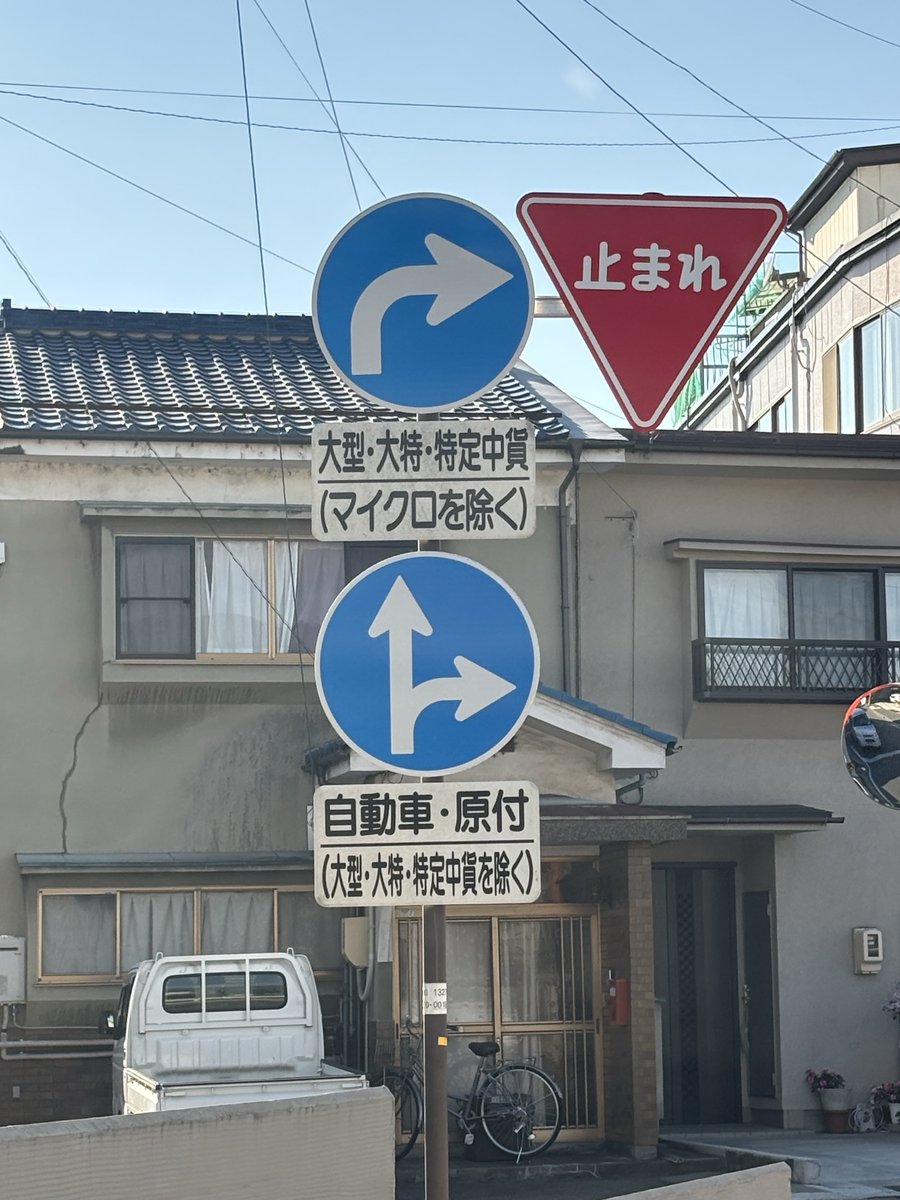
Read the plate starting with the numbers
Let’s look at three examples the Tokyo Metropolitan Police Department shows for foreign drivers.
8-20
This means from 8 a.m. to 8 p.m. In the example, you can only go right during these hours.
日曜・休日を除く
This is an example of no entry except on Sundays and holidays. 除く means the rule doesn’t apply on the days written there.
土・日曜、休日を除く 7.30-8.30
土 means Saturday. This is an example where cars can’t get through from 7:30 to 8:30 on weekdays.
休日 means holidays, such as the national public holidays set by Japanese law.
Vehicle types are sometimes written in short words such as 大型 and 二輪. You can look up what they mean in “A Mini Japanese Dictionary for Road Signs.”
Even if you can’t read kanji, you can read the numbers. But when 除く is added, the rule doesn’t apply on the days written. Along with the numbers, check whether the characters 除く are there.
In Okinawa, there are restrictions that make some lanes or roads bus-only. Check the plate on site for when they apply.
Directions to destinations in rural areas
On main roads, many of the main destinations are also shown in English. On rural roads, that isn’t always the case.
Some companies have cars with a navigation system that works in other languages.
If you’ll be driving a lot in rural areas, one option is to get a road map in English and Japanese before you set off.
When you book, ask whether there’s a navigation system in another language.
When you come across a sign you can’t read, stop first
Look up a sign you don’t understand only after you’ve stopped somewhere safe. If someone’s riding with you, have them look it up.
Before you drive, put your phone in driving mode or similar so it won’t ring.
Talking on a phone or keeping your eyes on the screen while you’re driving is prohibited by law. It’s different when you’re stopped.
Read the white plate below starting with the numbers
On the white plate below, look at the numbers and 除く. Look things up after you’ve stopped.
Words you often see on the plates are collected in “A Mini Japanese Dictionary for Road Signs.”


