Category: Road Signs

  • A Mini Japanese Dictionary for Road Signs (道路標識の日本語ミニ辞典)

    This is a dictionary for quickly checking, on the spot, the Japanese you often see on road signs in Japan and on the white plates beneath them.

    It gives not just the meaning but also what to do when you’re there.

    The words in this dictionary

    Words you see on signs

    Words you see on the road surface

    • 止まれ(路面) — stop (on the road)

    Words you see on the white plate below

    Signs and plates without words

    • 進入禁止 (a white horizontal bar on a red background) — no entry
    • 車両通行止め (a red ring on a white background) — no vehicles
    • 踏切あり (a steam train or electric train on a yellow diamond) — railroad crossing ahead
    • 左折可の板 (a blue left-pointing arrow on a white background) — left turn allowed

    Words you see on signs

    止まれ/STOP

    A solid red upside-down triangle sign. Come to a full stop before the white stop line, or before the intersection if there’s no stop line. Go on after you’ve checked left and right.
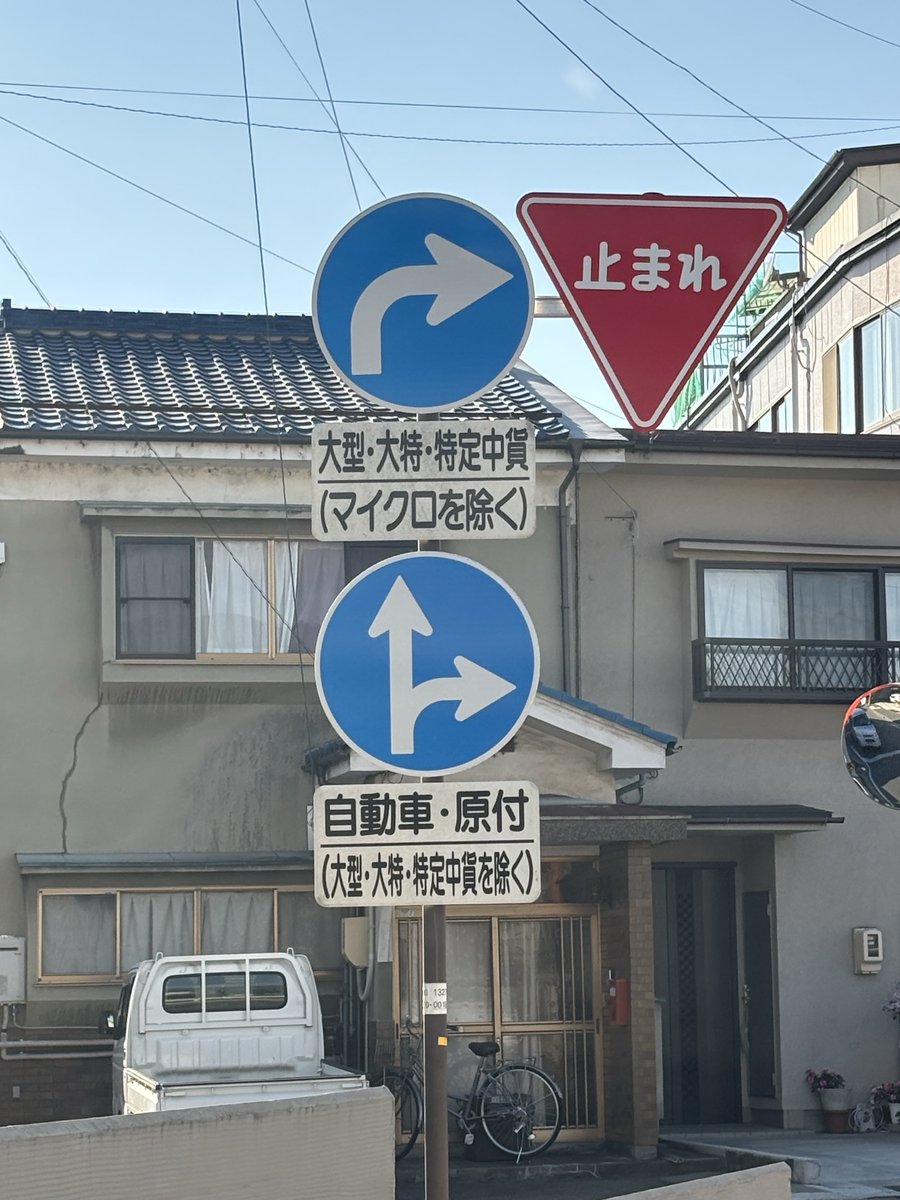
    Red inverted-triangle 止まれ (Stop) sign without the English word STOP

    徐行/SLOW

    An upside-down triangle sign with a red border on a white background. Go slowly enough to stop right away. The National Police Agency’s guideline is 10 km/h or less.

    前方優先道路

    Words on a plate that goes under the 徐行 sign. The road you’ll cross up ahead has priority. Go slowly.

    一方通行

    A sign with a white arrow on a blue background. You can only go in the direction of the arrow. At the exit end of the same road, you often see 進入禁止.

    通行止

    Beyond this point, neither pedestrians nor vehicles can get through. Find another road.

    歩行者専用

    A road for pedestrians, and vehicles can’t use it. If there are times on the plate below, the rule applies during those times.

    自動車専用

    A road for motor vehicles. Pedestrians, bicycles, mopeds and so on can’t use it.

    バス専用

    A lane only for the vehicles listed on the plate. If there are times on the plate below, stay out of it during those times. Just before you turn left at an intersection, you can enter it.

    駐停車禁止

    You can’t park, and you can’t stop even briefly.

    駐車禁止

    A sign that says you can’t park. What it means and how to spot it are covered under 駐車禁止 in “Parking in Japanese: A Mini Dictionary for Parking Lots in Japan.”

    Words you see on the road surface

    止まれ(路面)

    止まれ written in white characters on the road surface. It’s written at places where you have to stop, and you stop before the stop line.

    Words you see on the white plate below

    8-20(時間)

    From 8 a.m. to 8 p.m. The rule on the sign above applies during these hours. 7.30-8.30 means from 7:30 to 8:30.

    除く

    〜を除く means the rule doesn’t apply on the days or to the vehicles written there.

    日曜・休日

    Sundays, and holidays such as Japan’s national public holidays. 日曜・休日を除く means the rule applies on days other than Sundays and holidays.

    区間内

    Within the section where the rule on the sign above applies.

    終わり

    The rule on the sign above ends here.

    通学路

    A road children use to get to elementary school, kindergarten, daycare and so on.

    踏切注意

    There’s a railroad crossing ahead. Before the crossing, stop even if the barrier is up. More in “Railroad Crossings in Japan.”

    大型/普通/二輪/原付/軽

    Short words for vehicle types.

    • 大型: large motor vehicles
    • 普通: ordinary motor vehicles
    • 二輪: motorcycles and mopeds
    • 原付: mopeds (small motorbikes)
    • 軽: ordinary motor vehicles built to a smaller standard (kei cars)

    If a plate has one of these words, the rule is about that type of vehicle. If 除く is added, the rule doesn’t apply to that type of vehicle.

    Signs and plates without words

    進入禁止

    A sign with a white horizontal bar on a red background. You can’t enter from the side this sign faces. You often see it at the exit end of one-way roads.

    車両通行止め

    A sign with a red ring on a white background. Vehicles can’t get through. Bicycles count as vehicles too.

    踏切あり

    A yellow diamond sign with a steam locomotive or an electric train on it. There’s a railroad crossing ahead.

    左折可の板

    A plate with a blue left-pointing arrow on a white background, found at the left edge of the road or on a traffic light. You can turn left even on a red or yellow light, while watching out for pedestrians and others around you.

    If you’re not sure

    If you come across a sign you don’t understand, don’t look it up while you’re driving; stop somewhere safe first. If someone’s riding with you, have them look it up.

    ※ How signs are written, where they’re placed and the hours restrictions apply differ from place to place. When you actually drive, follow the signs on site.

  • Signs in Japanese Only — Times, Days and Vehicle Types Are on the White Plate Below

    This site offers information based on guidance from the police, national government bodies and others, to help you prepare before you drive in Japan (as of September 2026; it isn’t an explanation of the law). How signs are written and the hours restrictions apply differ from place to place, and they can change. When you drive, follow the signs on site and the official information listed at the end of this article.

    What if the signs are only in Japanese? You may be worried about that.

    This article goes through these three things in order.

    1. The white plate underneath, with times, days and vehicle types
    2. Directions to destinations in rural areas
    3. When you come across a sign you can’t read

    Times, days and vehicle types are on the white plate under the sign

    Sometimes there’s a small white plate under a sign.

    It’s called a supplementary sign, and it shows when, and to which vehicles, the rule on the sign above applies. Things like times, days and vehicle types.

    It’s written in black characters on a white background.

    Some of the signs above also have Japanese or numbers in them. But when and to which vehicles the rule applies is usually written on this plate below.

    Red inverted-triangle 止まれ (Stop) sign without the English word STOP

    Read the plate starting with the numbers

    Let’s look at three examples the Tokyo Metropolitan Police Department shows for foreign drivers.

    8-20
    This means from 8 a.m. to 8 p.m. In the example, you can only go right during these hours.

    日曜・休日を除く
    This is an example of no entry except on Sundays and holidays. 除く means the rule doesn’t apply on the days written there.

    土・日曜、休日を除く 7.30-8.30
    土 means Saturday. This is an example where cars can’t get through from 7:30 to 8:30 on weekdays.

    休日 means holidays, such as the national public holidays set by Japanese law.

    Vehicle types are sometimes written in short words such as 大型 and 二輪. You can look up what they mean in “A Mini Japanese Dictionary for Road Signs.”

    Even if you can’t read kanji, you can read the numbers. But when 除く is added, the rule doesn’t apply on the days written. Along with the numbers, check whether the characters 除く are there.

    In Okinawa, there are restrictions that make some lanes or roads bus-only. Check the plate on site for when they apply.

    Directions to destinations in rural areas

    On main roads, many of the main destinations are also shown in English. On rural roads, that isn’t always the case.

    Some companies have cars with a navigation system that works in other languages.

    If you’ll be driving a lot in rural areas, one option is to get a road map in English and Japanese before you set off.

    When you book, ask whether there’s a navigation system in another language.

    When you come across a sign you can’t read, stop first

    Look up a sign you don’t understand only after you’ve stopped somewhere safe. If someone’s riding with you, have them look it up.

    Before you drive, put your phone in driving mode or similar so it won’t ring.

    Talking on a phone or keeping your eyes on the screen while you’re driving is prohibited by law. It’s different when you’re stopped.

    Read the white plate below starting with the numbers

    On the white plate below, look at the numbers and 除く. Look things up after you’ve stopped.

    Words you often see on the plates are collected in “A Mini Japanese Dictionary for Road Signs.”

    Official sources we checked (5)

    ・警視庁:日本で運転するために (Tokyo Metropolitan Police Department: Driving in Japan, in Japanese)

    ・警察庁:交通の方法に関する教則(PDF) (National Police Agency: Rules of the road, in Japanese, PDF)

    ・沖縄県警察:バスレーン規制について (Okinawa Prefectural Police: About bus lane restrictions, in Japanese)

    ・日本政府観光局(JNTO):Things to know when renting a car (Japan National Tourism Organization, in English)

    ・警察庁:Stop Using Your Smartphone, Cellphone, etc., While Driving! (National Police Agency, in English, PDF)

  • Japan Railroad Crossings (踏切): Stop Even With the Barrier Up

    This site offers information based on guidance from the police, national government bodies, railway companies and others, to help you prepare before you drive in Japan (as of September 2026; it isn’t an explanation of the law). Railroad crossing equipment and guidance differ by place and by company, and they can change. When you drive, follow the signs on site and the official information listed at the end of this article.

    At a railroad crossing in Japan, you stop before you cross, even if the barrier is up and the warning signal isn’t sounding.

    Railroad crossings don’t have a 止まれ sign

    Under police standards, 止まれ signs aren’t put up before railroad crossings.

    You stop at a crossing not because there’s a sign, but because the law (the Road Traffic Act) says so.

    If there’s a white stop line, stop before it.

    Even without a sign, stop before the tracks.

    A yellow diamond sign tells you a crossing is coming up. Some show a steam locomotive and some show an electric train.

    Why stop even when the barrier is up?

    Japan has crossings with no warning signal and no barrier. When a train is coming, there’s nothing to tell you.

    A train running at 60–80 km/h needs about 200–400 m to stop.

    Even after one train has gone by, another may come right after it from the other direction.

    At crossings with barriers too, stop before the crossing in the same way and check with your own eyes and ears.

    Once you’ve stopped, open the window, look and listen

    Once you’ve stopped, open the window, for example, and check left and right with your own eyes and ears.

    Toyota Rent a Car’s guidance in Chinese (traditional characters) puts it as 「停、看、聽」: stop, look, listen, in three characters.

    If the warning signal starts sounding, don’t go onto the crossing.

    If traffic is backed up on the other side and you might end up stopped on the crossing, don’t go onto it. Even if you’re following another car across, stop first yourself.

    Don’t stop on the crossing; go straight across in one go.

    If the signal starts sounding while you’re crossing

    If the warning signal starts sounding while you’re crossing, get off the crossing quickly.

    Even if the barrier has come down, you can get out by pushing it with your car.

    According to JAF, modern barriers don’t break when a car pushes them; they lift up at an angle.

    Don’t panic. Push slowly, and get off the crossing.

    If your car stops moving on the crossing

    1. Get out of the car and get off the crossing.
    2. Press the emergency button near the warning signal to alert the train driver.
    3. Call the contact number shown.

    At crossings without an emergency button, use the emergency flare to warn the train.

    Check where the flare is in the car when you set off.

    If you know where it is, you won’t have to panic.

    At the tracks, stop

    Even when the barrier is up, stop before you cross. Stop, look, listen.

    Along with the 止まれ sign, it’s one of the two places you stop in Japan. For 止まれ, see “Japan’s Stop Sign (止まれ).”

    Official sources we checked (7)

    ・運輸安全委員会:踏切事故を起こさないために (Japan Transport Safety Board: Avoiding railroad crossing accidents, in Japanese)

    ・国土交通省 北陸信越運輸局:踏切通行時には安全確認を! (Hokuriku-Shinetsu District Transport Bureau, Ministry of Land, Infrastructure, Transport and Tourism: Check it’s safe when you go over a railroad crossing, in Japanese)

    ・JAF:クルマで踏切を渡る時の注意点は? (JAF: What to watch for when driving over a railroad crossing, in Japanese)

    ・警察庁:ルールを守って日本で安全運転(PDF) (National Police Agency: Follow the rules and drive safely in Japan, in Japanese, PDF)

    ・警察庁:交通の方法に関する教則(PDF) (National Police Agency: Rules of the road, in Japanese, PDF)

    ・警察庁:交通規制基準(PDF) (National Police Agency: Traffic regulation standards, in Japanese, PDF)

    ・JR西日本:Railroad crossing rules (JR West, in English)

  • Japan’s Stop Sign (止まれ) — When You See a Red Upside-Down Triangle, Come to a Full Stop

    This site offers information based on guidance from the police, national government bodies, rental car companies and others, to help you prepare before you drive in Japan (as of September 2026; it isn’t an explanation of the law). Where signs are placed and the rules they set differ from place to place, and they can change. When you drive, follow the signs on site and the official information listed at the end of this article.

    In Japan, the 止まれ (“stop”) sign is a red upside-down triangle.

    This is the one sign to learn first.

    White characters on a red upside-down triangle

    A solid red upside-down triangle, with 止まれ in white characters.

    The sign is called 一時停止 (literally “temporary stop”). It means you stop once.

    Some have the English word “STOP” underneath, and some just say 止まれ.

    Red inverted-triangle 止まれ (Stop) sign without the English word STOP

    Since July 1, 2017, the word STOP has been added under 止まれ. It was done partly because more people from abroad are visiting Japan, to make the sign easier to understand for people in Japan and visitors alike.

    The Japanese-only 止まれ is still valid. Signs are switching to the STOP version as new ones go up or old ones are replaced.

    Whichever you come across, the shape and color are the same. See a red upside-down triangle, stop — that’s all you need.

    A white upside-down triangle is 徐行 (“slow”)

    There’s one more upside-down triangle sign.

    A white background with a red border, and 徐行 in blue characters. Some have “SLOW” underneath.

    徐行 means going slowly enough to stop right away. As a guide, that’s 10 km/h or less.

    Sometimes there’s a plate underneath that says 前方優先道路 (“priority road ahead”). It means the road you’ll cross up ahead has priority. The sign above it is the same 徐行, so go slowly.

    Red means stop. White means slow. Same shape, but you can tell them apart by color.

    Stop before the white stop line

    Where you stop is before the white stop line.

    If there’s no stop line, stop before the intersection.

    止まれ is sometimes written on the road surface too, in white characters.

    How to stop: come to a full stop

    At 止まれ, bring the car to a complete stop.

    “Stopping” lasts until you’ve looked left and right and made sure it’s safe.

    Once you’ve made sure it’s safe, go ahead without getting in the way of cars on the road you’re crossing.

    Stop, look left and right, go. Take it in that order.

    Red means stop, white means slow

    A red upside-down triangle means stop. A white upside-down triangle means slow.

    The other place you stop in Japan is at railroad crossings. There’s more in “Railroad Crossings in Japan.”

    Official sources we checked (7)

    ・警察庁:ルールを守って日本で安全運転(PDF) (National Police Agency: Follow the rules and drive safely in Japan, in Japanese, PDF)

    ・警察庁:道路標識、区画線及び道路標示に関する命令の一部を改正する命令の制定及び施行について(PDF) (National Police Agency: Notice on the amendment to the order on road signs, lane lines and road markings, in Japanese, PDF)

    ・沖縄県警察:英語が併記された標識の新設について「STOP」、「SLOW」 (Okinawa Prefectural Police: New signs with English added, “STOP” and “SLOW”, in Japanese)

    ・警視庁:日本で運転するために (Tokyo Metropolitan Police Department: Driving in Japan, in Japanese)

    ・国土交通省:道路標識一覧(PDF) (Ministry of Land, Infrastructure, Transport and Tourism: List of road signs, in Japanese, PDF)

    ・警察庁:交通の方法に関する教則(PDF) (National Police Agency: Rules of the road, in Japanese, PDF)

    ・全国レンタカー協会:Traffic Rules in Japan(日本語版) (National rental car association: Traffic Rules in Japan, in Japanese)

  • Japanese Road Signs and Their Meanings — Read the Shape and Color, and Learn the Two Places You Stop First

    This site offers information based on guidance from the police, national government bodies and others, to help you prepare before you drive in Japan (as of September 2026; it isn’t an explanation of the law). Where signs are placed and the rules they set differ from place to place, and they can change. When you drive, follow the signs on site and the official information listed at the end of this article.

    You don’t need to learn every sign before you drive in Japan.

    In 1963, Japan took much of its road sign system from the United Nations road signs.

    This article looks at just three things first.

    1. A map of shapes and colors
    2. The two places you stop (止まれ signs and railroad crossings)
    3. Red lights and arrows

    Shape and color tell you what kind of sign it is

    A yellow diamond means “watch out ahead.” It uses a black symbol to warn you about roadwork, crosswinds, animals crossing, railroad crossings and so on.

    Signs with a red ring on a white background have blue numbers or symbols inside. They show rules, such as speed limits and weight limits.

    There are also signs with a white symbol on a blue circle, such as 自動車専用 (“motor vehicles only”) and 歩行者専用 (“pedestrians only”).

    A white arrow on a blue background means one-way (一方通行). You can only go in the direction of the arrow. What you see at the exit end of that road is 進入禁止 (“no entry”), a white horizontal bar on a red background (more in “A Mini Japanese Dictionary for Road Signs”).

    And then the red upside-down triangle. That’s 止まれ (“stop”).

    The two places you stop — learn these first

    The National Police Agency’s leaflet for foreign drivers shows 止まれ in a diagram as an example of a sign that differs from the one in your home country, and gives stopping at railroad crossings its own section.

    First, 止まれ. It’s the red upside-down triangle. Here, you come to a full stop and check that it’s safe to the left and right.

    Second, railroad crossings. Even if the warning signal isn’t sounding, stop before the crossing and check that no train is coming.

    Start your preparation with these two.

    There’s more in “Japan’s Stop Sign (止まれ)” and “Railroad Crossings in Japan.”

    At a red light, you can’t even turn left

    At a red light, you can’t go straight, turn right or turn left. Cars turning left stop too, and wait for the light to turn green.

    Even at a red light, if a green arrow is showing, you can go in the direction of the arrow. If it’s a right-pointing arrow, you can also make a U-turn.

    When the red light is flashing, come to a stop at the stop line before you go on.

    At the left edge of the road or on the traffic light, there’s sometimes a plate with a blue left-pointing arrow on a white background. Where there’s one of these plates, you can turn left even on a red or yellow light, while watching out for pedestrians and others around you.

    Start with these three

    The map of shapes and colors. The two places you stop. Red lights and arrows.

    Get these three in your head first, and carry on getting ready for your trip.

    For driving on the left, turning right, and crosswalks, see “Your First 10 Minutes Driving in Japan.”

    Official sources we checked (5)

    ・国土交通省:世界の道路標識 (Ministry of Land, Infrastructure, Transport and Tourism: Road signs around the world, in Japanese)

    ・国土交通省:道路標識一覧(PDF) (Ministry of Land, Infrastructure, Transport and Tourism: List of road signs, in Japanese, PDF)

    ・警察庁:ルールを守って日本で安全運転(PDF) (National Police Agency: Follow the rules and drive safely in Japan, in Japanese, PDF)

    ・警察庁:交通の方法に関する教則(PDF) (National Police Agency: Rules of the road, in Japanese, PDF)

    ・警察庁:Traffic Safety Rules (National Police Agency: Traffic Safety Rules, in Japanese, English, Chinese and Korean, PDF)

  • Your First 10 Minutes Driving in Japan — Keep Left, Wait to Turn Right, Let Pedestrians Go First

    This website provides information based on guidance from the National Police Agency and other authorities to help you prepare before driving in Japan (as of October 2026; this is not a legal explanation). Rules may change. When driving, follow local signs and the official guidance at the end of this article.

    You have just left the rental car company’s parking lot. In the first 10 minutes, the easiest mistakes to make do not involve difficult signs.

    Here is the answer first.

    Drive on the left. When turning right, wait for oncoming traffic. Pedestrians at crosswalks go first.

    This article covers those three points and just four more things you will encounter once you start driving: speed numbers, places where you must stop, sirens, and the controls by the driver’s seat. It does not cover every traffic rule in Japan.

    Drive on the Left. Take Extra Care After Turning

    Japan drives on the left. The steering wheel is on the right.

    The National Police Agency warns people who have driven in countries with right-hand traffic that they may end up driving on the right side after turning at an intersection or in similar situations.

    After turning, move to the left side first.

    Before turning right, move as close as possible to the center of the road. At the intersection, turn just inside the center of the intersection at a speed that lets you stop immediately (what the traffic rules call “proceeding slowly”). After the turn, enter the left side of the road.

    Before turning left, move as close as possible to the left edge of the road. Then follow the left edge as closely as possible and turn at a speed that lets you stop immediately (what the traffic rules call “proceeding slowly”).

    When leaving the rental car company’s parking lot and entering the road, enter the left side too.

    When Turning Right, Wait

    Because Japan drives on the left, a right turn crosses the lane of oncoming traffic.

    When turning right, vehicles coming straight toward you and vehicles turning left have priority. Do not obstruct them even if your car entered the intersection first.

    The National Police Agency’s multilingual guidance says to wait with your turn signal on until pedestrians and oncoming vehicles have passed.

    Even when there is a gap in oncoming traffic, do not go immediately. First check that no one is on the crosswalk beyond the turn.

    Pedestrians at Crosswalks Go First

    A National Police Agency leaflet for visitors from overseas says that in Japan, “pedestrians always have priority.”

    When approaching a crosswalk, slow down to a speed that lets you stop before it.

    If someone is crossing or is about to cross, stop before the crosswalk and let that person cross first. The same applies at a crosswalk without traffic lights.

    The same applies to bicycles. When a bicycle is crossing or is about to cross at a crosswalk or bicycle crossing lane, stop before it and give way.

    Whether turning right or left, check the crosswalk beyond the turn before proceeding.

    Follow the Number on the Sign First. Since September 2026, Roads with No Number or Center Line Have a 30 km/h Limit

    First, follow the number shown on a sign or painted on the road. The sign has a blue number inside a red circle on a white background.

    The speed limit set by law for roads without a posted number changed on September 1, 2026 (confirmed on the National Police Agency website on October 22, 2026).

    The limit is 30 km/h on an ordinary road that has no center line, no marked traffic lanes, and no fence or similar structure separating traffic traveling in opposite directions. Narrow roads running between homes are one example. The National Police Agency calls these “roads used in daily life.” A road outside a town also has a 30 km/h limit if it meets these conditions. Before the change, the limit was 60 km/h.

    The limit remains 60 km/h on the following types of ordinary roads:

    • Roads with a center line or marked traffic lanes
    • Roads where traffic traveling in opposite directions is separated by plantings, a fence, posts, or similar structures

    A center line may be indicated by a traffic sign as well as by a line painted on the road.

    And if there is a numbered speed-limit sign, that number takes priority. If a road without a center line has a 40 sign, the limit is 40. If a road with a center line has a 50 sign, the limit is 50.

    Check two things, in this order. If there is a number, follow that number. If there is not, check whether traffic in opposite directions is separated by a line or a barrier. If you are unsure, drive at the lower speed.

    Even within the stated limit, drive at a safe speed for the road and weather. Both the National Police Agency and the Tokyo Metropolitan Police Department urge drivers to do so.

    On expressways, also follow the number on the sign first. For what to know before getting on, see “Japan’s Expressways — Typical Tolls, Plus Just This Before You Get On.”

    Two Places Where You Stop, Plus Traffic Lights

    At a red inverted-triangle 止まれ (“stop”) sign, come to a complete stop and look both ways.

    At a railroad crossing, stop before the crossing and check that no train is coming, even if the alarm is not sounding.

    At a red light, stop even if you are turning left. If a green arrow is showing, you may proceed in the direction of the arrow.

    For details, see “Japanese Road Signs and Their Meanings — Read the Shape and Color, and Learn the Two Places You Stop First.”

    If You Hear a Siren, Move to the Left

    If an emergency vehicle such as an ambulance approaches with its siren on, move to the left side of the road and clear the way.

    Near an intersection, avoid the intersection, move to the left, and stop.

    On a one-way road, if moving left would instead block the emergency vehicle, move to the right.

    Try Each Control Once Before You Start Driving

    The steering wheel is on the right. This car is new to you, so while you are still in the rental car company’s parking lot, try each of these once before leaving:

    Turn-signal lever

    Windshield-wiper lever

    Hazard lights

    How to open the fuel door

    Then you will not have to search for the turn-signal lever just before an intersection. If you are not sure, it is fine to ask a staff member. The things to ask at the rental location are collected in “Picking Up a Rental Car in Japan: The First 30 Minutes.”

    For the First 10 Minutes, Remember These Three Things

    Drive on the left. When turning right, wait. Pedestrians at crosswalks go first.

    Then look for the speed number and stop where you must stop. That is enough to get started.

    Read next

    Official sources we checked (7)

    ・警察庁:生活道路における自動車の法定速度が引き下げられます (National Police Agency: The statutory speed limit for motor vehicles on roads used in daily life will be lowered, in Japanese)

    ・警視庁:生活道路における法定速度について (Tokyo Metropolitan Police Department: Statutory speed limits on roads used in daily life, in Japanese)

    ・警察庁:生活道路の法定速度のリーフレット(PDF) (National Police Agency: Leaflet on statutory speed limits for roads used in daily life, in Japanese, PDF)

    ・警察庁:ルールを守って日本で安全運転(PDF) (National Police Agency: Follow the rules and drive safely in Japan, in Japanese, PDF)

    ・警察庁:Follow the rules and drive safety in Japan(英語。PDF) (in English, PDF)

    ・警察庁:Traffic Safety Rules(日本語・英語・中国語・韓国語。PDF) (in Japanese, English, Chinese, and Korean, PDF)

    ・警察庁:交通の方法に関する教則(PDF) (National Police Agency: Rules for Methods of Traffic, in Japanese, PDF)