Tag: The Short Answer

  • Where to Stay for Comiket 109|Ichigaya on the Yurakucho Line, Ariake, or Shinjuku for Easy Access to Tokyo Big Sight (Winter 2026)

    The Short Answer — If You Are Unsure, Stay Along the Yurakucho Line, in an Area Such as Ichigaya

    Not sure where to stay for Comiket? We’d stay somewhere along the subway Yurakucho Line, such as Ichigaya.

    That is because one Tokyo Metro Yurakucho Line connects three useful places.

    • Ikebukuro ― A shopping district with Animate, Toranoana, and Melonbooks stores. About 11–14 minutes from Ichigaya with no transfer
    • Ichigaya ― Where you stay
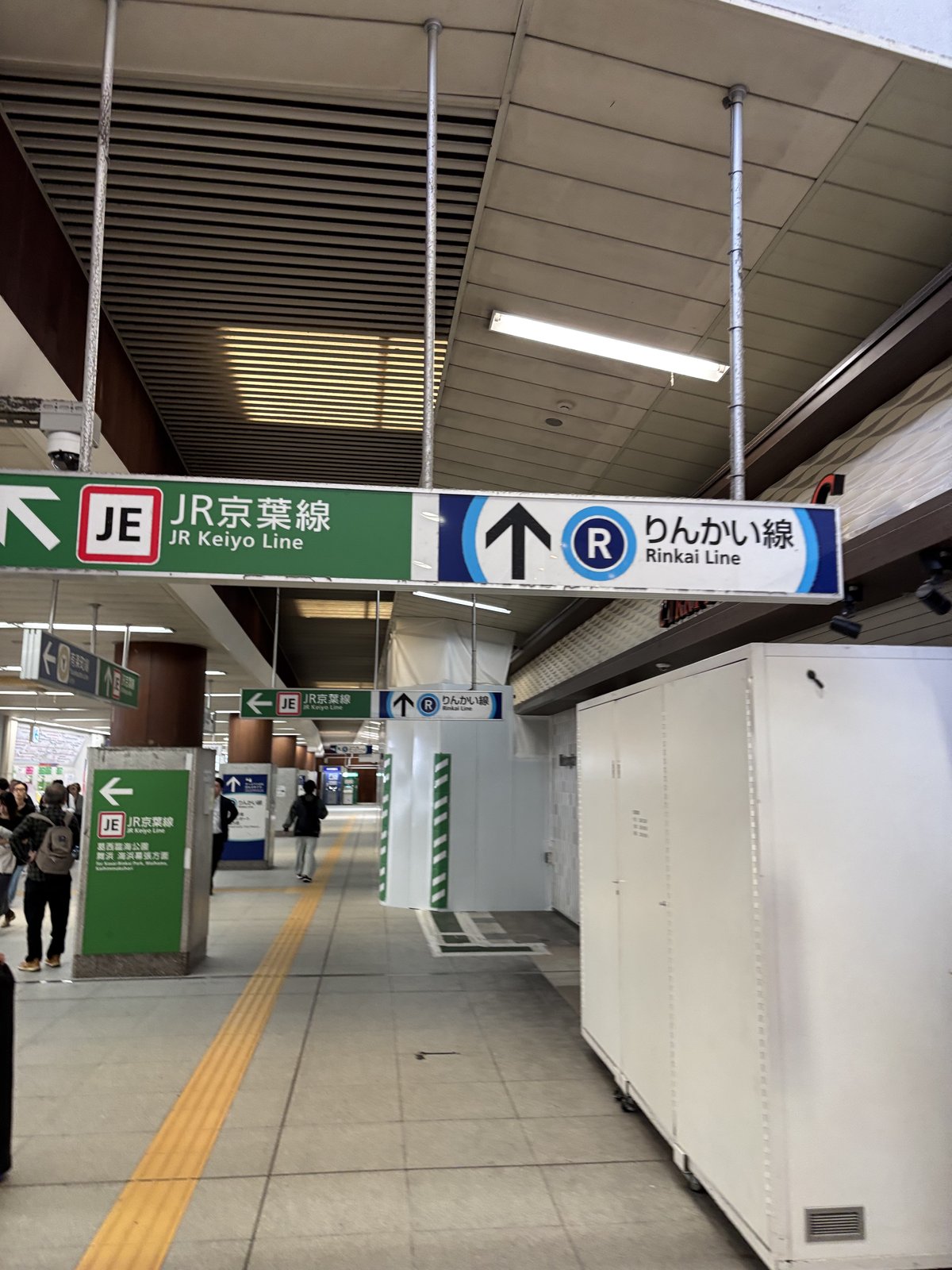
    • Shin-Kiba ― The station just before the venue. About 20–25 minutes from Ichigaya with no transfer. Change here to the Rinkai Line for Kokusai-Tenjijo Station

    From Ichigaya to Kokusai-Tenjijo Station, the trip takes about 31–36 minutes with one transfer (depending on the transfer wait) and costs 490 yen (481 yen with an IC card). These figures, including the times above, were checked using a route planner and platform route maps in October 2026; they are not based on the year-end timetable. When we traveled on a weekday, it took about 36 minutes including the wait.

    We also stayed at a capsule hotel in Ichigaya in October 2026 (see “We Stayed Here” below).

    Choose Ariake if you want to line up from the morning or walk to the venue. Choose Shinjuku if a direct train matters most. Both are under “The Next-Best Options” below.
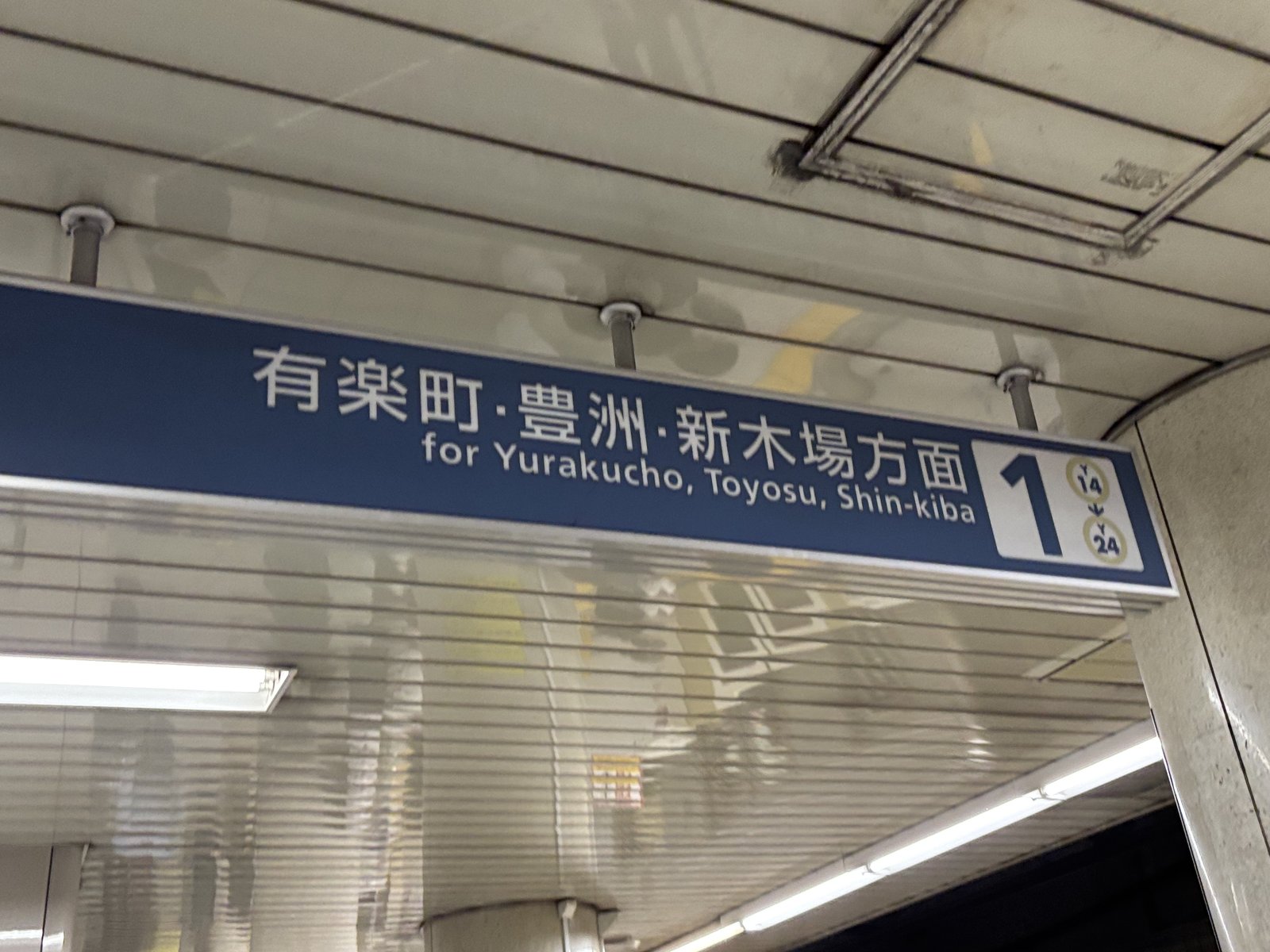
    Ichigaya Station sign: Yurakucho Line Platform 1 for Toyosu and Shin-kiba

    Here Is the Reasoning

    The stores in Ikebukuro and the venue are on the same line. The safest option is to buy your wristband before departure in your country if it is sold there, in case it sells out. Last time, wristbands were sold at Animate stores in places including Korea, Taiwan, and Thailand, and at Toranoana and Melonbooks stores in Taipei (check the official announcement to see which stores will sell them for C109). Last time, an eplus overseas e-ticket for AM entry was also available online. If you do not make it in time, go to the stores in Ikebukuro after arriving in Japan. From Ichigaya, you can get there without a transfer. For details, see “02 Tickets and Wristbands.”

    You can also stop at a store in Ikebukuro on the morning of Comiket before heading to the venue. However, whether wristbands remain depends on each store’s stock. Check each store’s year-end opening hours too. According to the sign at the store in October 2026, the Melonbooks Ikebukuro store opened at 12:00.

    You can commute to the venue with one transfer. The Yurakucho Line runs directly from Ichigaya to Shin-Kiba. On the route map inside the train, Ikebukuro, Ichigaya, and Shin-Kiba all appear on the same gold line.

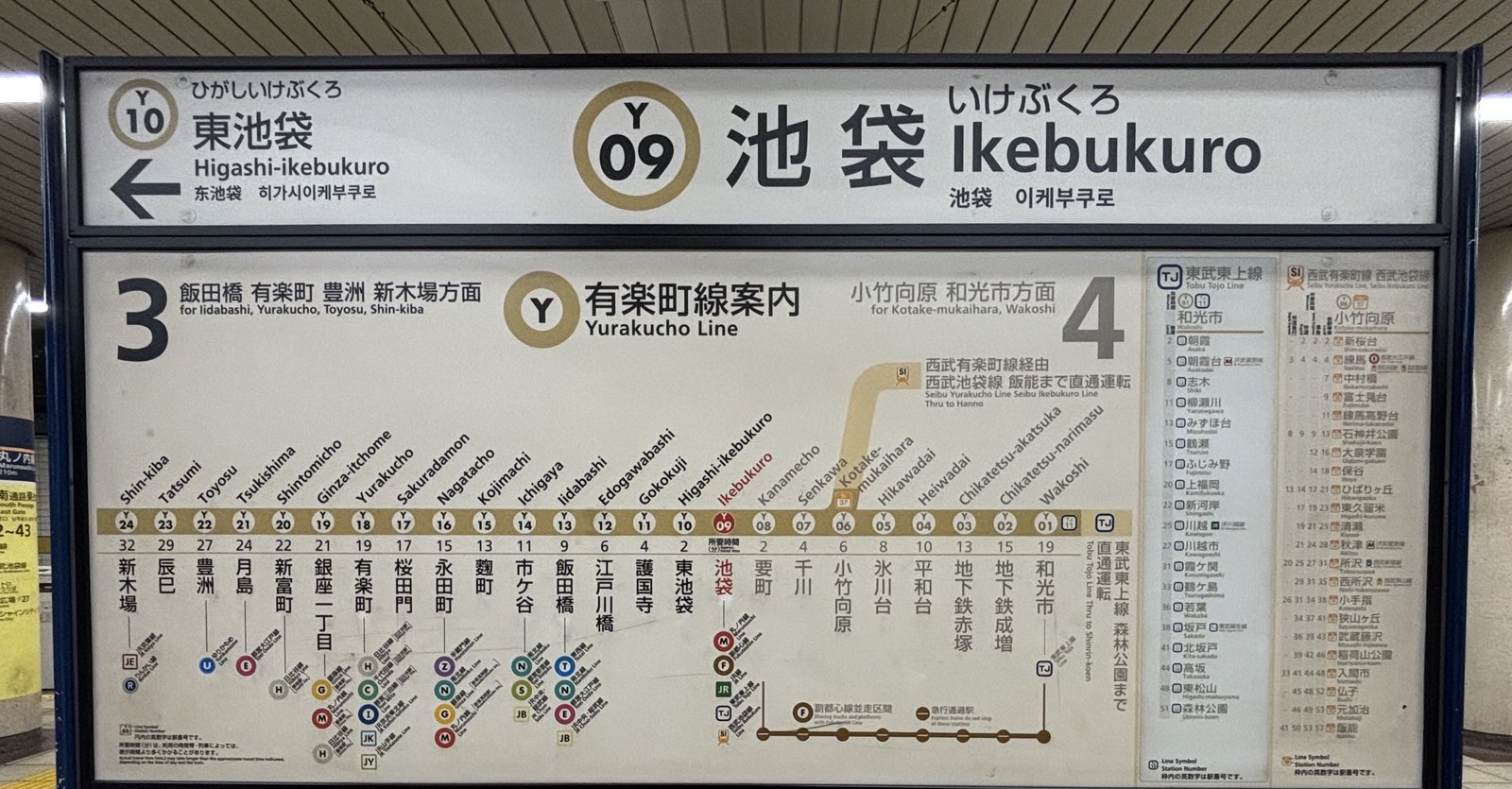
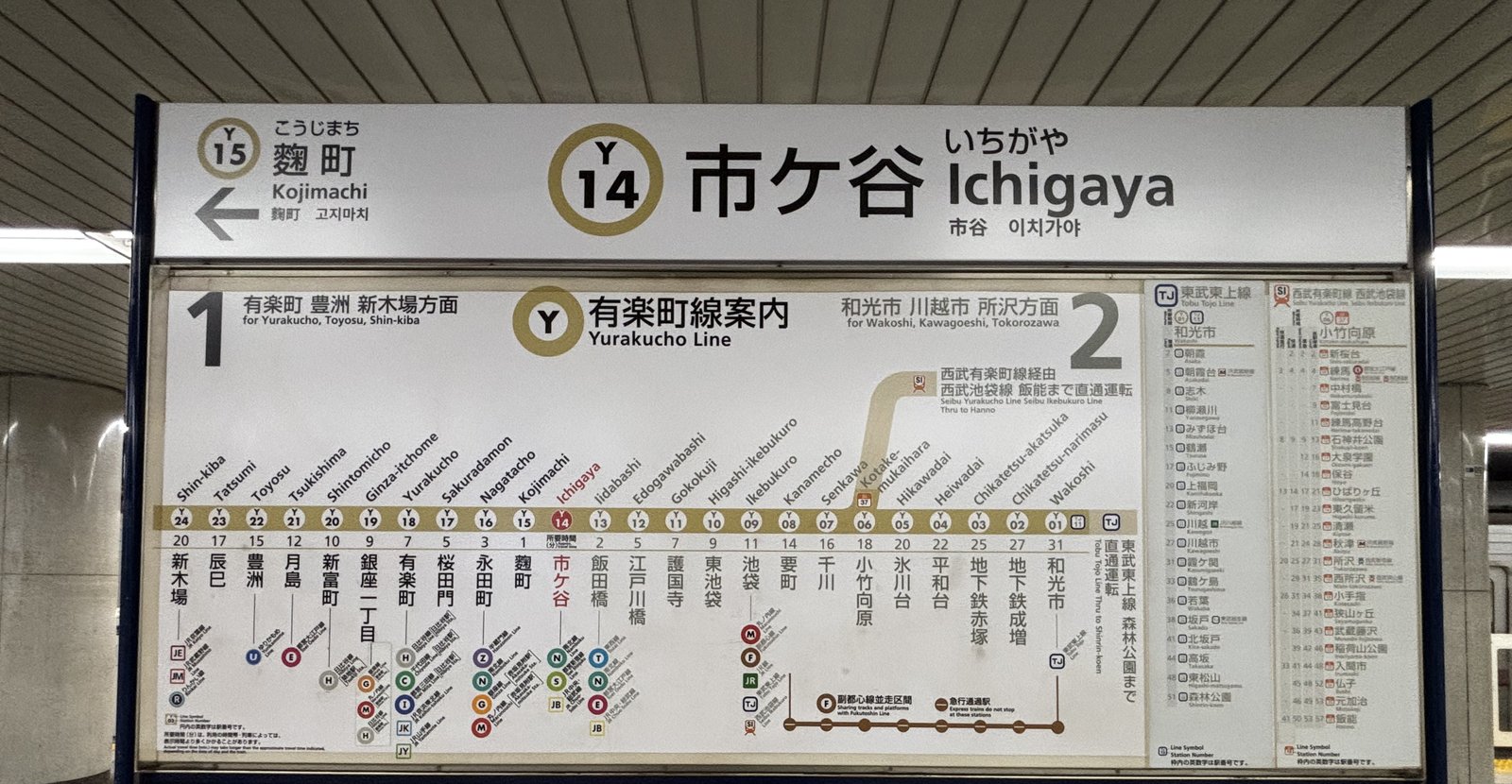
    Platform route maps also show travel times. The map at Ichigaya Station said 20 minutes to Shin-Kiba and 11 minutes to Ikebukuro; the map at Ikebukuro Station said 32 minutes to Shin-Kiba (signs on October 17, 2026). They also state that trips may take longer depending on the time and train. The figures of about 14 minutes and about 25 minutes above came from a route planner checked on a weekday morning.

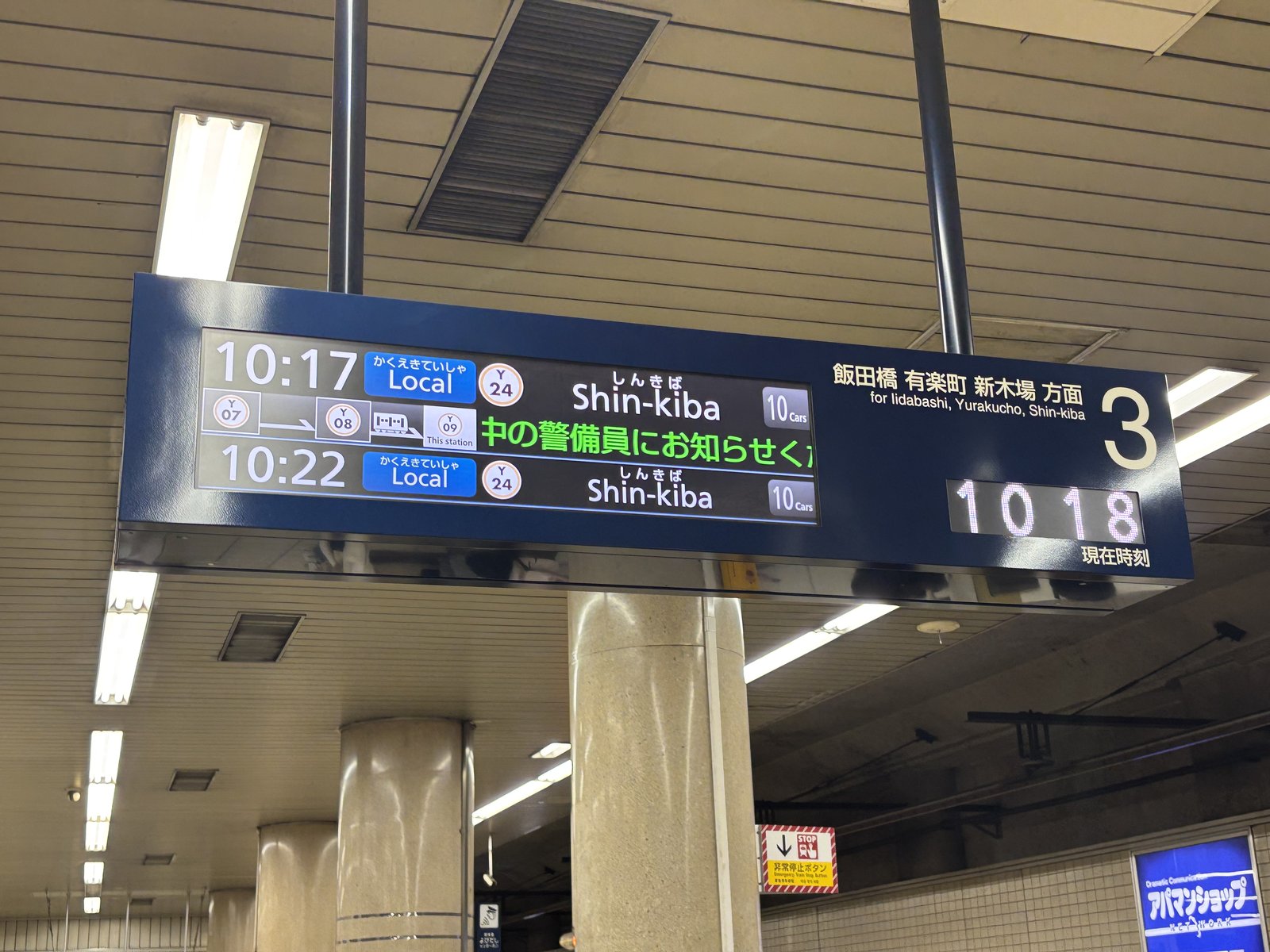
    At Ichigaya, trains toward Shin-Kiba use Platform 1; at Ikebukuro, trains toward Shin-Kiba use Platform 3 (Platform 4 is toward Wakoshi). When we checked Platform 3 at Ikebukuro between 10:00 and 11:00 on a Saturday, a 10:17 Shin-Kiba train was followed by one at 10:22, about five minutes later.
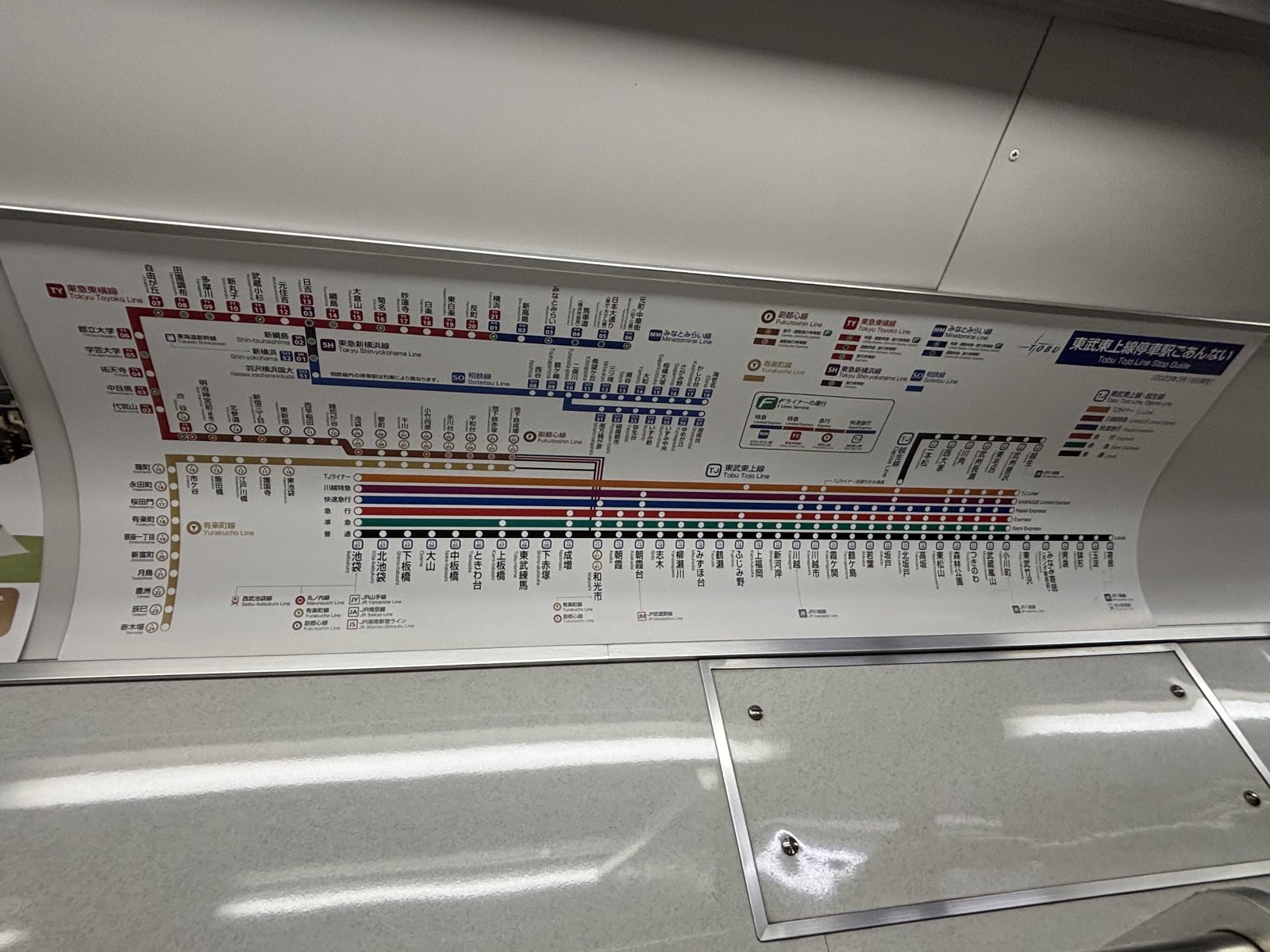
    Yurakucho Line map inside the train: Ikebukuro, Ichigaya and Shin-kiba on the same gold line
    Yurakucho Line map on the platform at Ichigaya Station: Platform 1 for Shin-kiba, Platform 2 for Wakoshi
    Yurakucho Line map on the platform at Ikebukuro Station: Platform 3 for Shin-kiba, Platform 4 for Wakoshi
    Departure board at Ikebukuro Platform 3: 10:17 and 10:22 local trains for Shin-kiba
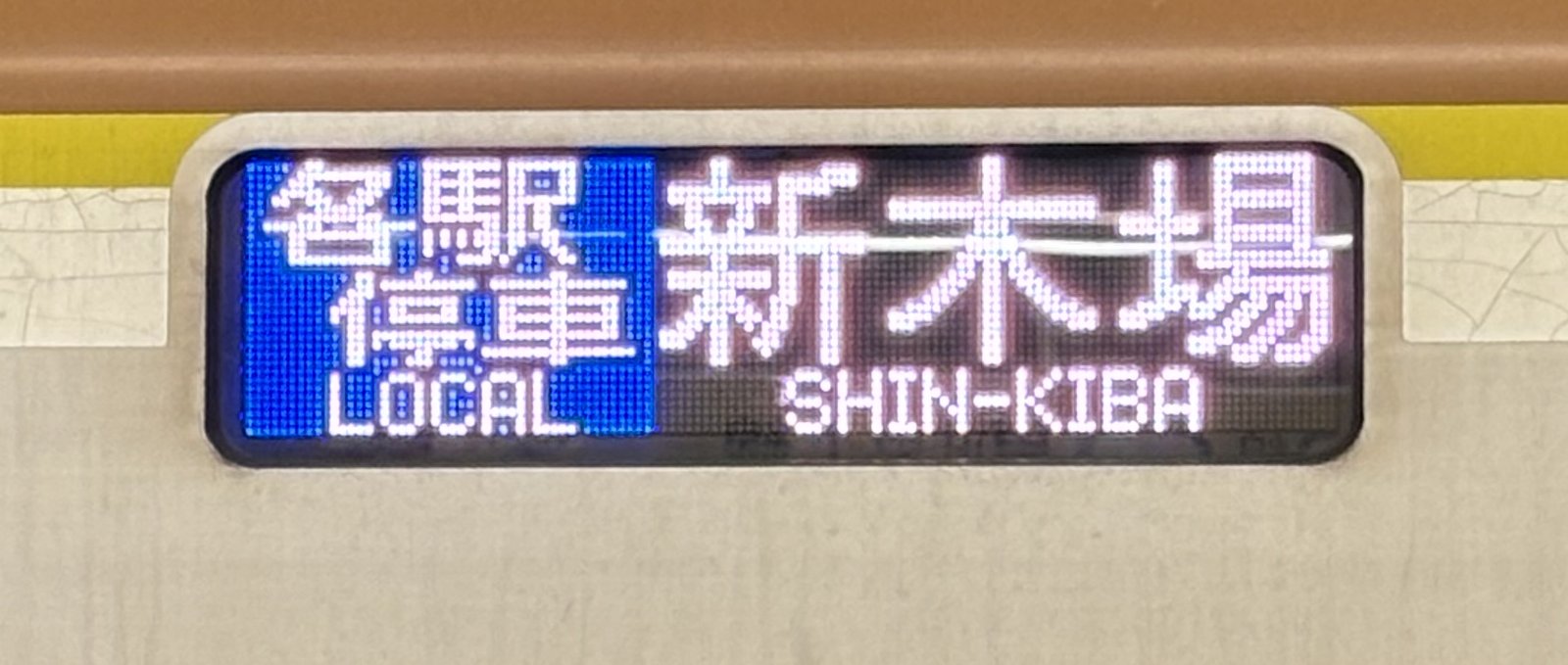
    The sign on the side of the train at Ikebukuro: Local, Shin-kiba
    • At Shin-Kiba, transfer to the Rinkai Line for about 5 minutes to Kokusai-Tenjijo Station (then walk about 7 minutes)
    • Or transfer at Toyosu to the Yurikamome for about 8 minutes to Tokyo Big Sight Station (then walk about 3 minutes)

    C109 runs for three days, December 29–31. Genres change completely each day, so some people will probably attend for two or three days. You can travel the same route each day with one transfer.

    At Ichigaya, the JR and subway stations are not connected inside the station. When transferring from JR, go outside once and enter through a subway entrance (see “01 How to Get There” for details).

    The same applies when you walk from your accommodation to the station. The morning after our stay, we walked from the hotel and realized we had arrived in front of the JR station. After descending through a subway entrance, the passage signs point in opposite directions: “→ 有楽町線・南北線・都営新宿線” and “← JR線.” Follow the arrow toward the Yurakucho Line (confirmed during our October 2026 reporting).
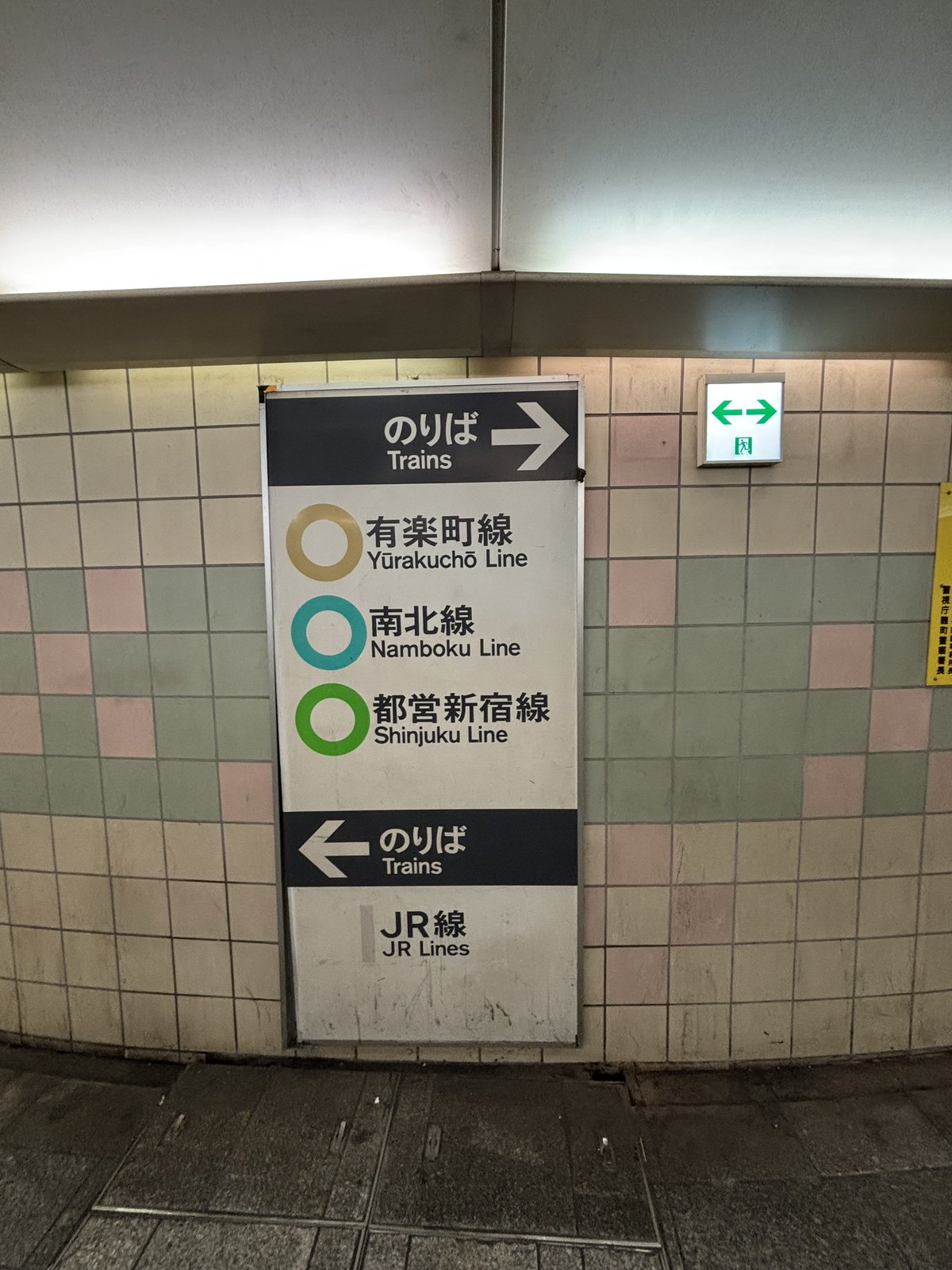
    Underground passage sign in Ichigaya: Yurakucho, Namboku and Shinjuku lines to the right, JR lines to the left
    Transfer sign at Shin-kiba Station to the JR Keiyo Line and Rinkai Line

    Reviews and Our Experience

    We Stayed Here ― First Cabin Ichigaya (October 2026)

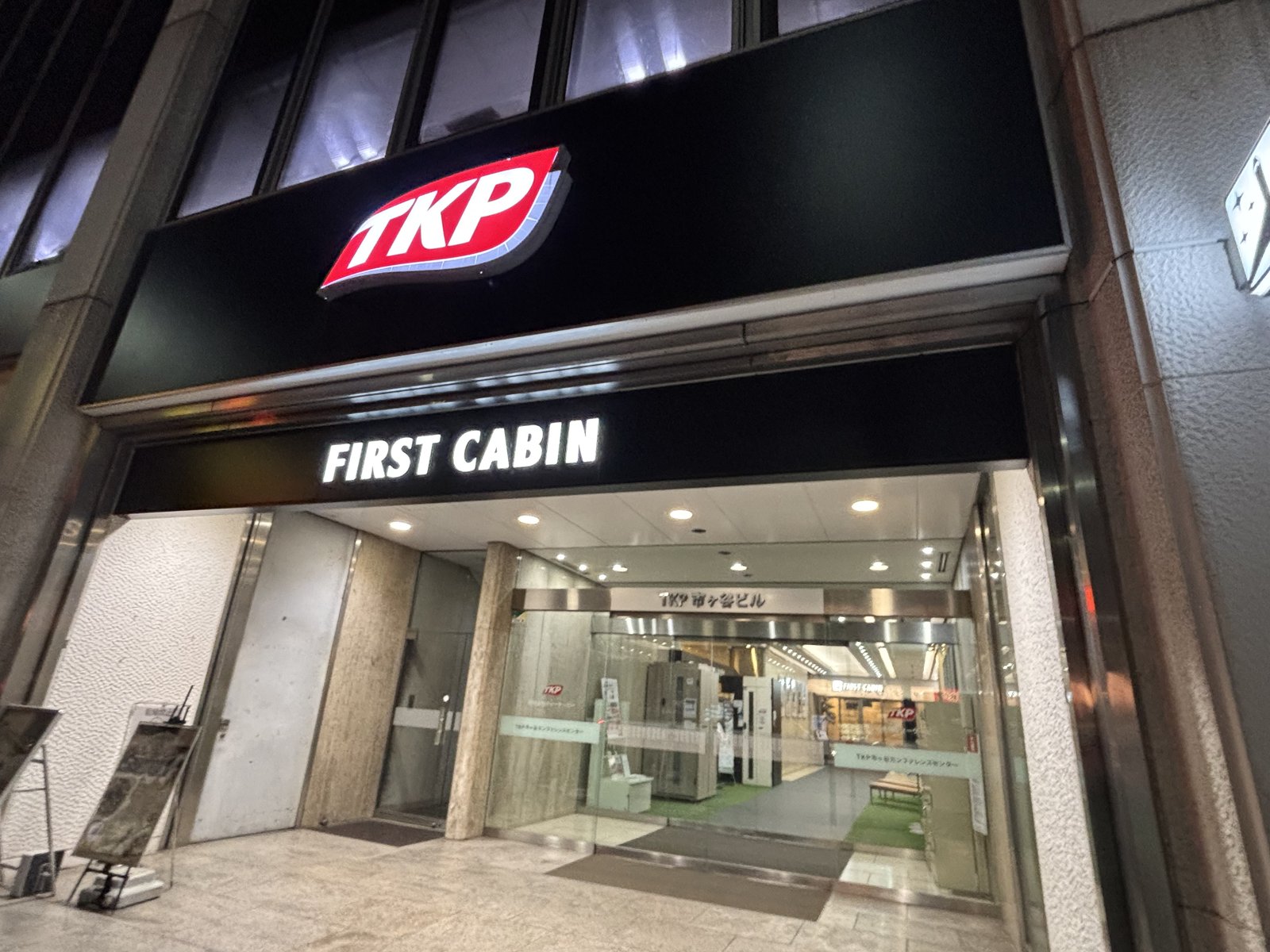
    In Ichigaya, we stayed at a capsule hotel called First Cabin Ichigaya (ファーストキャビン市ヶ谷). It is about a two-minute walk from JR Ichigaya Station, on the first floor of a building along Sotobori-dori Avenue. From the subway’s Ichigaya Station, leave through the underground ticket gates toward “市ヶ谷橋方面” and use Exit A1 or 1–4 (look for the “市谷八幡町” sign).
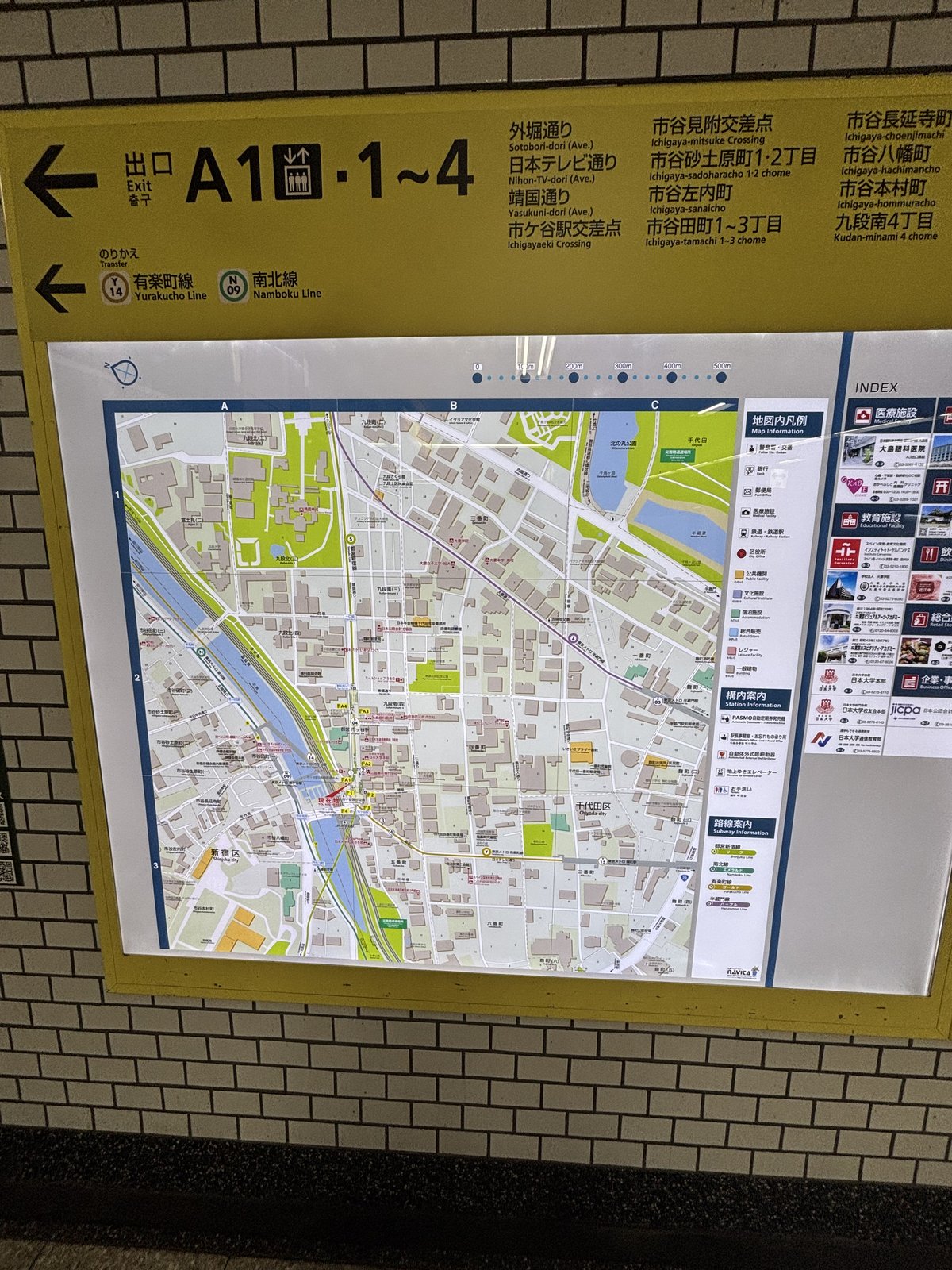
    Underground exit guide at Ichigaya Station (Exits A1 and 1-4)
    Entrance of First Cabin Ichigaya on the ground floor

    First, you should know that the cabins do not have locks. The entrance closes only with a roll screen.
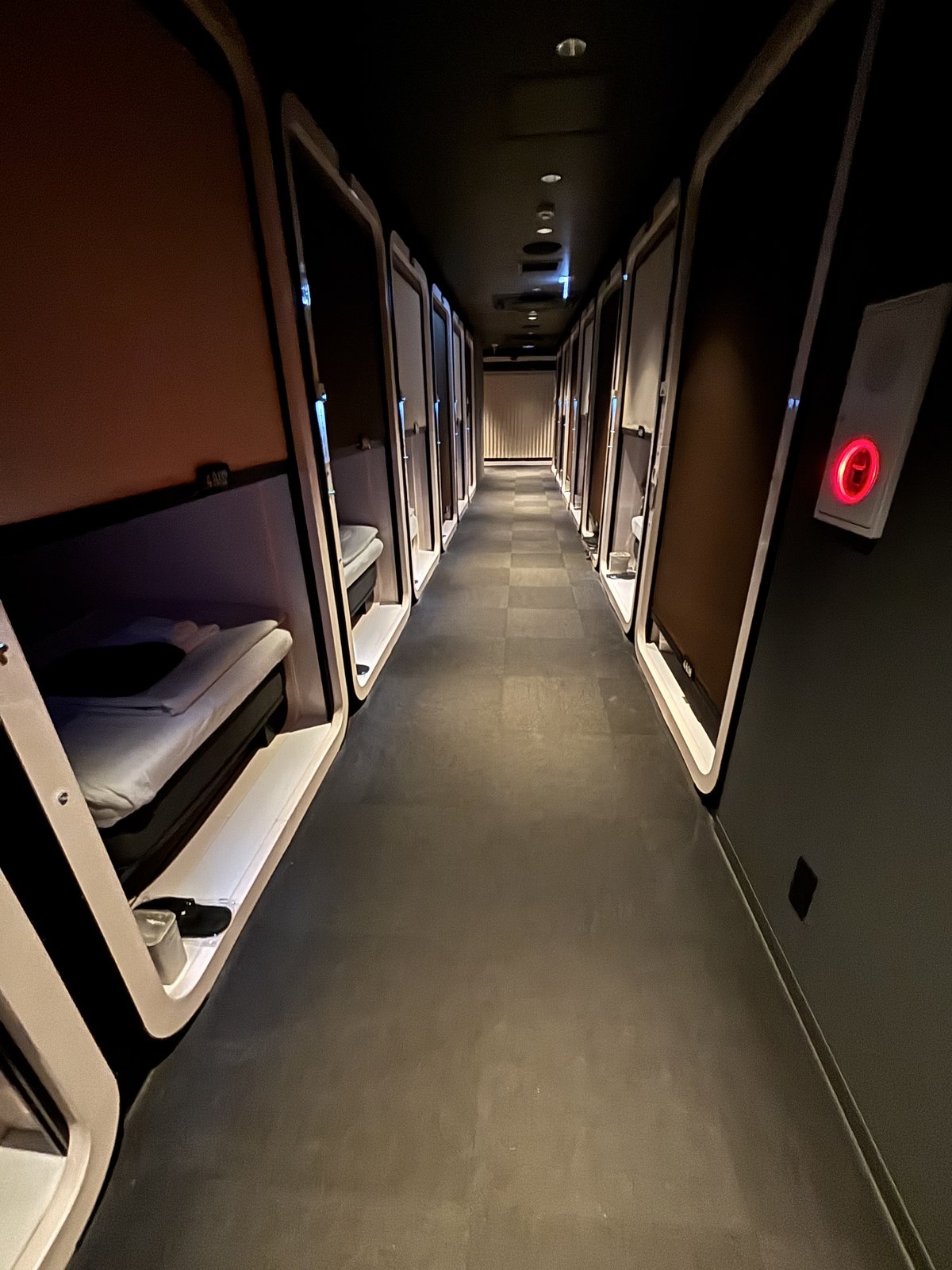
    Cabins lined up along the corridor

    But security was provided elsewhere.

    • Men and women stay on separate floors. The men’s floor where we stayed required a key card at the entrance (we did not see how the women’s floor works)
    • Security cameras operate 24 hours a day
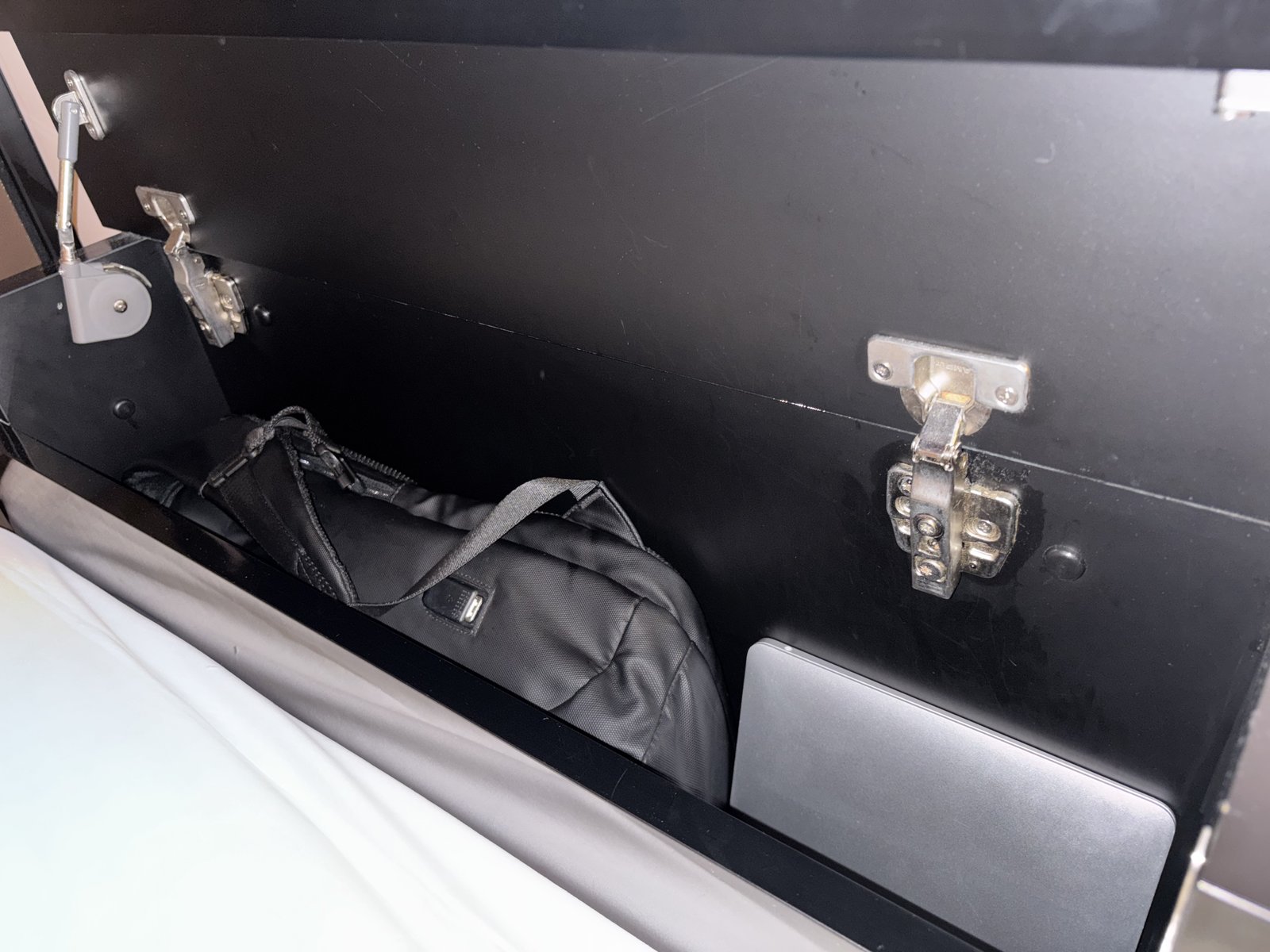
    • Beside the bed is a lockable valuables box. Our one business backpack and laptop fit inside when compressed slightly
    • Large luggage such as suitcases is left at the front desk. Staff are at the desk 24 hours a day
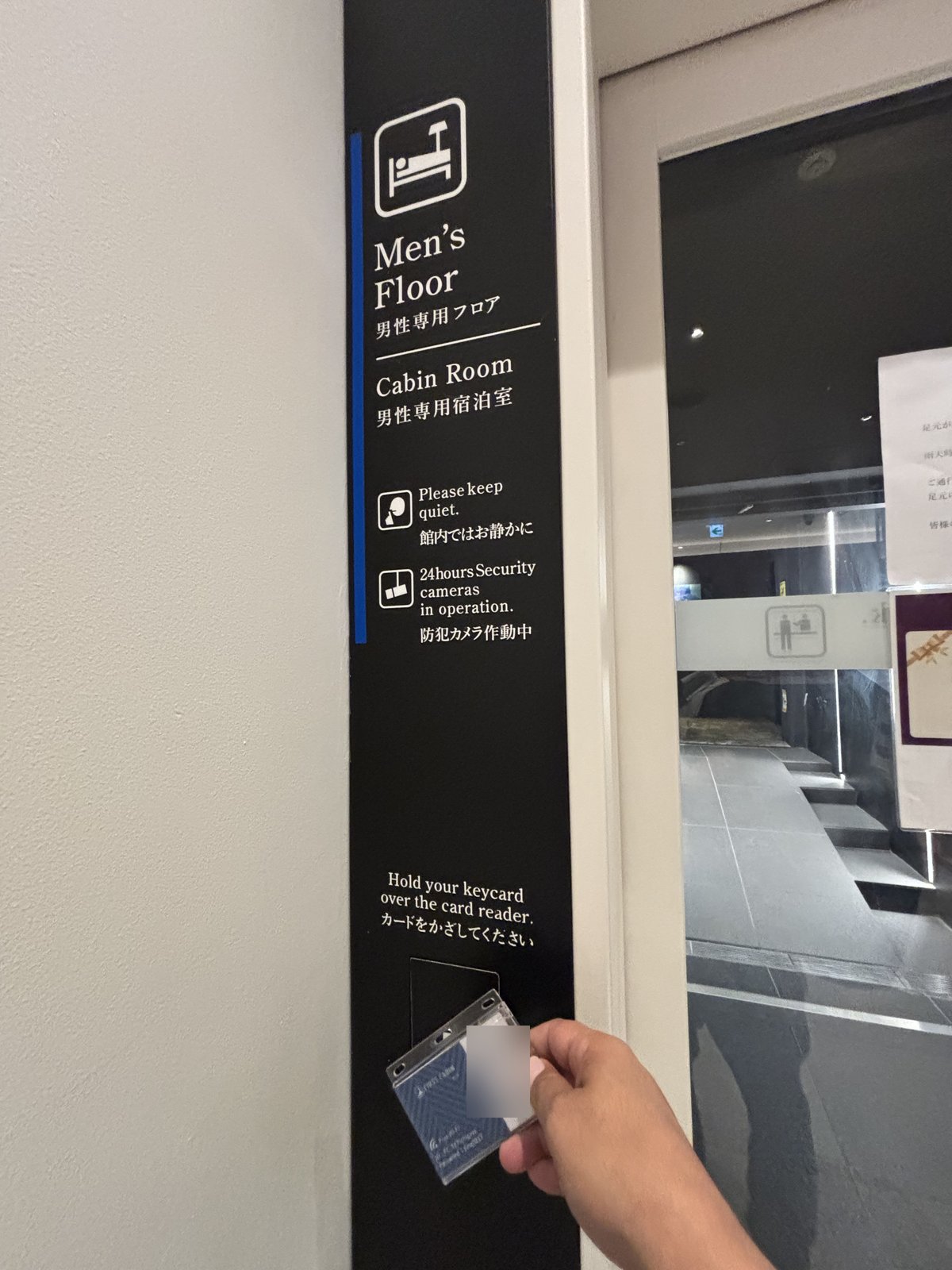
    Entrance to the men-only floor, opened with a key card
    A backpack and a laptop inside the lockable box next to the bed
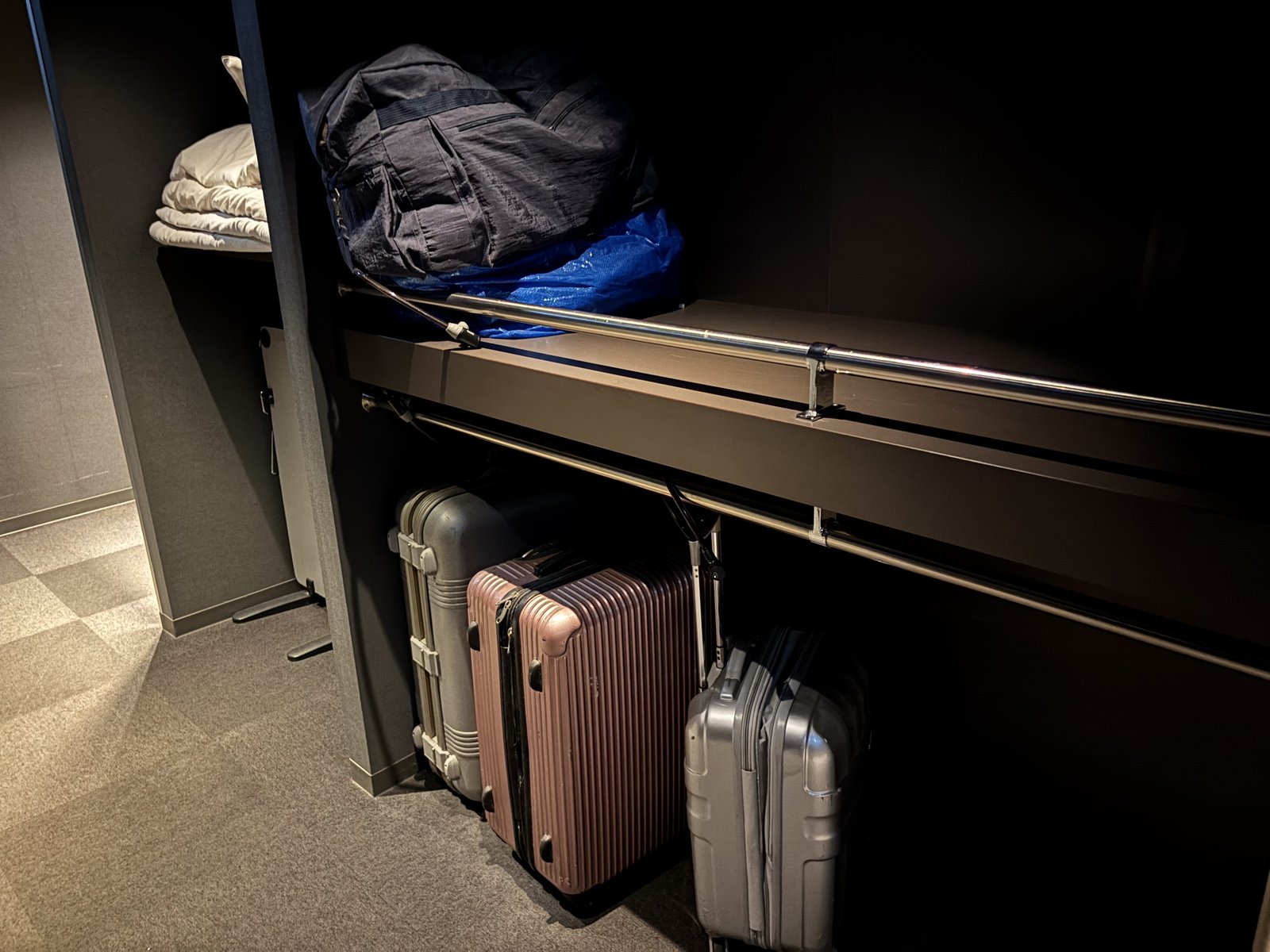
    Suitcases left with the front desk, lined up in the storage area

    Clothes and a laptop go in the lockable box beside you, while large luggage goes to the front desk. It was convenient not to have to leave everything with someone else.

    You cannot eat or make phone calls inside the cabins. Use the lounge for both. The lounge had a microwave and hot water, partitioned seats for one person with power outlets, and manga shelves (including Slam Dunk). The large baths are separated by gender.
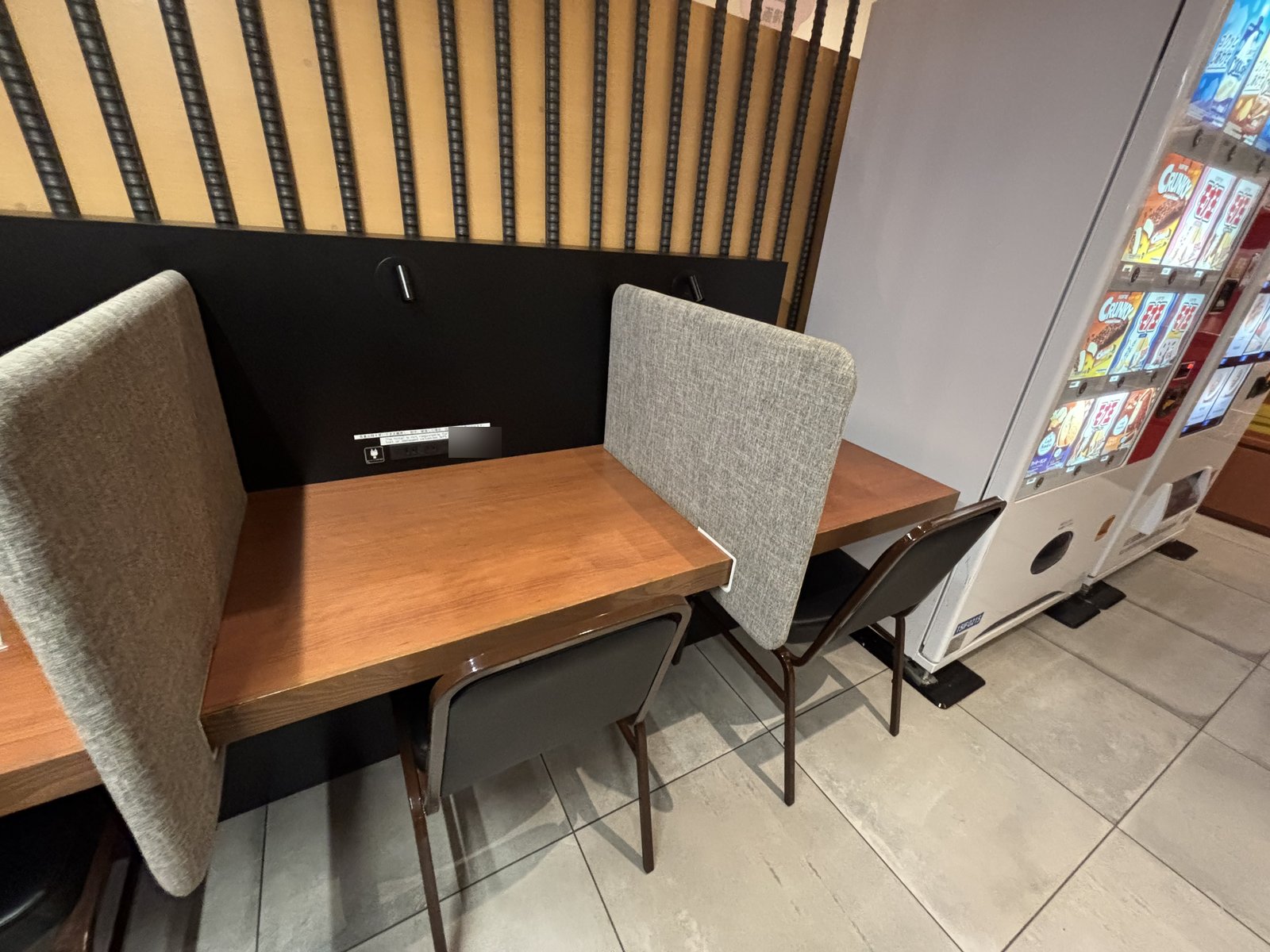
    A partitioned single seat with power outlets in the lounge

    At night, it was quiet enough to hear the air-conditioning. Even though each entrance is only a screen, the place works because everyone stays quiet. Reading manga in the lounge, warming up in the large bath, and sleeping in the cabin became a distinctly Japanese memory in itself.

    It was clean and more than adequate for sleeping. Our impression was that it might feel nicer than an older hotel.

    It does not suit everyone. If you are a family or couple who wants to share one room, or you want a room with a locking door, a business hotel may feel more reassuring. Prices change by day, so check a booking site (they may rise over the year-end period).

    For how to stay at a capsule hotel, see our capsule hotel article. We introduce the atmosphere of Ikebukuro in Where to Stay in Tokyo ― Ikebukuro and Akihabara.

    The Second-Best Option

    If You Want to Line Up from the Morning or Walk to the Venue ― Ariake (Within Walking Distance)

    Ariake is the area where Tokyo Big Sight is located. Both Kokusai-Tenjijo Station on the Rinkai Line and Tokyo Big Sight Station on the Yurikamome are in this area. From a hotel near a station, you can walk to the venue without taking a train.

    • You can avoid winter travel and crowded trains on the way back. Large numbers of people leave the venue at the same time, so the stations and ticket machines become extremely crowded. If you can walk back, you avoid both that congestion and transfers outside in the cold (on average, mornings are around 2°C during the three event days; prepare for the cold with 05 What to Bring in Winter).
    • You can return to the hotel at midday to leave the books you bought. Books become heavier than you expect. If the hotel is within walking distance, you can leave them in your room, lighten your load, and head back out (check the C109 information for the rules on leaving and reentering the venue).
    • One bus also connects you with the airports. The limousine bus takes about 25 minutes from Haneda Airport to Tokyo Big Sight and about 60 minutes from Narita Airport (times vary with road traffic). You do not have to transfer while carrying a large suitcase.
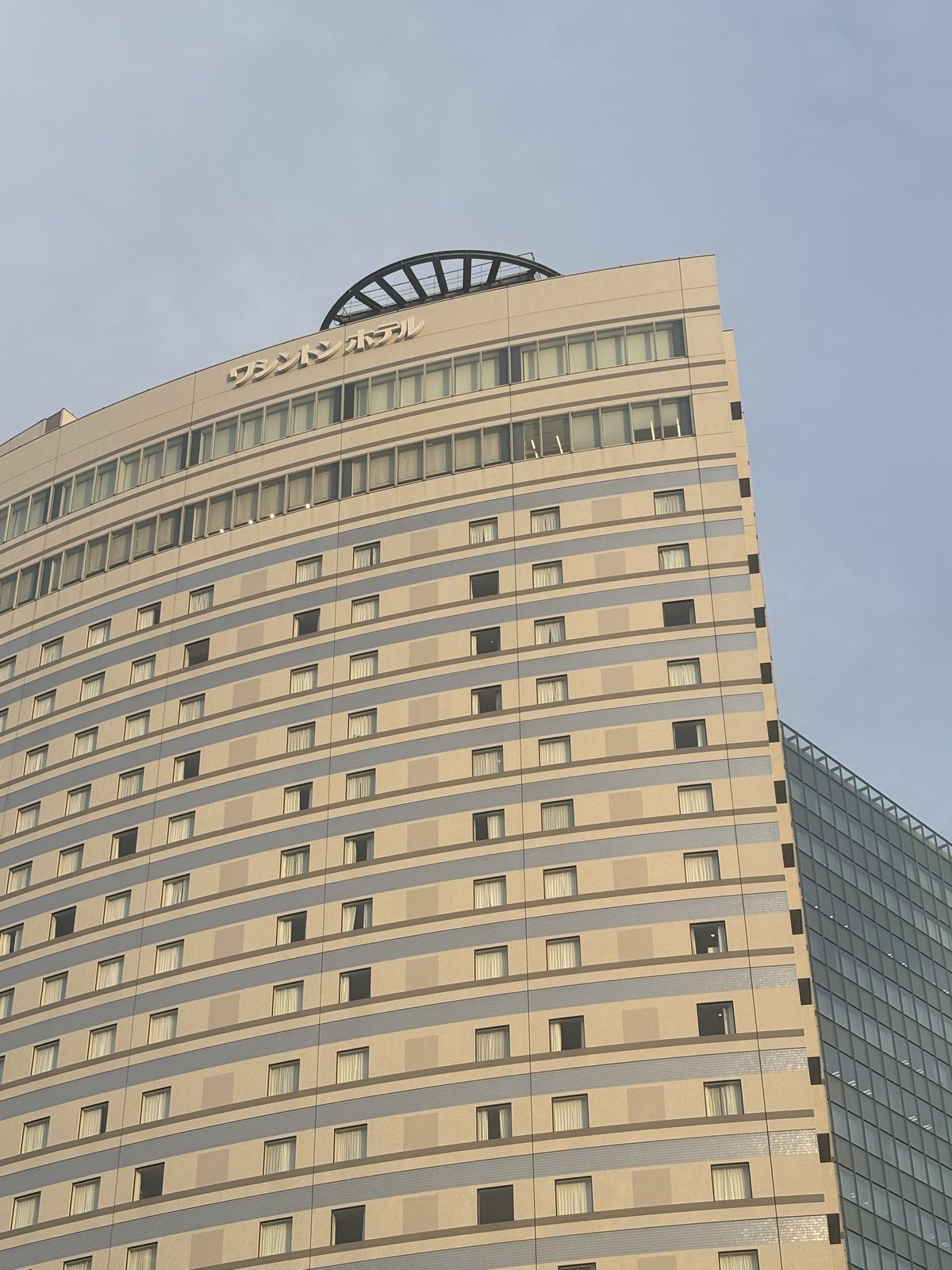
    Tokyo Bay Ariake Washington Hotel, seen on the way from Kokusai-tenjijo Station to the venue

    If a Direct Train Matters Most ― Shinjuku

    From Shinjuku, trains running directly from the JR Saikyo Line onto the Rinkai Line took about 26–28 minutes to Kokusai-Tenjijo Station without a transfer (figures checked on a weekday morning in October 2026). However, the Rinkai Line is operated by a company separate from JR. If you have a JR Pass, read 01 How to Get There in advance for how to pay.

    We introduce Shinjuku itself in Where to Stay in Tokyo ― Shinjuku.

    Other Areas with a Direct Train

    Other areas also have a direct train to the venue.

    AreaTrain to the venueTime
    ToyosuYurikamome (about a three-minute walk from Tokyo Big Sight Station). The Yurakucho Line also serves itAbout 8 minutes
    OdaibaAlong the Rinkai Line and Yurikamome. The area next to the venue―
    Shimbashi and ShiodomeYurikamome (starts at Shimbashi)About 22 minutes (about 21 minutes from Shiodome)
    Shin-KibaRinkai LineAbout 5 minutes
    OimachiRinkai LineAbout 11 minutes
    OsakiRinkai LineAbout 14 minutes

    The Rinkai Line operates direct services with the JR Saikyo Line (toward Shibuya, Shinjuku, and Ikebukuro). If you stay in Shibuya or Ikebukuro, some trains will also bring you to the venue without a transfer.
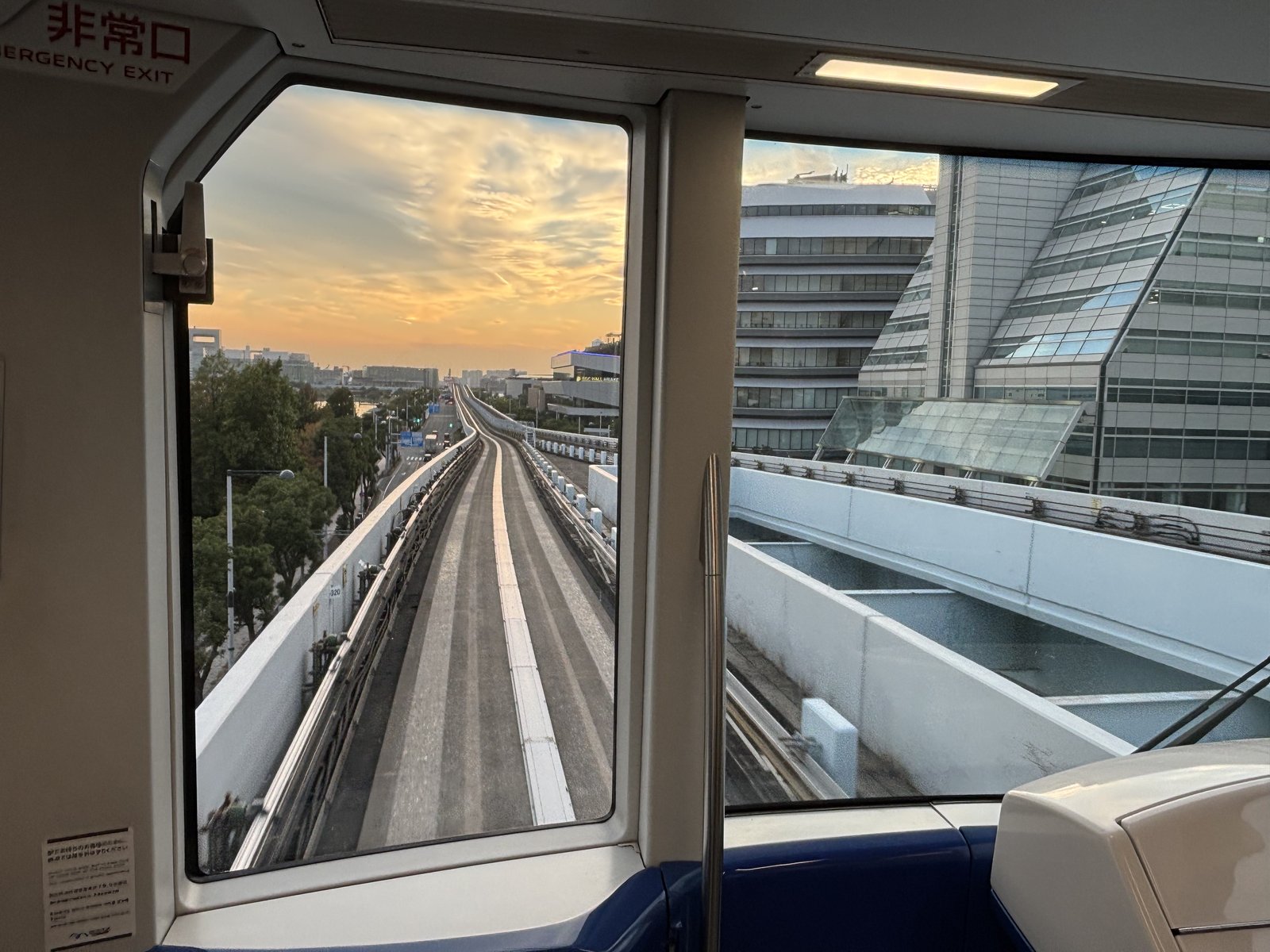
    Sunset and the track seen from the front window of the Yurikamome
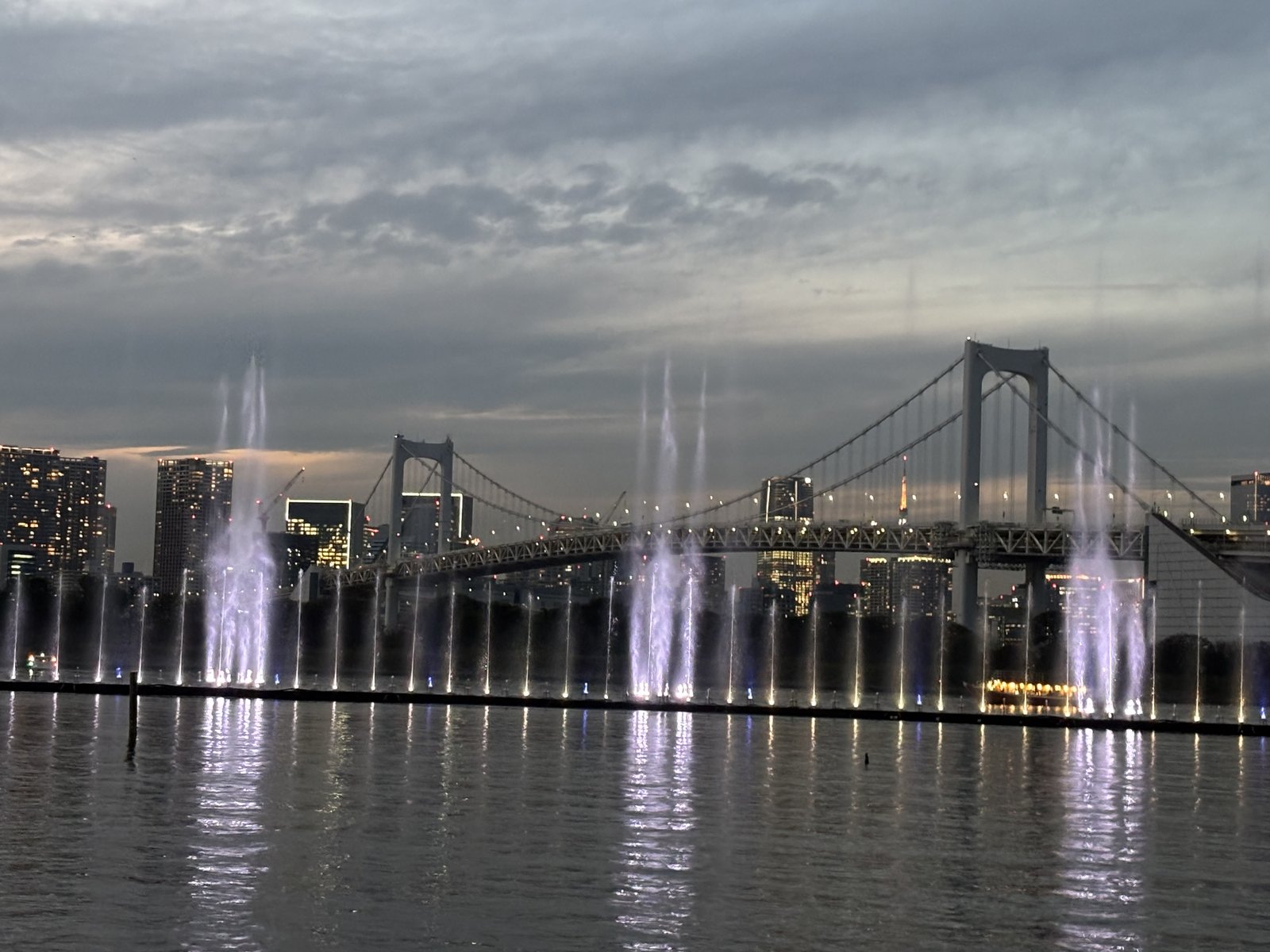
    Odaiba at night: the fountain, Rainbow Bridge and Tokyo Tower

    We introduce the atmosphere of the waterfront areas themselves—Odaiba, Ariake, and Toyosu—in Where to Stay in Tokyo ― Waterfront.

    Notes for a Year-End Stay

    • Book early. The year-end period is busy, so once you decide where to stay, secure your booking early
    • Year-end and New Year train schedules (including overnight service on New Year’s Eve) should be checked in each operator’s announcement. We have not confirmed them yet. The train times in this article are figures checked in October 2026

    —

    Official sources we checked (13)
  • Comiket 109 (C109), Dec 29–31, 2026: First-Timer Guide

    This article is based on official information from the Comic Market Preparations Committee as of October 15, 2026. The Committee says the entry-ticket system will follow the same format as at the previous events (C102–108). However, C109 entry prices and time slots have not yet been announced (the announcement is planned for around early November). We will update this page when the announcement is released.

    More than 100,000 people a day gather on the Tokyo waterfront at the end of the year. Beyond the lines stands Tokyo Big Sight, with its inverted-triangle building. The first two questions for a first-time visitor are which pass to buy—when and where—and what time to arrive.

    This article answers those two questions first. We have divided the details among articles 01–05 below.

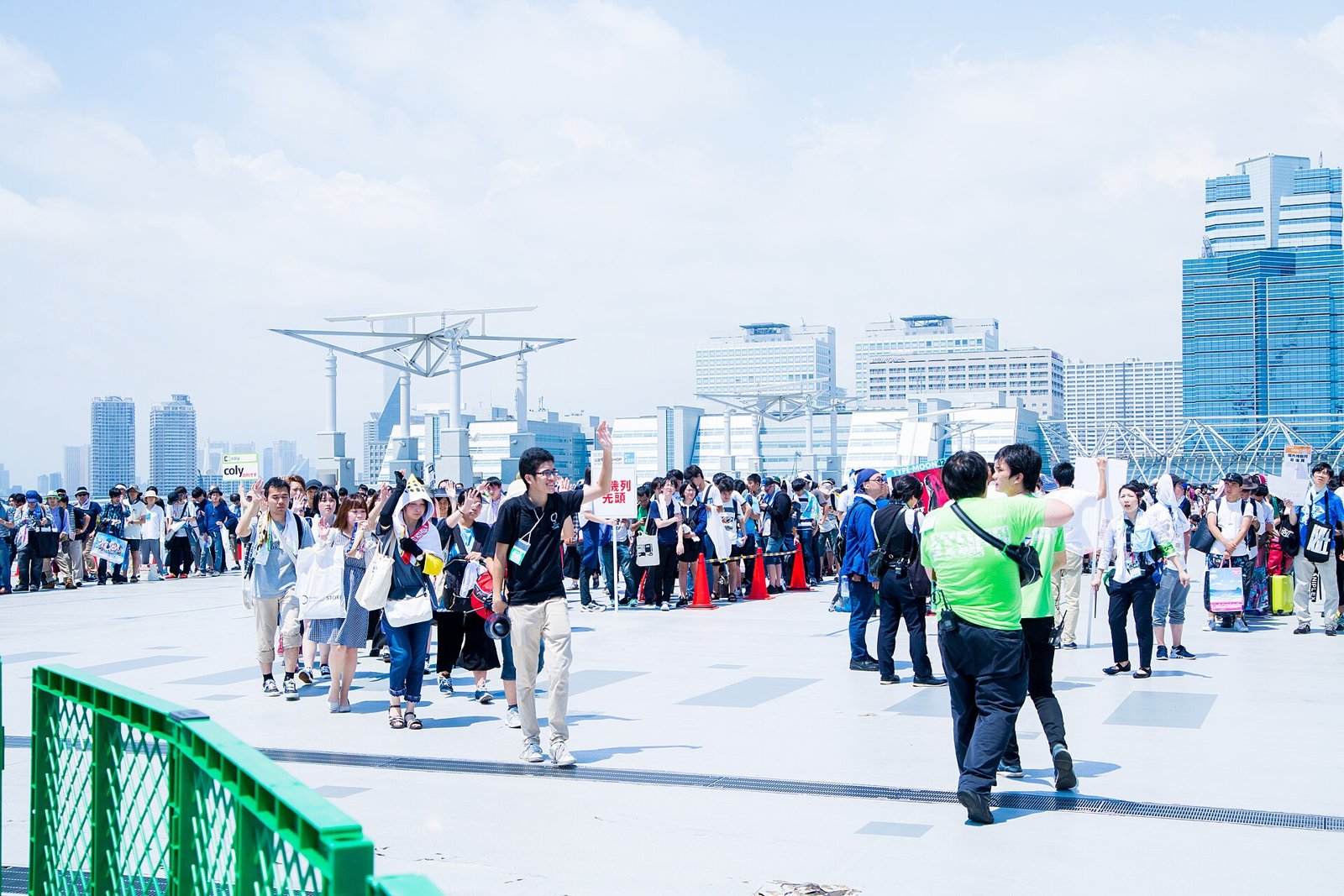
    Visitors lining up outside the venue at Comiket, summer 2018
    Dick Thomas Johnson, "Comic Market 94 Day 1" (2018), CC BY 2.0, via Wikimedia Commons

    When Is Comiket 109? ― Three Days, December 29 (Tue.)–31 (Thu.), 2026

    The venue is Tokyo Big Sight. This will be the first three-day event since C97 in winter 2019. The official site says that all of the venue will be available again in fiscal 2027, so the three-day format is planned for “this winter only.”

    East Halls 4–6 cannot be used because of major renovation work.

    Once you enter the venue, the route splits in the Entrance Hall, beyond the space under the inverted-triangle building (Entrance Plaza, second floor). The East Halls are to the left and the West Halls to the right (confirmed during our October 2026 reporting). Follow staff directions on the day (see 01 for how to walk through the venue).

    Hours
    Circles (booths selling doujinshi and other works)10:30–16:00
    Corporate booths10:30–17:00 (until 16:00 on Day 3)
    Changing rooms (cosplay)10:30–17:30 (until 17:00 on Day 3)
    Cosplay areasUntil 16:30 (until 16:00 on Day 3)

    Day 3 is December 31, New Year’s Eve. The corporate booths and cosplay activities close earlier than usual.

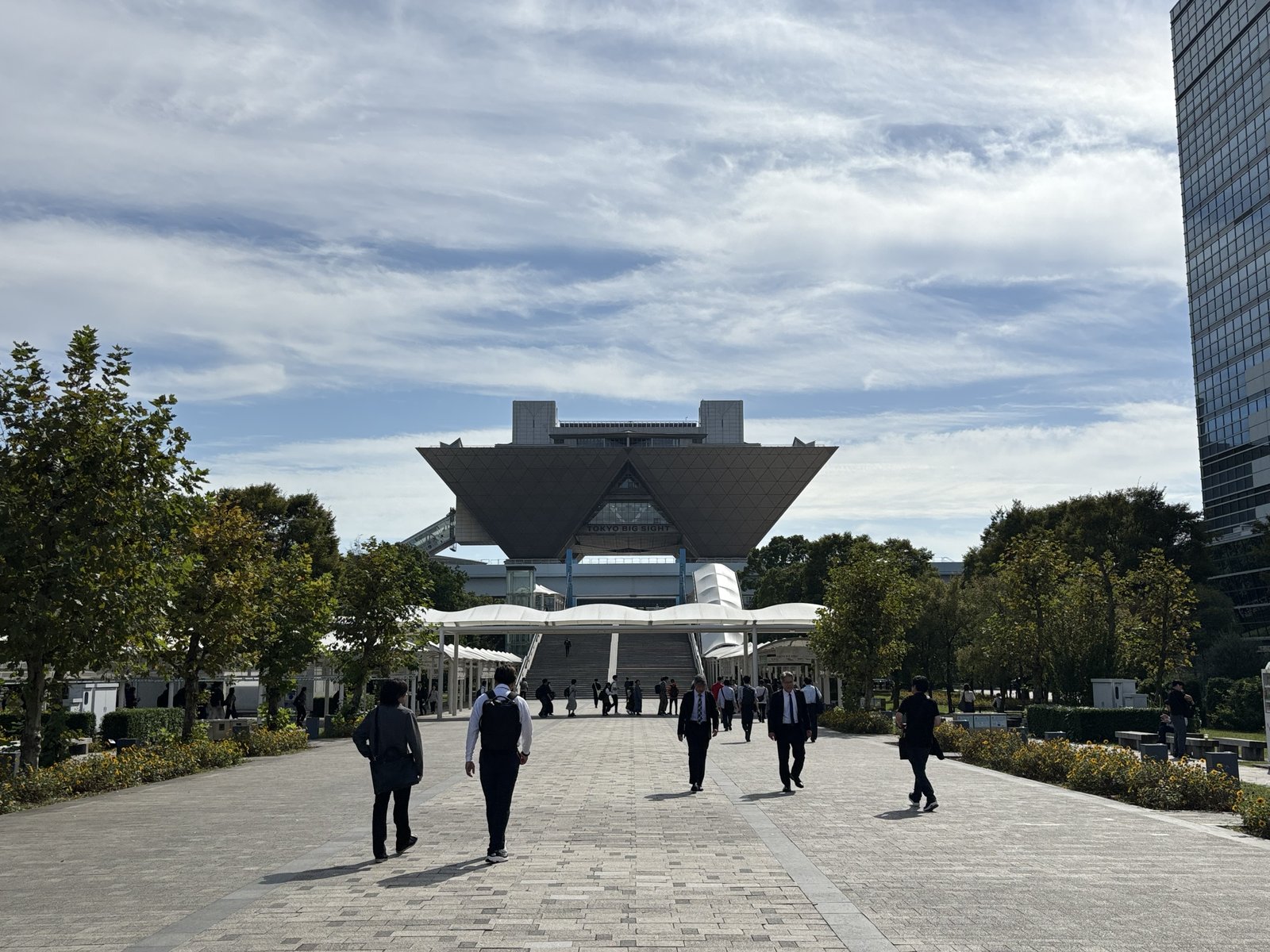
    Tokyo Big Sight and its upside-down pyramid, seen from the walkway from the station

    The Short Answer

    For a first visit, PM entry is enough. To prepare for wristbands selling out, buy one before departure in your country, if possible and if it is sold there. Just before noon on the day, take a train from Shinjuku or Shibuya that runs directly onto the Rinkai Line, and get off at Kokusai-Tenjijo Station.

    Here Is Why

    • Buy your wristband before departure if possible. Last winter, advance AM wristbands sold out at almost every store. The Committee expects enough PM wristbands overall, but individual stores may sell out. Last time, they were sold at Animate stores in places including Korea, Taiwan, and Thailand, and at Toranoana and Melonbooks stores in Taipei (check the official announcement to see which stores will sell them for C109). Last time, an eplus overseas e-ticket for AM entry was also available online.
    • If you do not make it in time, buy one at a store after arriving in Japan. You can buy one if it is in stock at stores such as Animate in Ikebukuro or Akihabara. If that also fails, the last resort is a same-day PM wristband at the venue (1,000 yen last time, with a long line). For details, see “02 Tickets and Wristbands.”
    • Winter mornings are cold. On average, Tokyo mornings are around 2°C during the three days of the event. Arriving at noon is much easier on your body than waiting outside from the morning (see 05 for preparing for the cold).
    • There are direct trains from Shinjuku and Shibuya. The Rinkai Line connects with the JR Saikyo Line, and some trains run directly from Shinjuku and Shibuya to Kokusai-Tenjijo Station. For details, see “01 How to Get There.”

    We also traveled from Ichigaya to the venue on a weekday in October 2026. It took about 36 minutes including the wait for the transfer. Leave Kokusai-Tenjijo Station through Exit B and follow the covered walkway; the inverted-triangle building will come into view straight ahead. Both the lockers outside the station and those inside the venue were full even at midday on a weekday. Expect them to be even less likely to have space on a Comiket day (see 05 for luggage).

    The Next-Best Option (For People Who Want a Particular Book First Thing in the Morning)

    If an overseas e-ticket for AM entry like last time is released, get it on the day sales open. Last time (C108), it was sold through eplus, allowed entry from 11:00, and cost 1,331 yen. Quantities were limited and sales were first-come, first-served. On the day, it was exchanged for a wristband near a Rinkai Line station from 8:00 onward. Because of the exchange start time, you could not join the very front of the AM line. Check the official announcement for how C109 tickets will be sold.

    There is also “Early Entry,” which allows even earlier entry (last time, from 10:30; 5,000 yen plus a 385-yen ticketing fee), but it requires a lottery, your legal name, and your original passport, making it a time-consuming option for travelers (see 02).

    What Is Comiket, Anyway?

    It is an event where you buy fan-made books (doujinshi) and other works directly from their creators (circles). There are corporate booths too. The Committee estimates that people came from 75 countries and regions for the last winter event (C107).

    All genres (types of works) and circles change completely each day. Go on the day for the genre you like. The list showing which genres are on which days will be released close to the event, after booth placement is finalized.

    Preparation Calendar

    1. Now ― Book your accommodation (see “04 Where to Stay”). Also decide how your phone will connect (see “05 What to Bring in Winter”).
    2. November 6 ― The C109 Web Catalog is released.
    3. Around early November ― Entry prices and times are announced (the English page says “late October or early November”). The Early Entry lottery follows.
    4. About one month before the event (planned) ― Tickets other than Early Entry go on sale. Last time (C108), AM and PM wristbands and the eplus overseas e-ticket went on sale about five weeks before the event. In addition to stores in Japan, they were sold at Animate stores in Korea, Taiwan, Thailand, and other locations (last time). For ticket details, see “02 Tickets and Wristbands.”
    5. Early December ― The printed catalog and map (the map will also be available as a PDF on the official website and at convenience stores) and the exhibitor list are released.
    6. Close to the event ― The daily genre list and venue map are released. Use these to decide which day to go.
    7. After arriving in Japan ― If you still do not have a wristband, buy one at a store (subject to stock). Also add money to your IC card and prepare coins (see 05).
    8. On the day ― When you arrive outside the venue, put the wristband around your wrist. For trains to the venue, see “01 How to Get There.”

    Prepare for Winter Comiket with Article 05

    Cold weather, coins, an IC card, and a phone that may struggle to connect: at winter Comiket, “I will sort it out when I get there” does not work. We list what to prepare before arrival in “05 What to Bring in Winter.” If you plan to cosplay, also read “03 Cosplay Rules” (you may not come from your hotel in costume).

    Decide Where to Stay Early

    If you are unsure, stay along the subway Yurakucho Line, in an area such as Ichigaya. One line connects you with Ikebukuro, where the stores are, and Shin-Kiba, just before the venue. The venue is one transfer and about 31–36 minutes away (figures checked in October 2026, not the year-end timetable). We also stayed in Ichigaya in October 2026. Choose Ariake, the area where the venue is, if you want to line up from the morning or walk to the venue; choose Shinjuku if a direct train matters most.

    → See “04 Where to Stay.”

    Articles in This Guide

    • 01 How to Get There ― The station you will use most is Kokusai-Tenjijo Station on the Rinkai Line. From Shinjuku, Shibuya, and the airports, including how the JR Pass applies.
    • 02 Tickets and Wristbands ― All four types of passes in one table, and where and when to buy them.
    • 03 Cosplay Rules ― Do not arrive in costume from your hotel. Changing rooms, photography, and props.
    • 04 Where to Stay ― If unsure, stay along the Yurakucho Line, in an area such as Ichigaya. Walkable Ariake, or direct trains from Shinjuku.
    • 05 What to Bring in Winter ― Cold weather, coins, an IC card, lockers, and shipping the books you buy.
    Official sources we checked (7)
  • Airport to the City in Japan: Train, Bus or Taxi? | Take the Train from Narita, Haneda or Kansai, Unless You Land Late, Travel Heavy, or Your Hotel Has a Bus Stop

    This article is based on official information from airports, railway and bus companies, and the Japanese government as of October 2026. Timetables and fares may change when schedules are revised. Check each official timetable for your travel date.

    When you enter the arrivals lobby, signs for trains, bus ticket counters and taxi stands all appear at once. Each one seems to say, “This way.”

    This article is for anyone unsure which to choose. We will keep the explanation short and give the answer first.

    The answer first — this is our short answer

    If you are unsure, take the train. Choose one direct service to the area where you are staying. That would be our first choice.

    Choose a bus or car only in these three situations.

    • You land too late for the last train → From Haneda, take a late-night bus or a flat-rate taxi from the taxi stand. From Narita, take a late bus to Tokyo Station or a taxi (a taxi from Narita to central Tokyo is a major expense at around ¥30,000)
    • You have many people and bags (more than two suitcases per person, small children, and so on) → Take a car. For a large group, reserve a large vehicle in advance
    • An airport limousine bus stops in front of your hotel → Take the limousine bus (up to two checked bags per person)

    Base your choice on three things: arrival time, people and luggage, and where you are staying. We do not use price as the deciding factor here. Train and bus fares are per person, while taxi fares are per vehicle, so they are difficult to compare on the same scale.

    Here Is the Reasoning

    Trains have predictable times and arrive in the city center

    Airport trains have clearly separated destinations: Tokyo Station, Ueno and Shinagawa. Once you know where you are staying, the train to take is usually almost decided.

    The limousine bus company itself warns that buses can be delayed by road traffic during weekday rush hours and tourist seasons. Because trains are not affected by road congestion, we think they make it easier to plan the rest of your arrival day.

    We list the train for each airport in “Airport to City by Train in Japan.”

    A taxi from Narita is a major expense

    Even though both are called “Tokyo airports,” fares to the city center differ considerably. For example, a limousine bus to Shinjuku costs ¥1,400 from Haneda and ¥3,600 from Narita.

    Both airports have flat-rate taxis.

    • Haneda → Flat rates apply to most destinations in Tokyo and Kanagawa Prefecture (government-approved fares; some areas use the meter), with tolls charged separately
    • Narita → To Chiyoda or Chuo Ward from ¥29,000, and to Shinjuku or Shibuya Ward from ¥31,500 (via the Keiyo Road), plus expressway tolls. A surcharge applies from 10:00 p.m. to 5:00 a.m.

    A taxi from Narita to central Tokyo costs around ¥30,000. This is why checking the last bus first is especially useful when you arrive at Narita late at night.

    If You Arrive Late at Night

    After your flight lands, you still have immigration procedures and baggage claim. Compare the last services below with the time you expect to enter the arrivals lobby, not your landing time.

    Haneda — Late-night buses and flat-rate taxis continue after trains stop

    • Last trains → From Terminal 3 Station, Keikyu departs for Shinagawa at 0:08 and the Tokyo Monorail for Hamamatsucho at 0:10 (weekdays)
    • Late-night buses to Shinjuku and Ikebukuro after that → Four buses from stop 3 at Terminal 3, at 0:20, 1:00, 1:40 and 2:20. The fare to Shinjuku Station West Exit is ¥2,800. Buy a ticket before boarding at a ticket machine or bus counter
    • To Yokohama Station (YCAT) and Sakuragicho → Departs stop 7 at Terminal 3 at 1:20. ¥2,000
    • Taxi → Stop 21 on the first floor of Terminal 3. Flat rates apply to many destinations in Tokyo’s 23 wards and Kanagawa Prefecture (some areas use the meter)

    Haneda Terminal 3 is open 24 hours, and passengers arriving on international flights can wait inside until morning.

    Narita — After the 10:00 p.m. hour, check the last bus to Tokyo Station

    • Train → Narita Express services run until the 9:00 p.m. hour (some services do not run every day). The last JR rapid train for Tokyo is at 22:57
    • Bus to Tokyo Station (AIRPORT BUS TYO-NRT) → The last bus departs Terminal 3 at 23:20, Terminal 2 at 23:25 and Terminal 1 at 23:30, arriving at Tokyo Station at 0:38. Times differ by terminal. There are no reservations and seats are unassigned, but capacity is limited. If it is full, you take the next bus; there is no next bus after the last service. Services from 11:00 p.m. to 5:00 a.m. cost 3,000 yen
    • For this last bus, go directly to the stop and pay on board with cash or a transit IC card such as Suica. Credit cards are not accepted
    • Taxi → Stop 15 at Terminal 1; stops 28 and 31-A at Terminal 2; and the taxi stand at Terminal 3. Flat rates are set by central Tokyo ward, and no reservation is required. Tell the driver you want the flat rate before boarding. Expressway tolls cost extra

    If you miss those too, you can wait until morning at Narita. The international arrivals floors of Terminals 1, 2 and 3 are open 24 hours. Parking area P2, connected to Terminal 2, has a 24-hour capsule hotel; advance booking is recommended because it may be full on the day.

    If you need cash in yen for the last bus, see “How Much Cash Do You Need in Japan?.”

    If You Have Many People and Bags

    On a train, you carry all your luggage yourself. If you transfer, your suitcases go with you through stairs and corridors. The more people and bags you have, the harder this becomes.

    • On a limousine bus, suitcases go in the luggage compartment, but the limit is two per person, each up to 50 × 60 × 120 cm and 30 kg
    • More than that, small children, or wanting to reach the door → Take a car. Taxis are priced per vehicle, so the per-person cost falls with a larger group
    • For a large group, reserve a large vehicle in advance (through the airport-transfer service below or directly with a taxi company)

    You can also send your luggage ahead and take the train unencumbered. It usually arrives the next day, so keep what you need that night with you. See “Luggage Forwarding in Japan: Sending Your Luggage from Hotel to Hotel (Hands-Free Travel)” for sending luggage from the airport to your accommodation.

    If You Want Someone Waiting at Arrivals with Your Name

    After a long flight, finding the taxi stand in an unfamiliar airport and explaining your destination while carrying luggage is hard. Kiwitaxi airport transfers are useful if you want someone waiting at arrivals with a board showing your name, then taking you directly to your booked destination. They can also suit families with children, travelers with many bags, and anyone who does not want to search for the pickup point after landing.

    Before You Book

    • Kiwitaxi is an intermediary booking service. It does not operate vehicles itself.
    • The booking screen does not let you verify the name of the company that will actually provide the transportation in Japan or its Japanese license. Anshin Japan does not guarantee the vehicle’s or driver’s licensing or safety, or the quality of the service.
    • If you are concerned, ask Kiwitaxi before or after booking for the actual operator’s name and contact details. On the day, check that the vehicle and driver match your booking.
    • If a white-license-plate vehicle arrives for a paid transfer without an explanation of the legal basis, do not board and contact Kiwitaxi. However, there are lawful exceptions for white-plate vehicles, such as a hotel transporting its guests free of charge.
    • Decide for yourself whether to book and board. We may receive compensation if you book through an advertising link on this page.

    You can also reserve directly with a taxi company. For example, MK Taxi’s flat-rate airport taxis require reservations and offer large vans. They serve major Japanese airports including Narita, Haneda and Kansai (according to the Kansai Airport information).

    If a Limousine Bus Stops in Front of Your Hotel

    Airport limousine buses operated by Airport Transport Service stop in front of major hotels in Shinjuku, Ikebukuro, Ginza and elsewhere. For example, Narita buses stop at the Keio Plaza Hotel and Hilton Tokyo in Shinjuku. If you are staying there, the bus is the easiest option. You arrive at your accommodation’s entrance while remaining seated.

    • As a rule, people not staying at a hotel can also board or leave at its bus stop. The “hotel next door” to yours is fine
    • Seats are capacity-limited, and you cannot board if the bus is full (no standing). Without a reservation, it is first come, first served. Reservation availability differs by route and stop; services that accept reservations can be booked online without membership and changed until five minutes before departure
    • Buy tickets at an airport counter or ticket machine. Credit cards are accepted at Narita and Haneda limousine bus counters, but not on the bus
    • Sample adult one-way fares: Narita → Shinjuku hotels ¥3,600 / Haneda → Shinjuku ¥1,400

    The route timetable on the limousine bus website shows which hotels it stops at. Hotel names appear directly in the list of stops.

    At Kansai Airport

    At Kansai Airport too, our answer is the train: the Haruka limited express to Kyoto, the JR Kansai Airport Rapid to Osaka Station, and Nankai trains to Namba. See “Airport to City by Train in Japan” for details.

    If you take a bus or car, this is all you need to know.

    • Bus to Osaka Station (Umeda) → No reservation; first come, first served. ¥1,800 and about 60 minutes from Terminal 1. There is also a late-night service after trains stop, departing stop 1 at Terminal 2 at 0:02 and stop 5 at Terminal 1 at 0:15, arriving at Osaka Station (Hankyu Sanbangai) at 1:13. The late-night service is cashless only, and no extra bus is provided even if it is full
    • Bus luggage → Up to two pieces per person in the luggage compartment, with a combined weight of up to 30 kg
    • Taxi → A guide price to Osaka’s Kita Ward is about ¥24,400 including bridge and expressway charges. A 20% surcharge applies from 10:00 p.m. to 5:00 a.m. A reserved flat-rate taxi from MK Taxi starts at ¥16,400 per vehicle to Umeda, excluding expressway tolls

    Do Not Take a Car That Solicits You at the Airport

    In Japan, it is illegal to transport passengers for payment without government permission or registration—an illegal private taxi known as shirotaku. The Ministry of Land, Infrastructure, Transport and Tourism warns travelers about vehicles soliciting customers at airports. Even a licensed hire car is not permitted to solicit customers at an airport.

    Take either a taxi from the official airport taxi stand or a vehicle reserved in advance with a taxi or hire-car company. The ministry also advises passengers to board at an official stand and to reserve hire cars in advance. When using a booking service such as Kiwitaxi, follow the “Before You Book” box above and check on the day that the vehicle and driver match your reservation.

    In our editorial team’s experience, we think there are many cases where there is no need for excessive concern when a transfer is provided by a legitimate Japanese taxi or hire-car company. On the other hand, regional transport bureaus affiliated with the ministry warn about illegal shirotaku carrying international visitors at airports and tourist sites. Cases arranged through apps and social media before arrival in Japan have also been reported. The issue is not the driver’s nationality, but the actual operator, its permission or registration, and the vehicle.

    Licensed taxis and hire cars have green license plates. Some white-plate vehicles are lawful exceptions, including vehicles that a hotel uses to transport its own guests free of charge and vehicles operating under the government-approved Japanese rideshare system. Simply going to a hotel does not make a vehicle an exception.

    Chubu and Fukuoka

    Take Meitetsu from Chubu Centrair International Airport to Nagoya, and the subway from Fukuoka Airport to Hakata or Tenjin. Each reaches the city center on one train. See “Airport to City by Train in Japan.”

    Before you go, just these things

    • Compare your flight’s arrival time with the last train from that airport
    • If arriving at Narita late, check the last bus from your terminal to Tokyo Station (in the 11:00 p.m. hour; cash or transit IC card)
    • Search your hotel’s name among limousine bus stops
    • If you have more than two suitcases per person, decide whether to take a car or send your luggage
    • For a large group, consider reserving a large vehicle
    • Decide not to take a vehicle that solicits you at the airport

    More details

    If you are unsure, take the train. Unless you are arriving late, have many people and bags, or have a bus stopping in front of your hotel, simply follow the train arrow in the arrivals lobby.

    Official sources we checked (31)

    Timetables and fares may change. Check each official source for your travel date (as of October 2026).

  • eSIM, SIM Card or Pocket Wi-Fi for Japan? If It’s One Phone for You, Start with an eSIM

    This article is based on official guidance from companies and organizations, and this site’s phone and internet articles, as of October 2026.

    eSIM, SIM card, pocket Wi-Fi. The more you research, the more each one starts to look like a good choice.

    This article is for anyone stuck at that point. We’ll keep the explanation short and give you the answer first.

    The answer first — this is our short answer

    If one person will use one phone, start with an eSIM. If your phone supports eSIM and has no SIM lock, this is what we would choose.

    Only move to one of the other two if that does not fit.

    • Your phone does not support eSIM → SIM card (provided the phone has no SIM lock)
    • You want to share with family or companions across several devices / you cannot remove the SIM lock → Pocket Wi-Fi

    There is one more option: roaming, using your usual phone as it is. If your home carrier has a plan that works in Japan and you can confirm its price and conditions before departure, that can also be a choice.

    This article does not compare which is fastest, cheapest, or how many GB you need per day. Those things vary with the way you travel, the company, and the plan, so there is no reliable single yardstick. Base your decision on your phone and how many people need to connect how many devices.

    First, check your phone

    The answer depends on two things about your phone.

    • Is it free of a SIM lock? On an iPhone, go to Settings → General → About. If Carrier Lock says “No SIM restrictions,” you are fine. If the phone is locked, neither an eSIM nor a SIM card will work
    • Does it support eSIM? For iPhones, that means iPhone XS, XS Max, XR, or later. However, some iPhones bought in mainland China do not support eSIM. Some models sold in Hong Kong and Macao take two physical SIM cards. If you bought your iPhone in one of these regions, check the specifications of your exact model first. For Android phones, it depends on the model (Google Pixel 3a or later; some Samsung phones may not support eSIM depending on the country of purchase, even when the model name is the same)

    There is also the reverse exception: eSIM-only phones with no place to insert a SIM card. Recent iPhones bought in places such as the United States are like this. See “SIM Card” for which models these are.

    For details on how to check, see “eSIM.”

    Who should choose an eSIM

    • You are traveling alone, or everyone will connect using their own phone
    • Your phone supports eSIM and has no SIM lock

    An eSIM is a travel plan you buy online and install inside your phone. You can install it over your home Wi-Fi before departure, so you do not have to look for a sales counter after landing. Because there is no card to swap, you do not risk removing and losing your home SIM. There is nothing extra to carry and nothing to return on your last day.

    Just remember these points.

    • When the validity period starts depends on the company and plan. With Airalo, for example, in most cases it starts when the eSIM first connects to a supported network in Japan. For other companies and plans, check the explanation before buying
    • Do not delete an installed eSIM. Once a travel eSIM has been deleted, it usually cannot be reinstalled
    • If you want to share the connection with a tablet or computer, check before buying whether tethering is available. It depends on the phone and network

    For installation, switching after arrival, and what to do if it will not connect, see “eSIM.”

    Who should choose a SIM card

    • Your phone does not support eSIM (but has no SIM lock)
    • Swapping a card feels easier than setting up an eSIM

    You swap your home SIM for a travel SIM card. While your home SIM card is removed, that line does not operate in Japan (if your home line is an eSIM, turn off data roaming for that line).

    You can buy one at airports (vending machines at Narita and Kansai, counters in Haneda Terminal 3, and elsewhere) or at electronics stores. If your flight arrives late at night, buying one online before coming to Japan is another option.

    Keep your passport at hand on the day you buy or insert it. Some companies require a passport check. SoftBank’s travel SIM, for example, requires a photo of the original passport, and people under 18 cannot sign up.

    Keep the SIM you removed somewhere safe. You will need it again after returning home.

    For places to buy and how to insert it, see “SIM Card.”

    Who should choose pocket Wi-Fi

    • You want one device to connect several phones or tablets for family or companions
    • Your phone has a SIM lock that you cannot remove before departure
    • You want to connect a device that supports neither eSIM nor a SIM card

    Pocket Wi-Fi means renting a Wi-Fi device and carrying it with you. Your phone simply connects to that Wi-Fi. Because you do not replace the SIM in your phone, its SIM lock does not matter. The number of devices you can connect varies by model; Japan Wireless, for example, allows up to eight.

    In return, there are a few extra tasks.

    • Decide how to receive and return it when booking (airport counter, unattended box, or delivery to your accommodation / return by post or in a box; the choices vary by company)
    • Charge it every night
    • Assume that anyone away from the device will lose the connection. On days when your family splits up, decide who will carry it
    • It does not come with a phone number. You cannot call 110 or 119 through pocket Wi-Fi

    For how to receive and return one, see “Pocket Wi-Fi.”

    If you need a Japanese phone number

    Many travel eSIMs, SIM cards, and pocket Wi-Fi products provide data only and do not include a Japanese phone number.

    Even without one, most trips work out fine. The main times you need a number are for verification codes sent when registering for an app and for calls in an emergency.

    • Keeping your home number can help. On an iPhone, you can keep your home number while using a travel eSIM for data only. In some cases, you can also continue using FaceTime and iMessage with your home number. How much of your home number works in Japan, and what it costs, depend on your home carrier’s settings and charges. Check with the provider before departure
    • If you truly need a Japanese number, some SIM cards and eSIMs come with a Japanese number beginning with 070, 080, or 090. For example, Mobal’s SIM with a phone number requires the original passport, and people under 18 cannot apply
    • An internet phone number beginning with 050 is different. Brastel’s My 050, for example, cannot call 110 or 119 and cannot receive SMS

    With a data-only SIM, you may be unable to call 110 (police) or 119 (fire and ambulance). If that happens, ask staff at your accommodation or a shop, or someone nearby, for help. For handling verification codes and emergencies, see “When You Need a Japanese Phone Number.”

    Before you go, just these things

    • You checked that your phone has no SIM lock and supports eSIM
    • If using an eSIM, you installed it over your home Wi-Fi. Do not delete the installed eSIM
    • If keeping your home number, you have a plan to turn off data roaming only for your home line (set the travel line as instructed by its provider)
    • If using a SIM card, keep your passport at hand
    • If using pocket Wi-Fi, check the pickup place, return method, and return deadline in your booking confirmation
    • If using roaming, confirm your home carrier’s plan and price

    If both the travel line and home line remain on, your home line may incur roaming charges. Turn off data roaming only for your home line.

    More details

    If you are unsure, open your phone and check only two things: no SIM lock and eSIM support. If both are in place, install the eSIM the night before (or just before arrival if its validity starts at installation), then switch to it at the airport after landing.

    Official sources we checked (16)

    Prices and rules vary by company and may change. Before buying, check the guidance from each company (as of October 2026).

  • Where Should You Book a Rental Car in Japan? How Much Is the Total?|We Checked 4 Booking Sources Under the Same Conditions

    The prices and conditions in this article were checked on each booking screen and in official information on October 17, 2026. Both prices and conditions change. When booking, check the latest information on the page where you make the reservation (this is not an explanation of insurance or law).

    The Short Answer ― Do Not Decide by the First Price You See. Check All 4 Before Deciding

    If we were choosing where to book a rental car, we would decide by looking at the following four points, not the price in the search results.

    • Total price ― Does the amount include tax and coverage?
    • Coverage ― If there is an accident, how much will you have to pay at the rental location?
    • Who to contact if there is a problem ― Who do you contact to change or cancel the booking?
    • Cancellation deadline ― How many days in advance can you cancel and get your money back?

    We actually checked four booking sources for the same dates, the same airport, and the same car size. The prices in the search results ranged from around 10,000 yen to the 20,000-yen range. But all four included different things, so we could not compare them by price alone.

    That is why we will not say which one is the cheapest. Instead, section 5 explains which one we would choose for each set of travel conditions.

    1 Where Should You Book?

    There are two starting points: a rental car company’s official site and a booking site that lists many companies at once.

    Among the booking sites we checked, Economybookings states in its terms that it acts as an intermediary, while the rental agreement is made directly with the rental car company, and that the booking confirmation is proof of the booking rather than the rental agreement itself. rentalcars.com also separates the booking arrangement with the site from the rental agreement made with the location at the counter. With these two companies, booking matters go to the booking site and car matters go to the rental location.

    An official site is not always safer, and a booking site is not always cheaper. Which works for you depends on the shape of your itinerary. We explain how to choose a company in “How to Choose a Rental Car Company|It Depends on the Shape of Your Itinerary.”

    2 What We Learned by Actually Checking 4 Companies

    Conditions we checked (the same for all four companies)

    • Pick up at Naha Airport and return to the same place
    • Three days, from 10:00 on Tuesday, December 8, 2026, to 10:00 on Friday, December 11
    • Compact class (a smaller car)
    • Driver age 30–65 (left at each site’s initial setting)
    • One search per company at around 22:30 on October 17, 2026. We stopped before booking

    Prices shown in the search results (the lowest one displayed in the compact category. Only rentalcars.com had no compact category, so we used the price for a Honda Fit or similar. The order is the order we checked them, not cheapest first)

    Booking sourcePrice in the search resultsWhat the price includes
    Economybookings14,557 yen (displayed as 14,557.27 yen)Displayed as the “total price for 3 days, including taxes and fees.” The details for this car showed Collision Damage Waiver (CDW), theft protection, and Third Party Liability as included
    Tabirai Car RentalFrom 14,750 yenTax included. The screen showed 免責補償 (CDW), a display audio system or navigation, and an in-vehicle ETC unit as included
    ToCoo!9,545 yenBefore tax. 免責補償 was included. The amount for ToCoo!’s own mandatory coverage (T.A.S.) was not shown at the screen we reached
    rentalcars.com22,470 yenHonda Fit or similar (“medium car”). Because there was no compact category, this was the car we checked, and it was not the lowest price in the results. We could not confirm whether tax and coverage were included (unconfirmed)

    We learned four things.

    1 Having a price is not the same as having a comparable price. At first glance, ToCoo! looks much cheaper, but its price is before tax and does not yet include mandatory coverage. Tabirai’s price has “from,” and we could not confirm on the screen how many days it charged for the three-day period. You cannot rank them just by lining up the numbers.

    2 Many of the cheaper cars were at locations outside the airport. The cars we checked on Economybookings, Tabirai, and rentalcars.com required taking a shuttle bus from the airport to the location (we did not record the location of the ToCoo! car). On Economybookings, cars in the same class at locations inside or near the airport terminal cost 46,831–59,944 yen, about three to four times the price at shuttle-bus locations. The companies were different too, so we cannot say the entire difference was caused by the shuttle, but whether the location is inside or outside the airport is something to check together with the price.

    3 Sites divide car classes differently. rentalcars.com had no “compact” category, and the Fit was categorized as a “medium car.”

    4 The number of results also differs. For the same dates and airport, before narrowing by class, Economybookings showed 114 cars, Tabirai 177 plans, ToCoo! 367 cars, and rentalcars.com 42 cars (only Tabirai counts “plans”). More is not necessarily better, but the number of cars shown changes depending on where you start.

    3 Why You Cannot Compare Prices Even Under the Same Conditions

    Even with the same dates, airport, and car size, the “contents” of the displayed price differ by starting point.

    • Tax ― Some include it and some do not
    • Mandatory coverage ― Some include it from the beginning and some add it on a later screen
    • Coverage for NOC (the car’s “time off” charge) ― For every site, it was either not included in the initial price or we could not tell whether it was included
    • Car class ― Category names and divisions differ
    • How days are counted ― Whether 72 hours are charged as three days or four

    So when comparing, first align tax and coverage, then look at the amounts. We explain how to read displayed prices in “Why the Same Car Has Several Prices|How to Read the Booking Screen,” and the levels of coverage in “Rental Car Coverage Has Three Levels.”

    4 Features and Cautions for Each Booking Source

    Economybookings

    • The search-result price said taxes and fees were included (“total price for 3 days”). It is a display that leaves fewer items to add later when comparing
    • Money returned after a cancellation first goes into Economybookings’ “E-Wallet” (you can withdraw it to the original payment method for free). Some plans are nonrefundable, so check the booking screen
    • Changes and cancellations are both handled through Economybookings’ “My Bookings.” If you tell the rental location directly that you are canceling, Economybookings’ refund rules do not apply. There is no fee for changes (you either pay or receive the difference)
    • If your flight is delayed, it tells you to notify them by phone as soon as possible. It also says that the location may hold the car for up to about one hour and that it is not responsible for losses caused by delays or cancellations
    • The screen languages are English, Simplified Chinese, Korean, Japanese, Indonesian, and Thai. Chinese is available only in Simplified Chinese; there is no Traditional Chinese screen
    • Its public Trustpilot rating was 4.4 (155,191 reviews, October 17, 2026). The page states that it uses a paid Trustpilot plan. Companies may collect reviews differently, so treat this only as a guide

    The paid “Full Coverage” is reimbursement-based. It is separate from the rental location’s coverage. It does not mean you pay nothing at the location after an accident. You pay the location first, then file a claim to have that money reimbursed. For the car we checked, it was 3,493.93 yen per day.

    The conditions below are for Economybookings’ own Full Coverage in its English terms (the version effective from October 5, 2026). Full Coverage may also be provided by another company, in which case its terms appear on the booking screen. We did not confirm which type the Full Coverage for this car was (unconfirmed). The same terms do not necessarily apply to every booking, so check the terms shown on the booking screen.

    • In an accident or theft, first pay the rental location the excess (deductible) and other charges, then claim reimbursement from Economybookings
    • Submit a claim through “My Bookings” within 30 days after returning the car (under the version of the terms above, for Economybookings’ own Full Coverage). If approved, the money goes into E-Wallet, and withdrawal is made within 14 days of the request
    • The reimbursement limit is the equivalent of 1,700 euros (again under the version of the terms above, for Economybookings’ own Full Coverage)
    • Covered items include the excess, theft excess, damage to tires, glass, and the underside of the car, towing charges, lost keys, and administrative fees the rental location charges in relation to the claim
    • Excluded items include negligence such as drunk driving, using the wrong fuel, driving off-road, or violating the rental agreement; dirt or damage inside the car; damage to other people or property; and natural disasters
    • The terms say it is not a substitute for CDW. The security deposit at pickup is not waived even if you have Full Coverage
    • After pickup, the Full Coverage fee is not refundable

    The terms do not say whether NOC (the car’s “time off” charge) is reimbursed (unconfirmed). We cannot say that it is covered or that it is not. The term NOC does not appear in the terms, and they do not say whether it falls under “administrative fees the rental location charges in relation to the claim.”

    Also be careful about the meaning of “CDW.” Economybookings’ terms describe CDW as limiting your liability to a set amount (the excess), on the assumption that the excess remains. We have not confirmed whether it is the same as the Japanese rental location’s 免責補償 described in our three-level coverage article (which means you do not have to pay the 50,000-yen excess).

    In other words, using the yardstick in the three-level coverage article, Full Coverage is a mechanism for getting money back later, separate from the rental location’s second- and third-level plans. It does not mean “you will pay the location zero yen both at the counter and after an accident.” Like ToCoo!’s T.A.S., remember that it is a booking-site product, not a rental car company product.

    Tabirai Car Rental

    • A banner on the screen said the price includes 免責補償 (CDW), an English-language display audio system (or navigation, depending on the car), an in-vehicle ETC unit, and consumption tax
    • An ETC card, NOC coverage (the company’s optional coverage), one-way fee, gas, and expressway tolls are outside the displayed price
    • For inquiries after booking, it says to contact “the rental car company or travel agency”
    • This time, we could not confirm on the screen how many charged days the three-day period counted as. We did not confirm whether there is a Traditional Chinese screen
    • We did not find the same type of rating page on Trustpilot

    ToCoo!

    • The “Total” in the search results is before tax. Consumption tax is added on the booking screen
    • 免責補償 is included in the base rate. Separately, ToCoo!’s own T.A.S. coverage (which covers NOC and towing charges in an accident) is mandatory for bookings through ToCoo!. It is not a rental car company product, so you cannot buy it at the rental location. The T.A.S. amount was not shown at the screen we reached
    • The cancellation fee is not waived even for a canceled flight or bad weather. To make a change, you cancel and book again
    • There is a Traditional Chinese (繁體中文) screen. However, we did not confirm whether you can continue in Traditional Chinese until the booking is complete
    • We did not find a rating page on Trustpilot

    rentalcars.com

    • It separates the booking arrangement with rentalcars.com from the car rental agreement with the location. It states that the order of search results considers not only price and ratings but also profit and other factors
    • This time, there was no “compact” category and we could not open the car-details screen, so we could not confirm whether tax and coverage were included
    • Its public Trustpilot rating was 1.5 (156,034 reviews, October 17, 2026). This is also only a guide

    We do not use review scores to rank the sites. We do not know whether every site collects ratings in the same way, and the two Japanese companies do not have ratings in the same place. Treat the scores only as a guide to the kinds of comments that have been collected.

    5 How We Would Choose

    We will not pick one company and call it “the correct answer.” The choice changes with your travel conditions.

    You want to compare prices side by side → Search booking sites under the same conditions. This time, Economybookings was the easiest to line up because its results showed a total including taxes and fees. Tabirai also included tax and 免責補償. When checking ToCoo!, add tax and the mandatory T.A.S. before comparing.

    You want to reduce as much as possible what you pay at the rental location after an accident → Book somewhere you can arrange coverage as a rental location product. For example, on some rental car companies’ official sites, you can add a plan at booking that also eliminates NOC charges (Nippon Rent-A-Car says that if you add full coverage on its own site, there is no additional coverage to add on the day). Booking-site coverage, such as Economybookings’ Full Coverage or ToCoo!’s T.A.S., is separate from the rental location’s plans.

    Your plans may change → Choose by the cancellation rules. Rules differ by company and may change. For example, Times Car Rental describes its cancellation rules differently on its Japanese and English pages. That is why we will not list numbers here. Before pressing the booking button, check these four items on the booking screen.

    • Deadline for free cancellation
    • Cancellation fee after the deadline
    • How changes are handled (whether you can change the booking or must book again)
    • How a canceled or delayed flight is handled

    If you are concerned that your flight may not operate, you will want to know before booking that ToCoo!’s rules do not waive the cancellation fee even when a flight is canceled.

    You want a single contact point if there is a problem after booking → If you book on a rental car company’s official site, the same company handles both the booking and the car. If you use a booking site, check whom to contact (Economybookings handles changes and cancellations itself; Tabirai says to contact the rental car company or travel agency after booking).

    You do not understand Japanese → This time, we reached the search stage in English on Economybookings, Tabirai, and ToCoo! (we opened rentalcars.com in Japanese this time). Tabirai says on screen that an English-language display audio system or navigation is included, depending on the car. Whether English is spoken at the rental counter differs by location, and we did not confirm it this time.

    You want to book in Traditional Chinese → ToCoo! has a Traditional Chinese screen (we did not confirm whether you can continue in Traditional Chinese until the booking is complete). Economybookings’ Chinese screen is Simplified Chinese only.

    6 What to Check Before Booking

    Before pressing the booking button, check just these items.

    □ Does the price include tax?

    □ Will mandatory coverage be added on a later screen?

    □ What will you do about NOC coverage? (Buy a plan from the rental location, or do not add it. Booking-site coverage is separate from the rental location’s plan)

    □ The cancellation rules (free-cancellation deadline, cancellation fee after the deadline, how changes are handled, and how canceled or delayed flights are handled) and whom to contact to cancel

    □ Is the rental location inside the airport, or do you take a shuttle bus to it? (For the shuttle stop and what happens after arrival, see “The First 30 Minutes at the Counter and Parking Lot”)

    □ Emergency contact details for an accident or breakdown (Check the emergency contact details on the booking confirmation or information you receive when renting the car. For what to do when it happens, see “If Your Rental Car Stops|Three Steps, in This Order”)

    □ Did you request an ETC card at the same time? (“ETC Card|Request It When Booking”)

    □ If booking with Economybookings, a credit card for the security deposit (Economybookings says the rental location places a hold on the card for the deposit)

    All other checks are in “Before Pressing the Booking Button” in “Why the Same Car Has Several Prices,” and situations in which you pay even with all-inclusive coverage are in “When Even All-Inclusive Does Not Mean Zero Yen.”

    Once you have checked the four points and decided, the next step is what happens on pickup day. Read “The First 30 Minutes at the Counter and Parking Lot” to see the day’s sequence in advance.

    ※The prices are examples from one search per company under the conditions above on October 17, 2026. They do not guarantee the lowest price. What displayed prices include, coverage, and cancellation and change rules vary by booking source and plan, and may change.

    Official sources we checked (15)

    ・Economybookings:Terms & Conditions (in English; effective from October 5, 2026)

    ・Economybookings:Help Center (in English)

    ・Economybookings:Flight delay (in English)

    ・Economybookings:日本のレンタカー (Economybookings: Rental cars in Japan, in Simplified Chinese)

    ・Tabirai Car Rental:表示価格について (Tabirai Car Rental: About the prices shown, in English)

    ・Tabirai Car Rental:表示価格に含まれないもの (Tabirai Car Rental: Items not included in displayed prices, in English)

    ・Tabirai Car Rental:運営会社 (Tabirai Car Rental: Operating company, in English)

    ・ToCoo!:ToCoo! Additional Support (in English)

    ・ToCoo!:変更と取り消し (ToCoo!: Changes and cancellations, in English)

    ・ToCoo!:予約の流れ (ToCoo!: Booking process, in English)

    ・ToCoo!:繁體中文のトップ (ToCoo!: Traditional Chinese home page)

    ・rentalcars.com:How we work (in English)

    ・ニッポンレンタカー:FAQ (Nippon Rent-A-Car: FAQ, in English)

    ・Trustpilot:Economybookings

    ・Trustpilot:rentalcars.com

  • Train or Rental Car in Japan?|Plan Your Trip by Train, and Rent a Car Only for the Days Trains Cannot Cover

    This article is based on official information from railway companies, rental car companies, local governments, and other sources, as well as articles on this site, as of October 2026.

    You often hear that trains are convenient in Japan. But when you open a map, some places you want to visit may be far from a station. Should you rent a car, or can you do without one?

    This article will help you decide.

    The Short Answer ― If You Are Unsure, Plan by Train. Rent a Car Only for the Days That Are Hard to Cover by Train

    If we were unsure, we would plan the trip by train. Then, if there were a day when it would be hard to get around by train or bus, we would rent a car just for that day.

    • If you are staying near stations and exploring cities such as Tokyo, Osaka, and Kyoto, you do not need to rent a car. Having a car adds the work of finding parking
    • If you have a day when you will visit several places far from stations, a car is a strong option for that day
    • If most of your trip is made up of days like that, use a car for the entire trip (see “The Second-Best Option” below)

    You cannot decide just from place names, such as “trains in Japan” or “cars in rural areas.” Even outside major cities, some sightseeing destinations tell visitors to park and transfer to other transportation. What matters is your own itinerary.

    Here Is the Reasoning

    Some Famous Sightseeing Destinations Say, “Leave Your Car Outside”

    Even if you go by car, you transfer to a train or bus for the last part. Japan has several sightseeing destinations like this.

    • Kyoto ― There are parking lots outside Kyoto City as well, in neighboring Otsu and Nagaokakyo, where you can park and enter by train. The idea is to “park before approaching Kyoto, then take the train in.” Nara also tells visitors to park farther away and enter by bus
    • Kamakura ― Park-and-ride services let you park in the surrounding area and transfer to the Enoden train or a bus (they do not operate in July or August, or from January 1 through 3)
    • Shirakawa-go ― Shirakawa Village asks sightseeing vehicles, including rental cars, not to enter the World Heritage area between 9:00 and 16:00
    • Mount Fuji ― During the summer climbing season, private vehicles are restricted on many roads to the fifth stations (there is no restriction at the Gotemba Trail entrance). On restricted roads, park at the foot of the mountain and take a shuttle bus or taxi
    • Kanazawa ― Kanazawa City’s parking information recommends parking in a lot with spaces and using a one-day pass to get around the city center

    If your trip only visits places like these, you will not get much benefit from renting a car. We summarize the local rules in “How to Avoid Parking Problems at Sightseeing Destinations.”

    You Can Start Traveling by Train Right from the Airport

    Five airports—Narita, Haneda, Kansai, Chubu, and Fukuoka—have trains that go to the city without a transfer. For example, the Keikyu train from Haneda Airport Terminal 3 to Shinagawa takes 11 minutes (as of October 2026).

    You can start your trip by train on the day you arrive. “From the Airport to the City by Train” explains which train to take at each of the five airports (that article does not cover other airports).

    You Can Rent a Car for Just Part of Your Trip

    You do not have to use a car for your entire trip. You can also build an itinerary that uses a car only for sections that are hard to reach by train.

    • Take the train to your hotel on the night you arrive. Rent a car the next morning, after it gets light
    • Use a “one-way rental,” returning the car to a different location from where you picked it up, and drive only one way
    • In a snowy area, take the train to a gateway station and rent there. Toyota Rent a Car has a location in front of Takayama Station, and JR West provides an English list of station rental car locations available when you show a JR-WEST RAIL PASS. However, check with each location to see whether it is open in winter. JR West’s English list includes locations that close during winter

    Arrange a one-way rental when you make the reservation. Some locations or vehicle classes may not offer it. For details, see “How to Choose a Rental Car Company.”

    Trips Where a Car Helps

    A car is most useful for trips like these.

    • You will visit several places far from stations in one day
    • You want to drive on scenic roads for the experience itself
    • You are traveling with family or a group and have several suitcases
    • You are traveling with children, and moving both your luggage and the children at every transfer would be difficult

    For example, Nohi Bus operates between Takayama and Shirakawa-go. The trip takes about 50 minutes, so you can go by bus. However, some services require reservations (Nohi Bus’s English information, checked on October 17, 2026). Check the official timetable to see whether the service you plan to take requires a reservation. If you go by bus, you will need to plan your trip around the bus schedule. If you want to continue beyond Shirakawa-go that day, a car makes it easier to get around. That is the kind of situation we mean.

    However, even if you go by car, during the day at Shirakawa-go you park outside the village and walk (see Shirakawa-go under “Here Is the Reasoning” above).

    When more people are traveling, the way you compare costs changes. Train fares are charged per person, while a car is priced per vehicle. But with more people and luggage, you need a larger car. Car size depends more on the number of suitcases than the number of people (see “Choosing a Car Size by the Number of Suitcases”). Which is cheaper depends on the itinerary. Use the same yardstick to compare them in “Use the Same Yardstick for Both Costs” below.

    The Second-Best Option ― If Most of Your Trip Is to Places Far from Stations, Use a Car for the Entire Trip

    Using a car for the entire trip is an option for people like these.

    • Most places you want to visit are far from stations, and you will visit several places almost every day
    • The easiest itinerary is to rent at the airport and return the car to the airport
    • Driving feels less stressful to you than transferring between trains

    Check just two things before you rent.

    • If you rent at the airport, will you arrive during the location’s business hours? If not, take a train or taxi to your hotel that night and rent the next morning
    • At famous sightseeing destinations, will there be days when you have to leave the car outside? Kyoto, Kamakura, Shirakawa-go, and Mount Fuji in summer are examples, as explained under “Here Is the Reasoning” above

    First, Apply This to Your Own Trip

    See which of the following apply to your trip.

    • Are you staying near a station? (→ If yes, the train is easier)
    • Are the places you will visit in one day within walking distance of a station or bus stop? (→ If not, consider a car for that day)
    • How many people and how many suitcases? (→ If there are many, consider the car size too)
    • How many days is the trip, and how many are “days far from stations”? (→ You can rent only for that number of days)
    • Are you very uneasy about driving on Japanese roads? (→ If so, stay within the range you can cover by train, bus, and taxi. For what’s different, see “Your First 10 Minutes Driving in Japan“)
    • Will you visit a snowy area in winter? (→ See “Winter Changes the Decision” below)
    • Does your accommodation have parking? (→ Check this for the places where you will stay on days you rent a car)

    If there are no “days far from stations,” you do not need to rent. If there are a few, rent only for those days. If almost every day is like that, choose the second-best option: “a car for the entire trip.”

    Use the Same Yardstick for Both Costs

    Which is cheaper depends on your itinerary. So calculate and compare the totals for both options using the same schedule. If you add costs to only one side, the comparison becomes distorted.

    What to include on the train side

    • Fares
    • If you take a limited express, the limited express ticket in addition to the basic fare
    • Buses and taxis beyond the station

    What to include on the car side

    • Car rental charge (what is included differs by booking source)
    • Coverage
    • Gas (the standard rule is to return the car with a full tank)
    • Expressway tolls
    • Parking fees (at sightseeing destinations and accommodations)
    • For a one-way rental, the one-way fee
    • Items you request, such as an ETC card or child seat

    For example, the booking site Tabirai says its displayed price includes the base rate, 免責補償 (CDW), navigation, an in-vehicle ETC unit, and consumption tax, but does not include the rental company’s additional coverage (such as NOC coverage), options, one-way fees, gas, or expressway tolls (checked in September 2026). What is included differs by booking source.

    If you will also take a train or bus on a day when you rent a car, add that to the car side too.

    For how to read displayed prices, see “Why the Same Car Has Several Prices,” and for coverage, see “Rental Car Coverage Has Three Levels.”

    Can You Drive in Japan?

    To drive in Japan, you need your home-country license and one more document. The other document is either an International Driving Permit or a Japanese translation. Which one you need depends on the country that issued your license. For some countries, neither can be used.

    Check this first before you rent. We explain it in “How to Drive in Japan.”

    Winter Changes the Decision

    If you are not used to snowy roads, think carefully about driving in winter. JNTO (Japan National Tourism Organization) recommends avoiding driving as much as possible on snowy days and using trains, buses, or taxis. At the same time, it also mentions the enjoyment of driving through snowy scenery.

    Our recommendation is to separate the days you drive from the days you leave transportation to trains and buses. Whether you need winter tires depends on where you will drive, not where you rent. You can also take the train to a gateway to the snowy area and rent there.

    Road conditions and the availability of winter tires vary by area and rental location. For details, see “Traveling by Car in Japan in Winter.”

    If You Are Unsure, Decide This Way

    No days far from stations → Go by train. You do not need to rent.
    For the first leg from the airport, see “From the Airport to the City by Train” (Narita, Haneda, Kansai, Chubu, and Fukuoka).

    One or more days far from stations → Use a car only on those days. If that is almost every day, use a car for the entire trip.
    First check whether you can drive in “How to Drive in Japan,” then go to “How to Choose a Rental Car Company.”

    Official sources we checked (5)