Category: Parking

  • Free Parking and 月極 — Can I Park Here?

    Driving around Japan, you’ll pass plenty of places that look like you could park.

    The side of the road, the front of a shop, an empty space.

    But empty doesn’t always mean yours to use.

    When you’re not sure, try asking

    “Who is this space for?”

    That question gets you most of the way there.

    Can you park on the street in Japan?

    In Japan, street parking is generally prohibited.

    The no-parking sign is blue, with a red border and a red diagonal band. The characters on it are white.

    Even with no sign standing there, a yellow line painted on the road means no parking.

    There are marked on-street spaces you can use, though, such as parking meters.

    Those have a set price and a set time, and a sign beside them.

    But on the spot, it’s often hard to tell whether you’re allowed to park there or not.

    So as a rule, don’t park on the street. Park in a parking lot.

    It’d be a shame to have an accident or some other trouble spoil the trip you’ve been looking forward to.

    Choose a place where you’re allowed to park, and all that’s left is to enjoy your trip.

    Convenience store parking

    A convenience store’s parking is for people using that store.

    It’s somewhere to leave the car while you shop, not while you go sightseeing.

    At a parking lot you pay for, leaving the car and going sightseeing is the whole point.

    Supermarkets and restaurants

    Supermarkets and restaurants also have free parking for their customers.

    Again, it’s for the time you spend in the shop.

    If a time limit or other rules are posted, go by those.

    Shopping malls and department stores

    Large shopping centers offer things like

    the first ○ hours free

    ○ hours free when you spend ○ yen or more

    as a service.

    It isn’t always completely free.

    Sometimes there’s a step to it, like showing your parking ticket (駐車券) at the register.

    Hotels and tourist facilities

    Hotels, hot springs and tourist facilities have parking for their visitors too.

    Some of it is free and some of it is paid.

    Sometimes it’s free only for people staying the night.

    Check the information at the facility.

    月極 belongs to a monthly renter
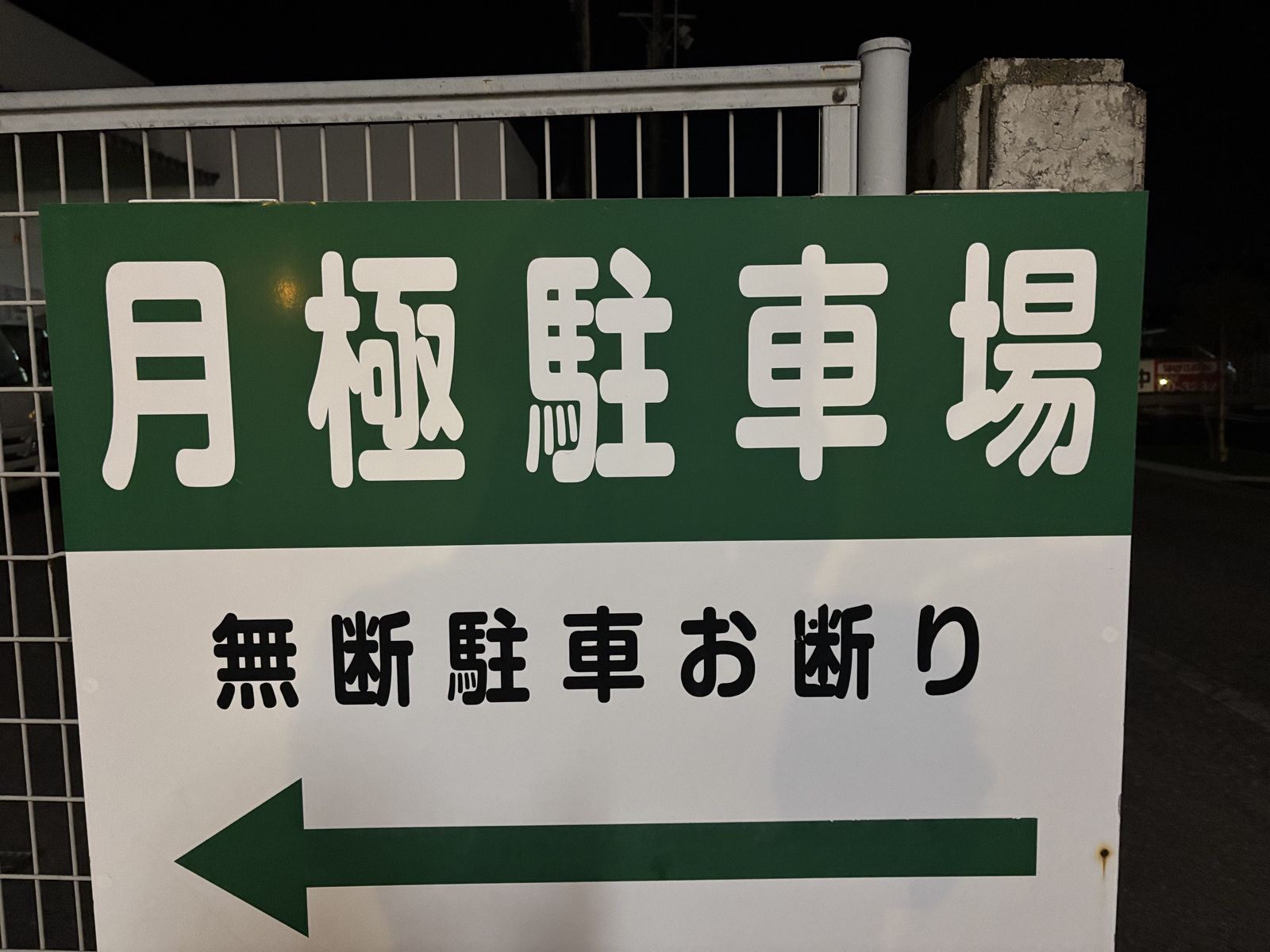
    Green and white sign reading 月極駐車場 and 無断駐車お断り with a green arrow, on a fence at night
    A green-and-white sign reading 月極駐車場 (monthly parking lot) and 無断駐車お断り (no parking without permission), with an arrow pointing to the lot.

    In a parking lot you may see the word

    月極

    on a sign.

    月極 means parking rented by the month on a contract.

    It isn’t a place where a traveler pays a fee and parks for a while.

    Even when it’s empty, it’s somebody’s space.

    Watch out for 専用 too

    You’ll also see signs like

    契約者専用 — contract holders only

    店舗利用者専用 — customers of the shop only

    カーシェア専用 — car-share vehicles only

    and others.

    What they share is the two characters 専用.

    When you see those two, the space is set aside for particular people or cars.

    Empty land and the front of buildings

    An empty lot or the space in front of a building can look like a parking space without being one.

    It belongs to someone, so leave it be unless it’s set up as parking.

    When in doubt: who is it for?

    When there’s no fee posted, ask yourself:

    For people using this shop?

    For people using this facility?

    For contract holders?

    Then see which one it is.

    If it’s none of them, it’s probably not somewhere to park.

    And when you can’t read the sign, asking a staff member is the fastest way.

    ※ The conditions for free parking, the time limits, and parking services based on shopping differ from one parking lot to another. Please check the signs on site and the information the facility gives you.
  • Parking Rates in Japan — Look at Just Three Things on the Sign

    Japanese coin parking lots have a big sign with the charges on it.

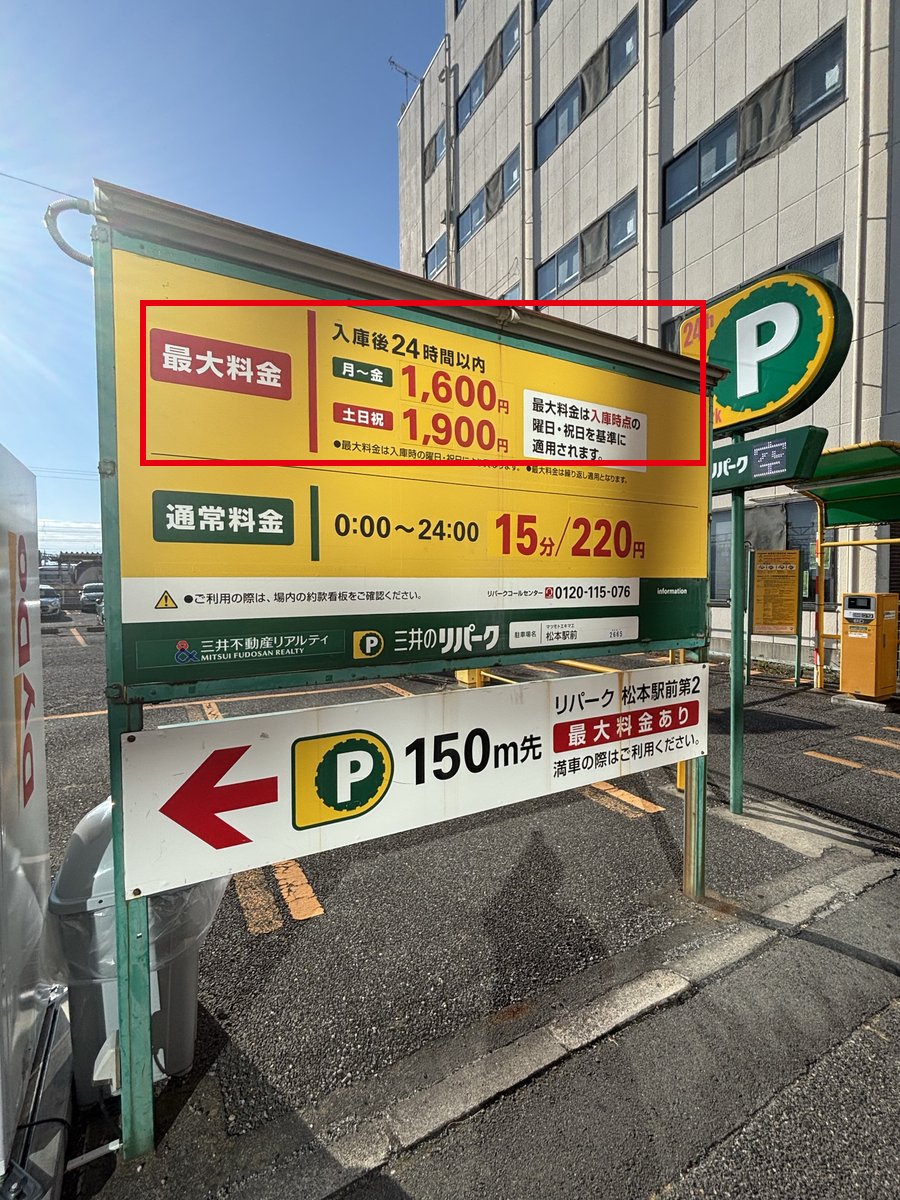
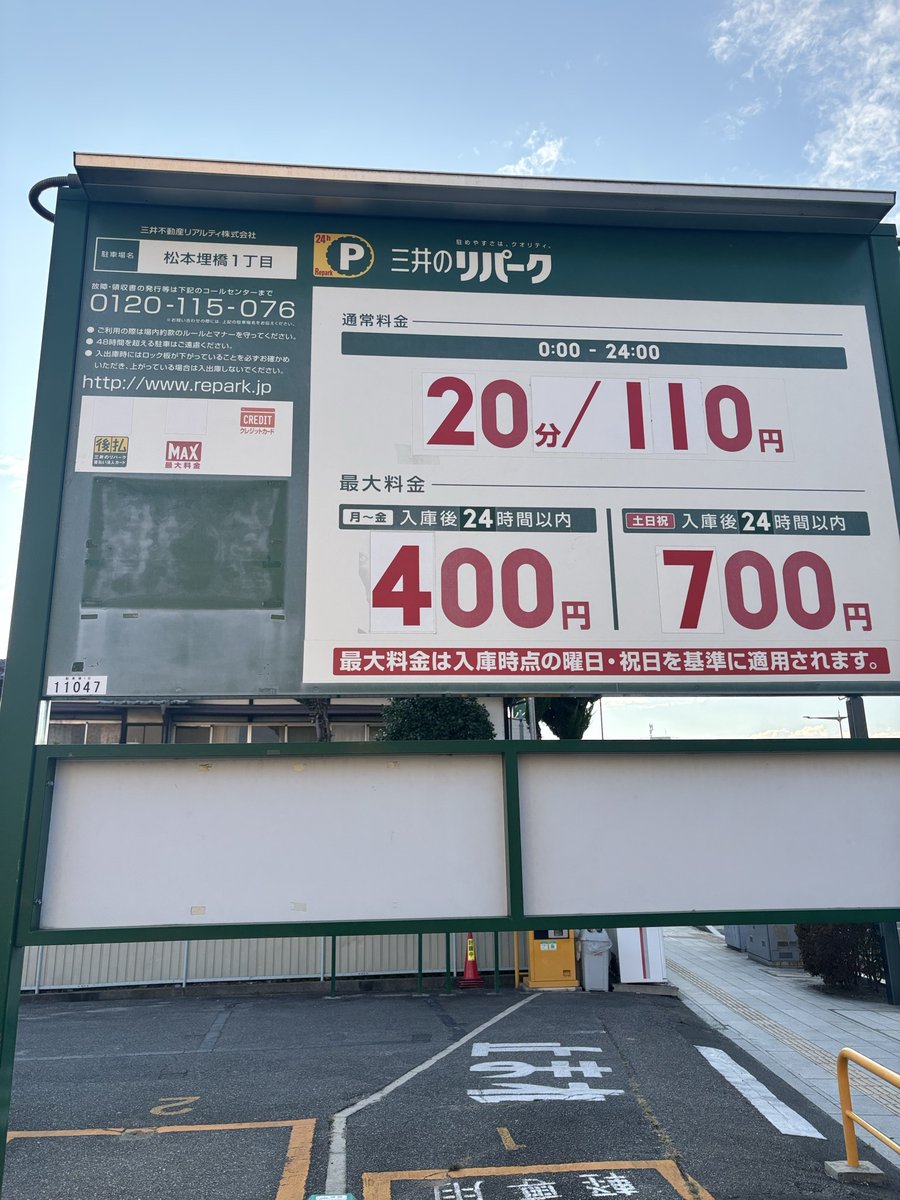
    A coin parking price sign: the regular rate and maximum charges that differ by day of the week

    There are a lot of numbers and a lot of Japanese on it, so you may find yourself thinking,

    “So what does it actually cost?”

    and not knowing where to start.

    But you don’t have to read all of it.

    To begin with, just three things.

    Two characters worth knowing

    円 is yen, and 分 is minutes.

    When those two sit side by side, that’s the price.

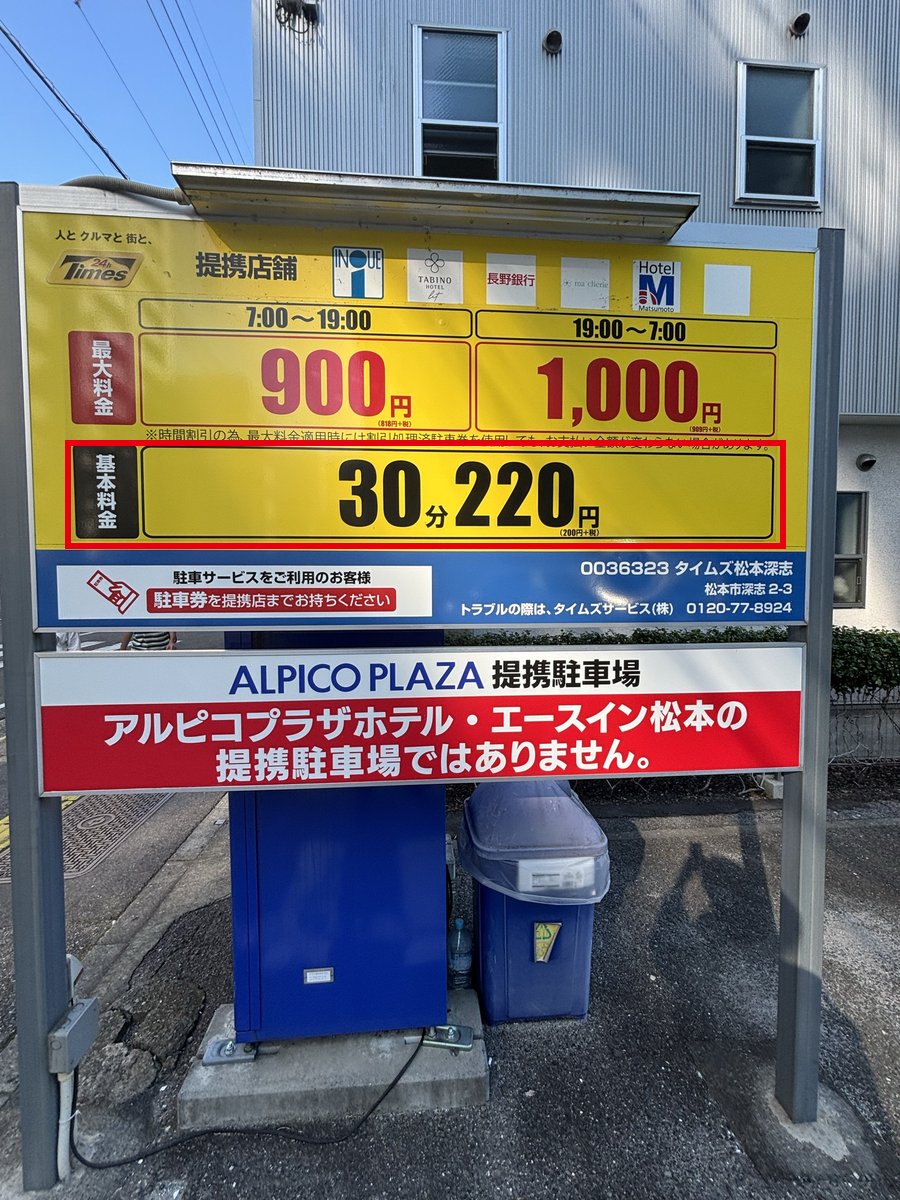
    1 The basic rate

    What you look at first is

    how many minutes or hours you get, and for how much.

    That’s it.

    For example,

    ○分 ○○円 (“○ minutes, ○○ yen”)

    means you’re charged that amount for each block of time.

    Price sign with the base rate (基本料金: 220 yen per 30 minutes) boxed in red

    2 “最大料金”

    Next, look for the characters

    最大料金 — “maximum charge”

    and see whether they’re on the sign.

    Price sign with the maximum charge (最大料金) boxed in red

    If they are, there’s a ceiling on what you pay.

    But even when it says

    最大料金 ○○円 (“maximum charge, ○○ yen”)

    that isn’t always what you end up paying.

    There can be conditions on the hours, the days, or the spaces it covers.

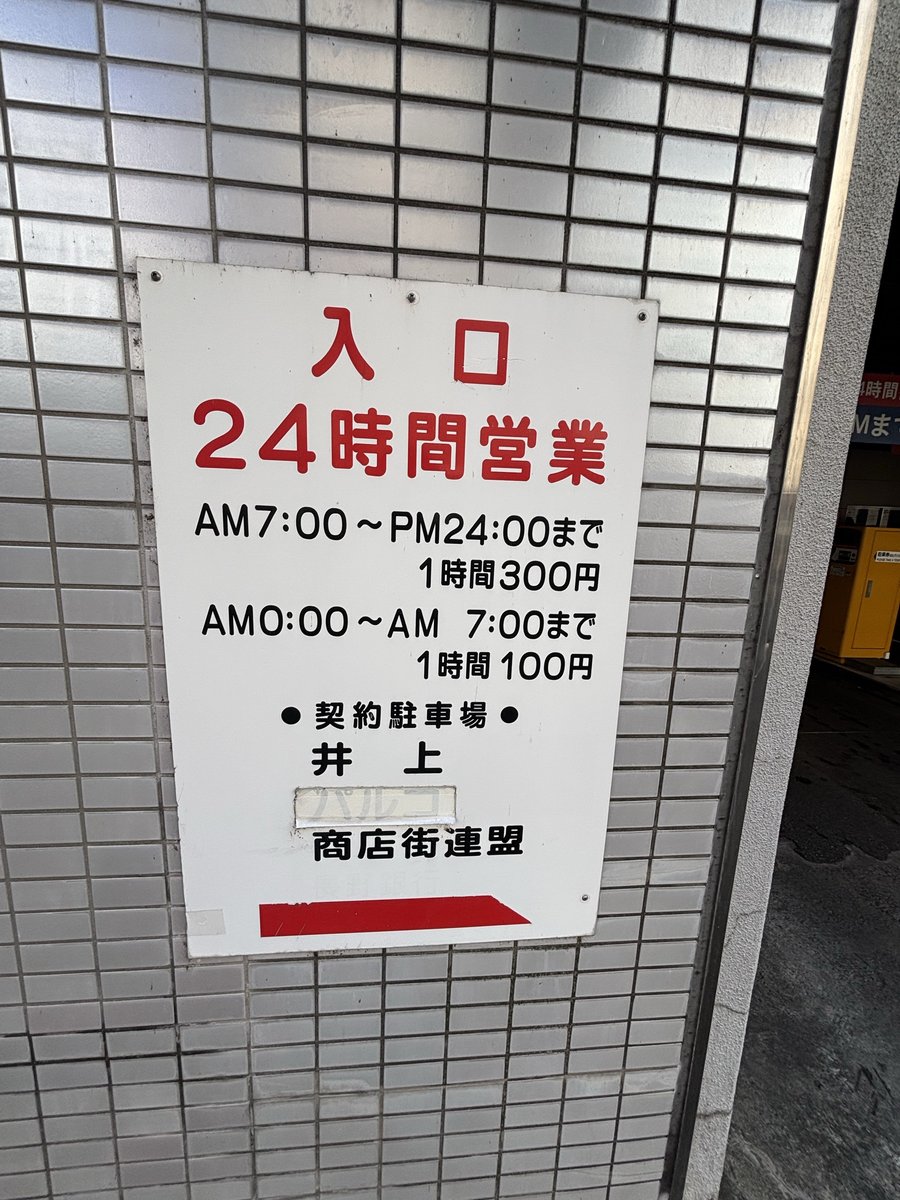
    3 The day of the week and the time

    Even at the same parking lot,

    平日 — “weekdays”

    土・日・祝日 — “Saturday, Sunday and public holidays”

    昼 — “daytime”

    夜 — “night”

    can each have a different price.

    A sign with rates by time of day: 300 yen per hour from 7:00 to 24:00, 100 yen per hour from 0:00 to 7:00

    Look for the price for the day and the time you’re parking.

    Look twice at 24時間

    The words 24時間 (“24 hours”) turn up on charge signs.

    What you want to know is what those 24 hours refer to.

    24時間最大 ○○円 — “maximum for 24 hours”

    is a condition attached to the maximum charge.

    Whether the parking lot itself is open 24 hours is on the sign at the entrance.

    How much? About 500 yen an hour in Tokyo

    A 2025–2026 survey across Tokyo found an average of 495 yen per 60 minutes in the daytime on a weekday.

    Within Tokyo alone, though, it ran from 200 yen to 1,290 yen — a sixfold spread.

    That average leaves out maximum charges, so a long stay costs less than it suggests.

    At sightseeing spots the price is sometimes per visit. Shirakawa-go charges 1,000 yen for an ordinary car.

    Keep 495 in mind, and the number on a sign tells you whether it’s cheap or expensive.

    For a short stay, the basic rate is enough

    For an hour or two of sightseeing or a meal,

    how many minutes for how much?

    is all you need.

    For a whole day or a whole night, look at the maximum-charge conditions as well.

    How to read those is in “最大料金 (Maximum Fee) and How to Read the Sign in Detail”.

    ※ Charges, the conditions for the maximum charge, and the days, times and spaces it covers differ from one parking lot to another. This article describes the basics of reading a charge sign. For the actual charges, check the sign on site and the guidance from the operating company.

  • How to Pay for Parking in Japan — Ticket, Space Number or License Plate

    There are a few different ways to pay for parking in Japan.

    What you need at the machine, though, is usually one of these.

    The parking ticket (駐車券)

    The number of the space you parked in

    Your car’s license plate

    Some parking lots also have you pay up front.

    1 Paying with a parking ticket

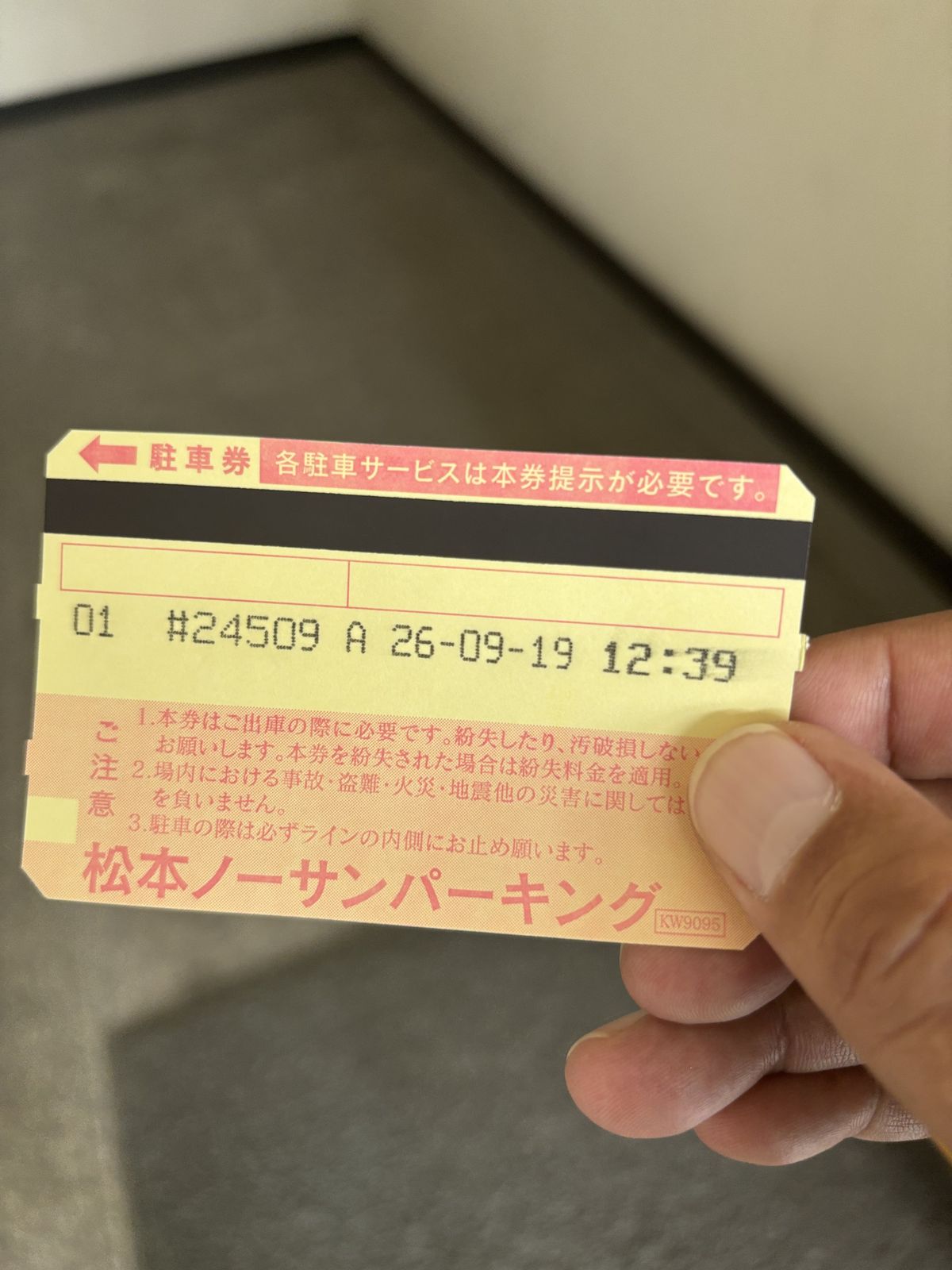
    Hand holding a yellow and orange Japanese parking ticket printed with 駐車券 and an entry date and time
    A real parking ticket (駐車券). It says "駐車券" and "each parking service requires this ticket", with the entry date and time printed on it.

    You’ll see this at multi-story and underground garages.

    You take a ticket at the entrance and pay when you leave.

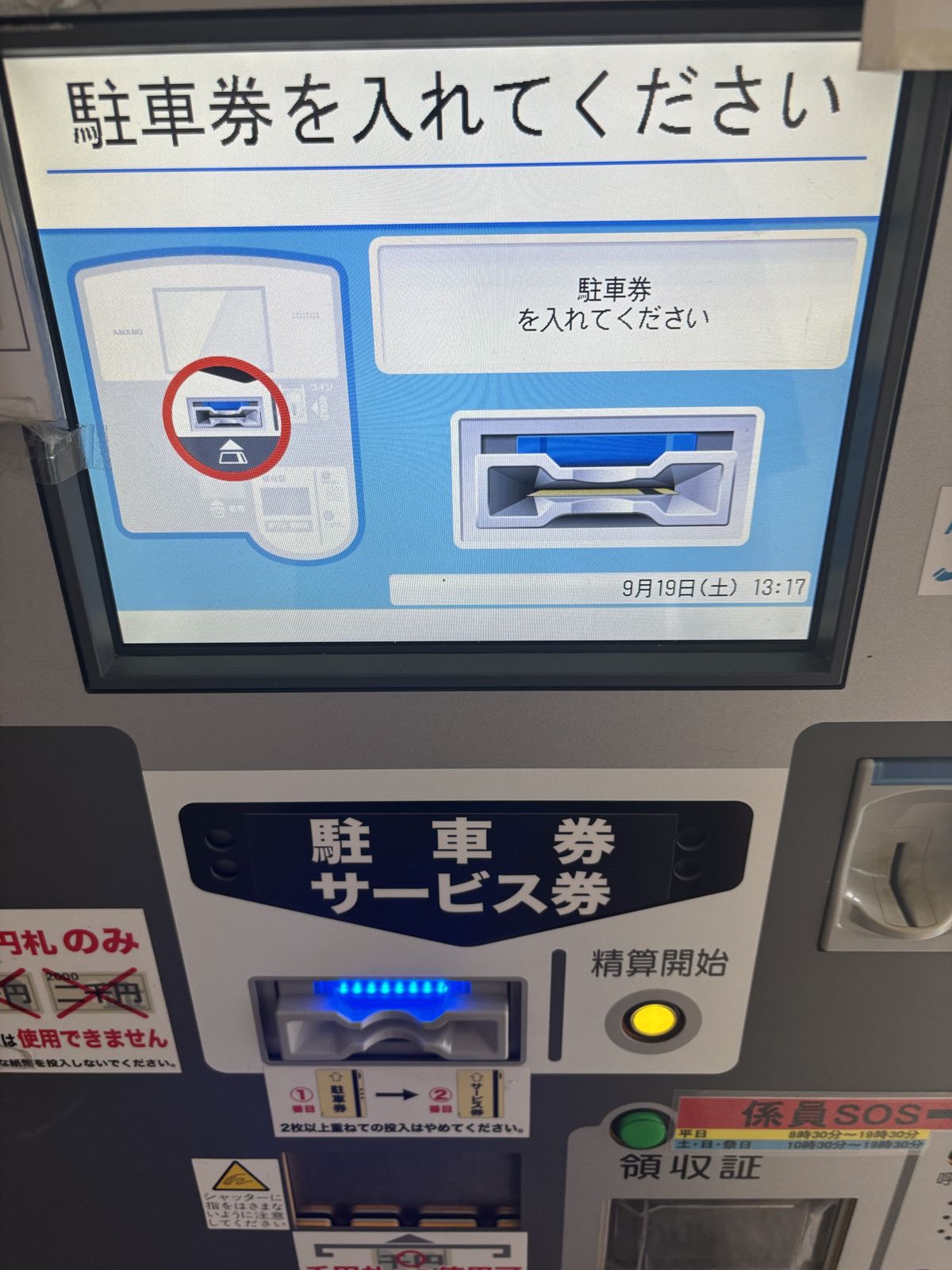
    Put the ticket into the pay machine (精算機) and the charge comes up.

    At malls and department stores, shopping can make your parking free or cheaper.

    You may need the ticket for that, so take it with you rather than leave it in the car.

    Parking pay machine whose screen reads 駐車券を入れてください, with a blue-lit ticket slot and a yellow 精算開始 button
    A parking pay machine (精算機). The screen says "駐車券を入れてください" (please insert your parking ticket). The ticket slot glows blue, with a 精算開始 (start payment) button beside it.

    2 Paying by the number of your parking space

    You’ll see this at ground-level lots (平置き駐車場).

    Every space has its own number.

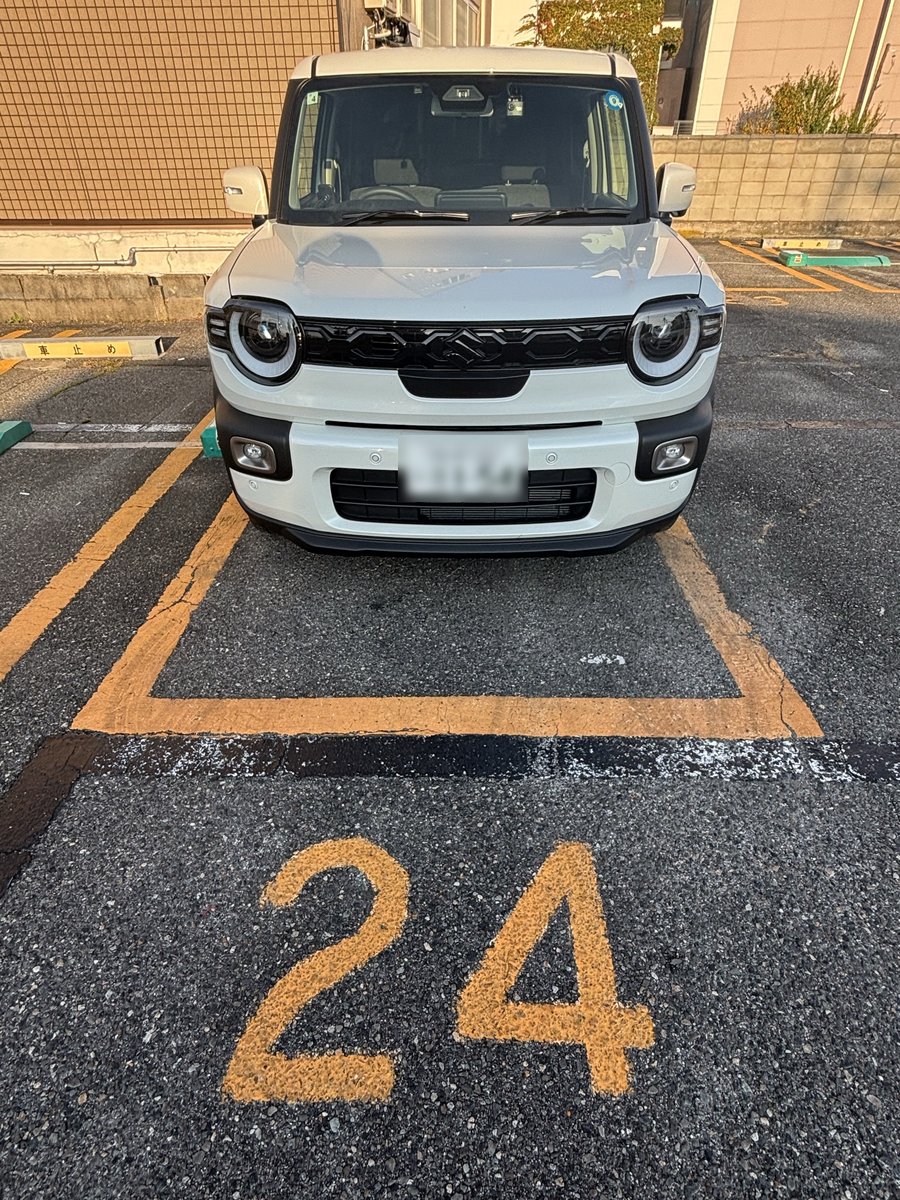
    Space number 24 painted on the ground, with the car parked in it
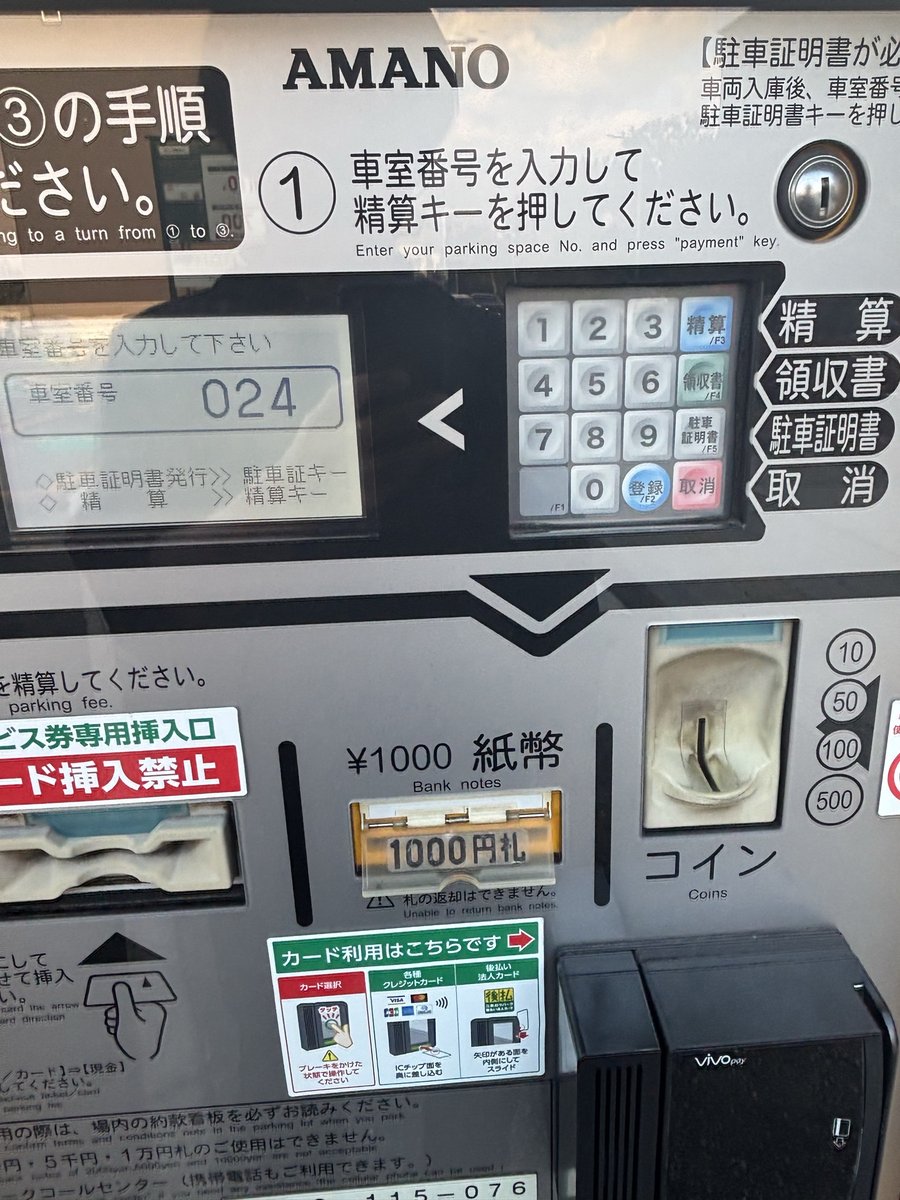
    Entering space number 024 on the payment machine

    When you leave, you enter your number at the machine and the charge comes up.

    Enter the wrong number and you pay for somebody else’s car.

    So photograph the number with your phone as soon as you park.

    3 Paying by your car’s license plate

    Some parking lots read your plate with a camera.

    You enter the number at the machine, and it shows you the matching car.

    With a rental car, photograph the plate when you pick it up.

    4 Paying first

    There’s also a 前払い式 (“pay in advance”) type, where you park and pay right away.

    The machine may print a ticket when you pay.

    If it tells you to leave the ticket somewhere visible inside the car, do that.

    It’s not always cash only

    Depending on the parking lot, you can use

    cash (現金)

    credit cards

    cashless payment such as e-money

    to pay.

    Even with cash, not every banknote works.

    Carry coins and small notes and you’ll rarely be stuck.

    The payment methods you can use are shown on the machine.

    If you’re not sure, look at the machine first

    “So how do I pay?”

    If you find yourself wondering that, look at the pay machine.

    The machine is asking you to

    put in the parking ticket

    enter the number of the parking space

    enter the car’s license plate

    Spot which one it wants, and the rest is the same everywhere.

    Handy things to remember

    With a rental car, photograph the license plate.

    When you park in a ground-level lot, photograph the space number.

    When a ticket comes out, take it with you rather than leave it in the car.

    Make those three a habit, and paying stops being something to think about.

    ※ How you pay, and which cash, cards and cashless payments you can use, differ from one parking lot to another. When you actually use one, check the pay machine and the signs on site.

  • How to Use Mechanical and Tower Parking (機械式・タワーパーキング) — The Machine Parks Your Car

    In cities and at hotels, you may come across a mechanical parking garage.

    The difference from a normal parking lot is that you don’t drive to the space yourself.

    Your car rides on a platform

    At the entrance there’s a platform just big enough for one car.

    You drive onto it and get out.

    The machine then carries your car into the building.

    Think of it as a big elevator.

    When you come back, you call up your car at the control panel.

    The elevator brings your car down to the entrance.

    First, check that your car fits

    A van or an SUV may not fit.

    Height and width are what matter.

    Your rental car’s size is on the 車検証 kept in the car.

    Look for the three words, 長さ・幅・高さ — length, width, height — and compare the numbers with the sign at the entrance.

    If you’re still not sure, it’s safer to find another parking lot.

    That said, if there’s an attendant, asking is the quickest way. You’ll know right away whether your car will fit.

    Drive to the marked position

    This type of parking usually has an attendant.

    If someone is standing there in a reflective vest, that’s them.

    Stop where they show you, and listen to what they say.

    If nobody is there, follow the signs and drive slowly to the marked position.

    Take your bags out first

    Once the car is inside the machine, you can’t go back for your bags right away.

    Take out any bags or shopping you need before you hand the car over.

    Everybody gets out of the car

    Everyone except the driver gets out before the car goes onto the platform.

    This is when you take the bags out too.

    Then the driver drives onto the platform and gets out.

    If you have children with you, hold hands while you wait.

    Don’t start the machine while anyone is still in the car.

    Your car goes into the machine

    Once everyone is out, the car is stored away.

    If there’s an attendant, they handle the controls for you.

    Getting your car back

    When you come back, pay and then work the controls to bring the car out.

    If there’s an attendant, they’ll do it for you.

    The machine carries your car to you, so wait where you’re shown.

    Get in once the car has stopped.

    Three things to remember

    ① Compare the numbers on the 車検証 with the sign at the entrance

    ② Take the bags you need out first

    ③ Everybody gets out of the car

    Those three.

    If you can’t work out the controls, leave the machine alone and ask the attendant, or use the intercom.

    ※ Names, vehicle size limits, how the machine is operated and how you pay differ from one parking lot to another. This article describes the general flow. When you actually use one, follow the signs on site and the attendant’s guidance.

  • How to Use Multi-Story and Underground Parking Garages (立体・地下駐車場) — This Is What Malls and Department Stores Have

    This is the type you see at shopping malls, department stores, stations and hotels.

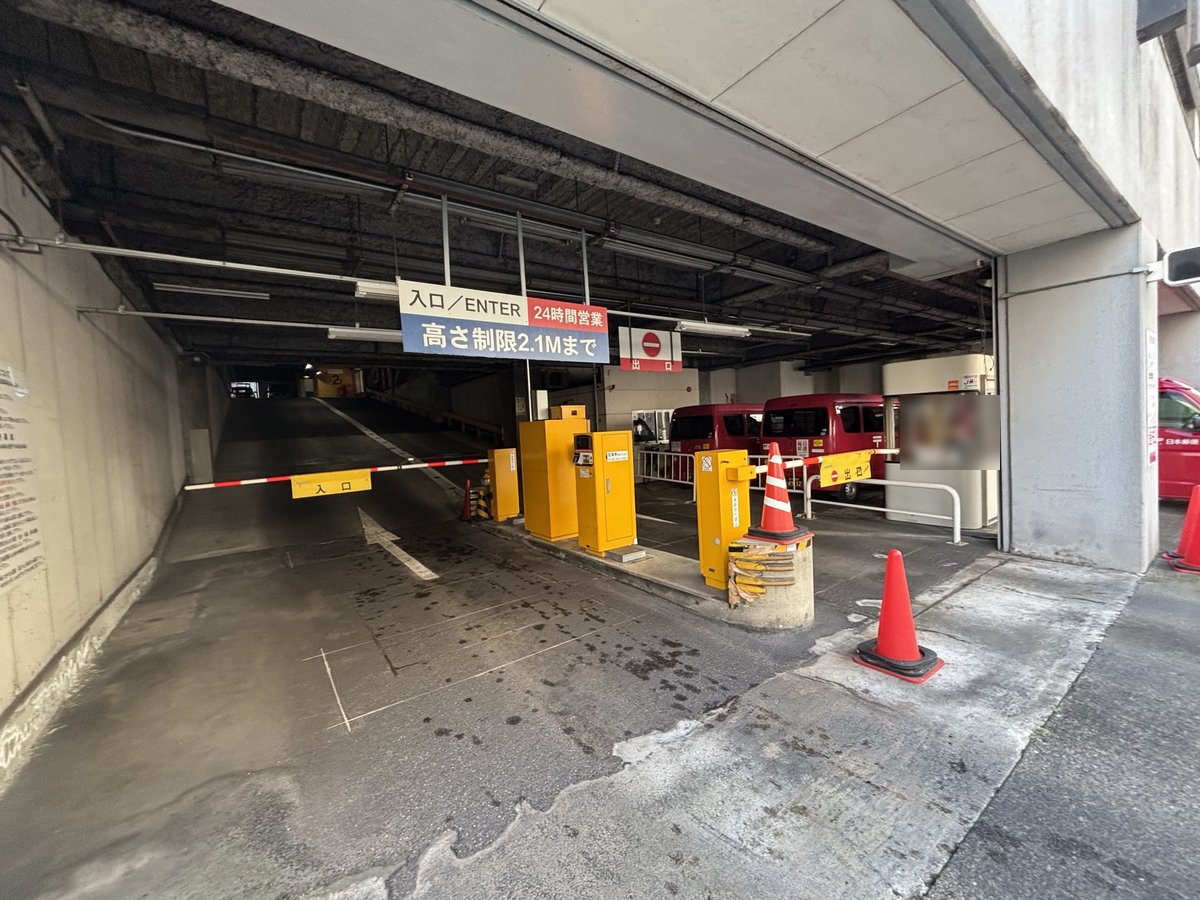
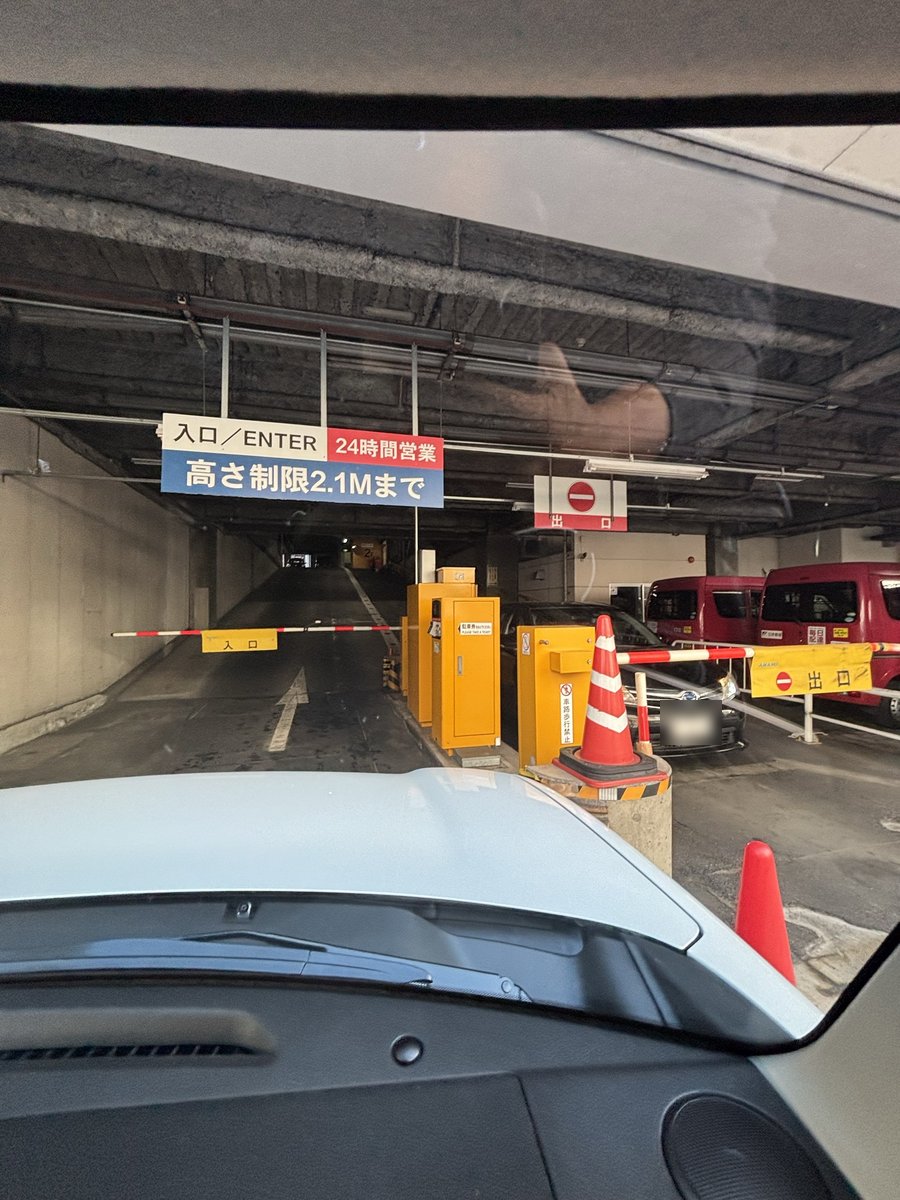
    Entrance to a multi-story parking garage, with ENTER and 2.1 m height-limit signs, the gate and the ticket machine

    You drive into the building yourself and park in an empty space.

    You’ll use one a lot when you go shopping, so it’s worth running through the steps once.

    Take it slowly at the entrance

    At a garage with a gate, stop your car in front of the ticket machine.

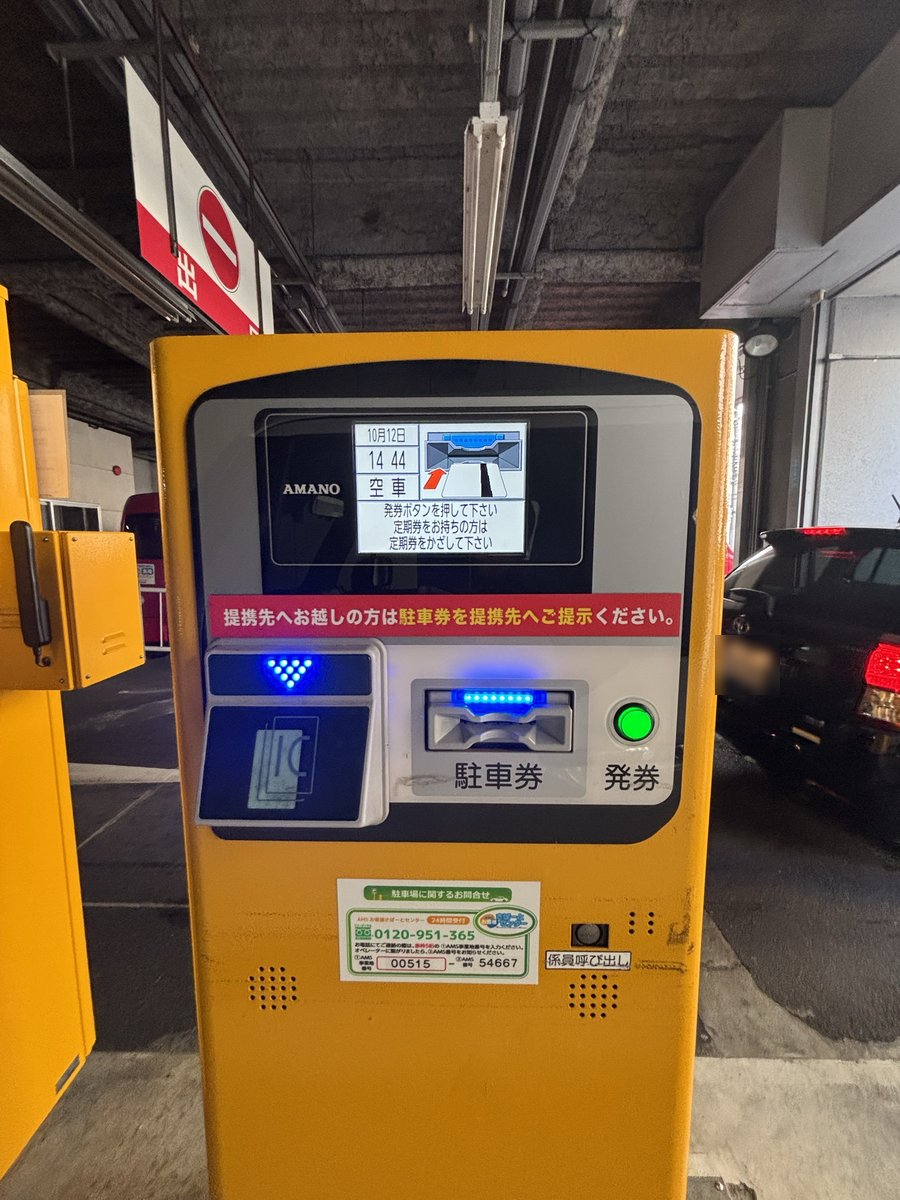
    The ticket machine at the entrance: press the green 発券 button and a parking ticket comes out

    Take the parking ticket (駐車券) when it comes out, and drive on once the gate opens.

    If a camera reads your license plate instead, no ticket comes out.

    Park in an empty space

    Once you’re inside, follow the signs marked 空 (“space available”) to find a spot.

    That said,

    月極 — “monthly contract”

    契約者専用 — “contract holders only”

    軽専用 — “kei cars only”

    and spaces like these are set aside for particular cars.

    Read the sign before you park.

    Don’t leave the parking ticket in the car

    If a ticket comes out, take it with you rather than leave it in the car.

    At malls and department stores, shopping or eating can make your parking free for a few hours.

    You may need the ticket to get it.

    Sometimes you pay before you go back to the car

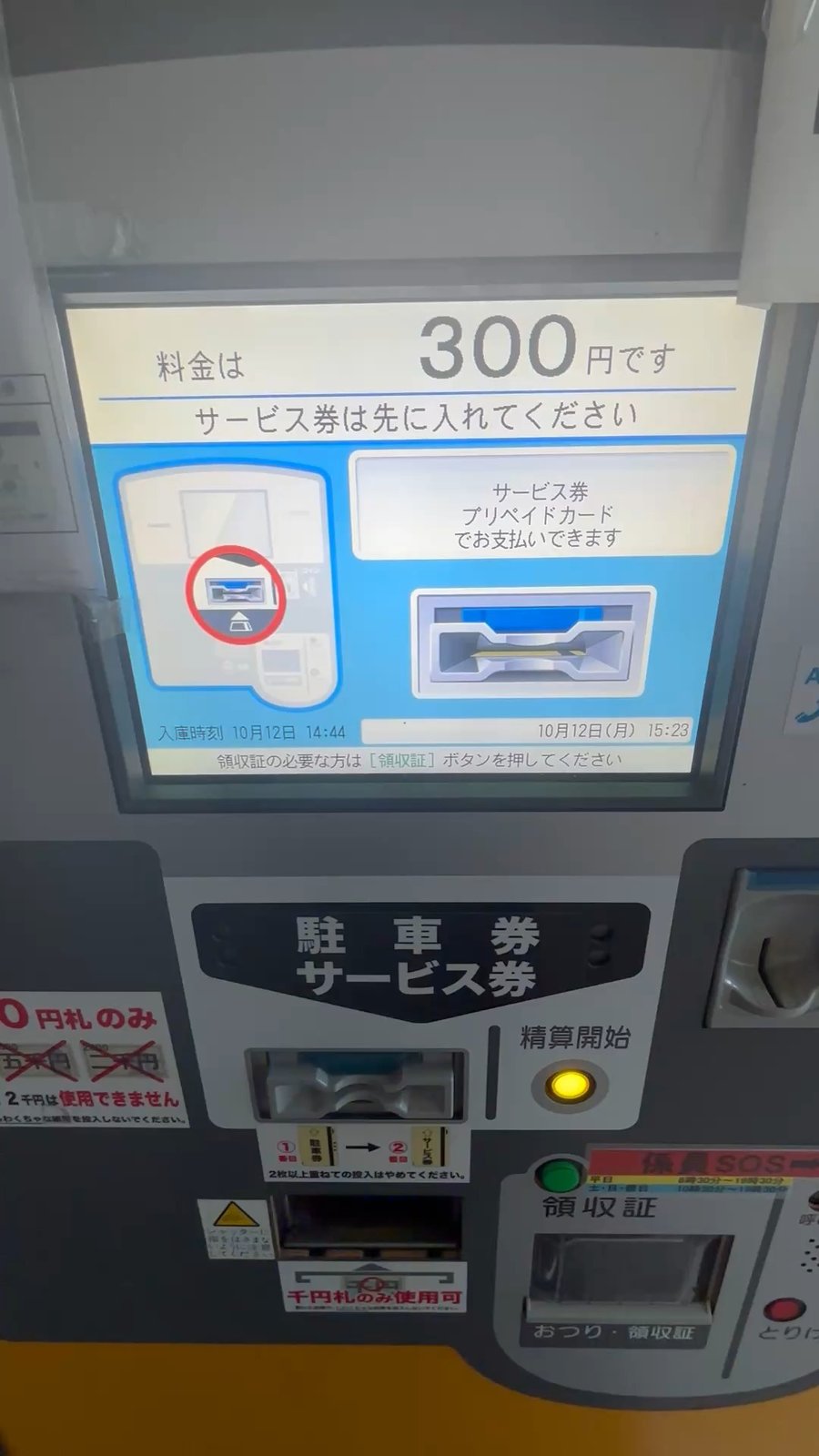
    Some garages have you pay at the exit; others have a 事前精算機 (“advance pay machine”) inside where you pay first.

    A pay station inside the garage: insert the parking ticket and the fee appears (300 yen that day)

    With the camera type, you may enter your license plate to find your own car.

    Check the guidance on site for how to pay.

    Check the height limit (高さ制限)

    At the entrance of a multi-story or underground garage you’ll see a sign such as

    高さ ○m — “height ○ m”

    or something like it.

    The "height limit 2.1 m" sign above the entrance, seen from the driver's seat

    With a tall SUV or a minivan, this is where you may have to turn around.

    Some garages set limits on width and weight as well as height.

    Your rental car’s height and width are on its 車検証, the inspection certificate kept in the car.

    Look for the three words, 長さ・幅・高さ — length, width, height. Compare the number beside 高さ with the sign at the entrance.

    If you’re still not sure, a garage with an attendant is worth trying. Ask at the entrance and they’ll tell you whether your car will fit.

    Keep an eye on the opening hours (営業時間) too

    A multi-story or underground garage isn’t always open 24 hours.

    At some of them you can’t get your car out once the building closes.

    If you’re out until late, check the opening hours at the entrance first.

    Once you’ve done it once, it’s the same everywhere

    Take a ticket, park, sort out the shopping discount, pay, drive out.

    That’s the order at most multi-story and underground garages.

    ※ Whether a ticket is issued, how you pay, parking services, opening hours and vehicle size limits differ from one parking lot to another. When you actually use one, check the entrance, the pay machine and the guidance inside the building.

  • How to Use Coin Parking in Japan: Flat Lots (平置き駐車場) — The Type You See Everywhere in Town

    In town, near stations and at sightseeing spots, most parking is the flat, ground-level kind.

    Basically, you park your own car in an empty space.

    What changes from lot to lot is what happens after you park.

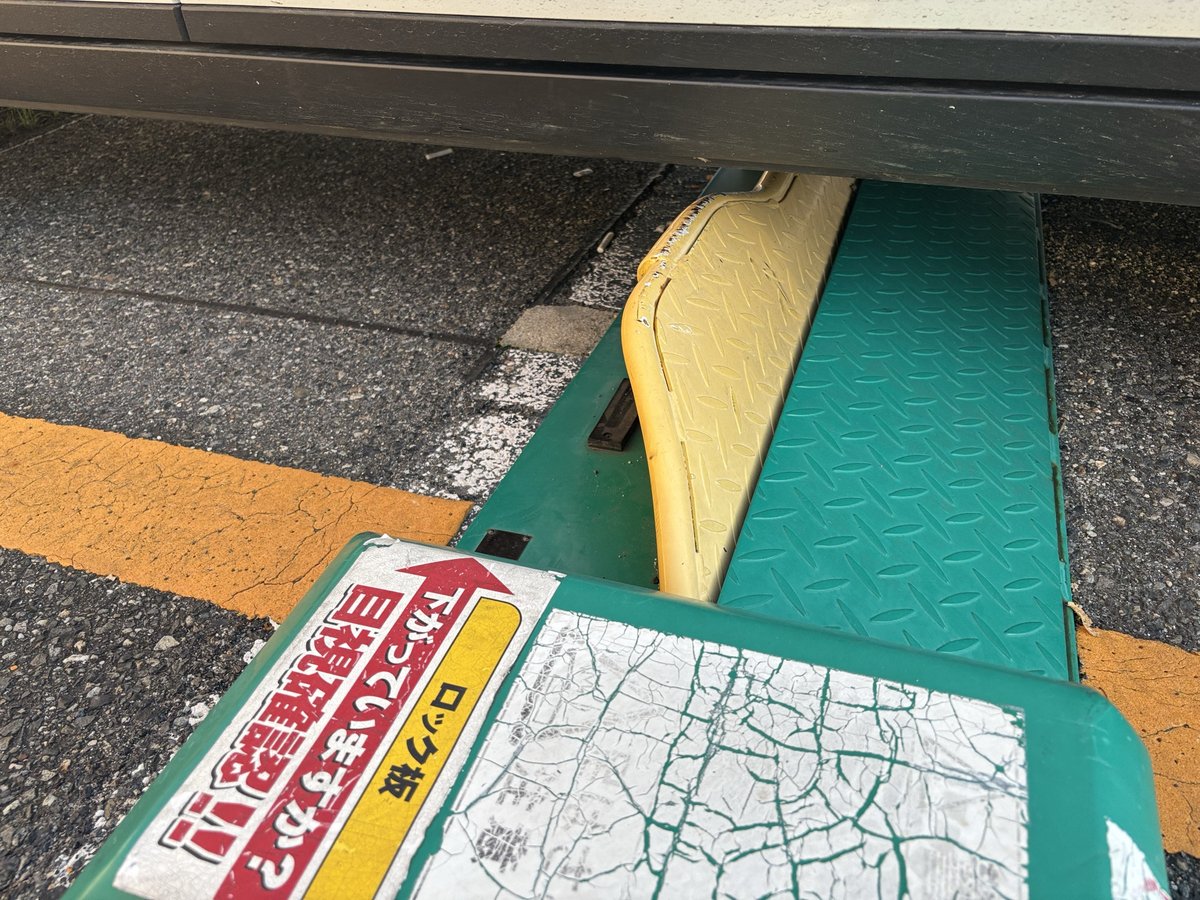
    1 A flap in the floor: ロック板式

    This type has a plate near the middle of the parking space.

    A raised lock plate under a parked car; the box says to check by eye that it is down

    Once you park, the plate rises.

    While it’s up, you can’t drive the car out.

    To leave, you enter the number of the space you parked in at the pay machine (精算機).

    So photograph the space number with your phone as you park.

    After you pay, watch the plate go back down before you move the car.

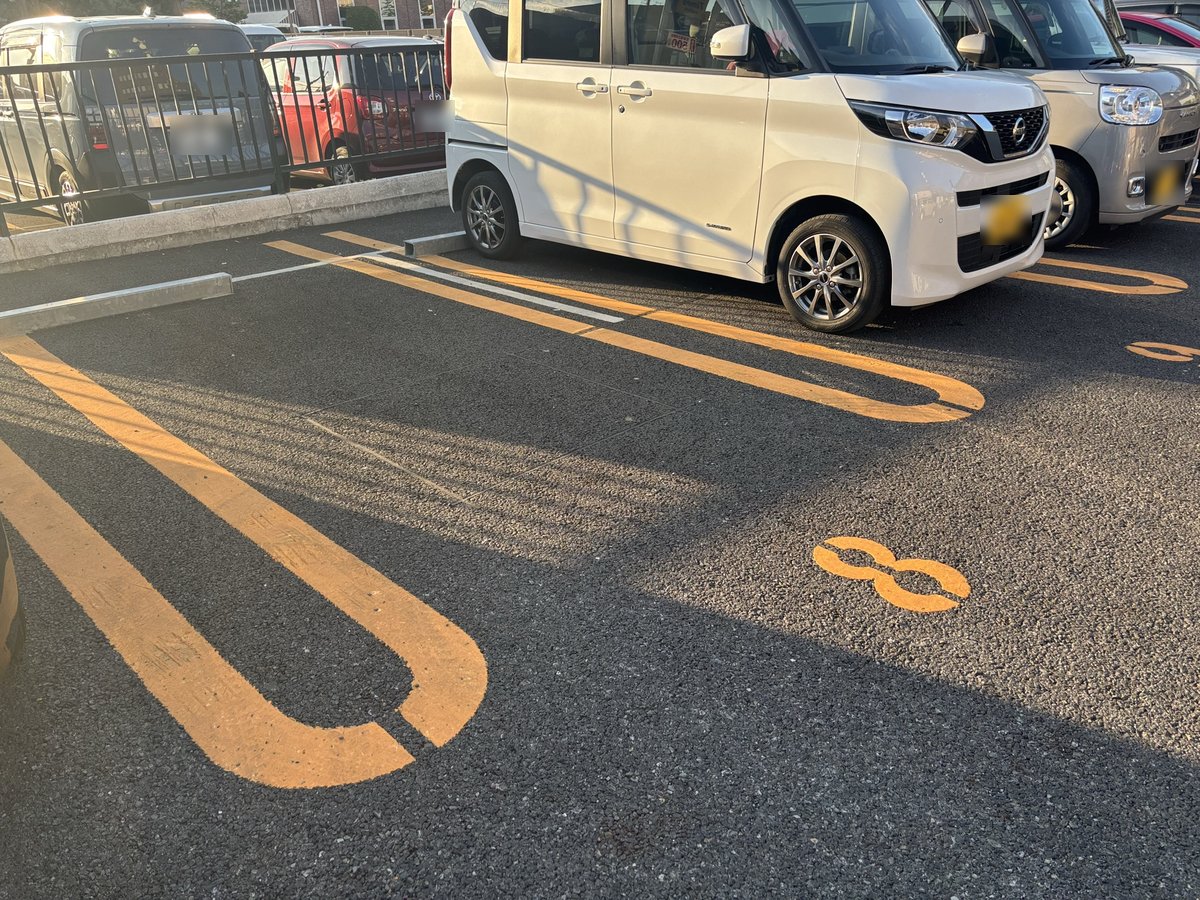
    2 No flap in the floor

    Some lots have no flap in the floor.

    Some even boast about it on their sign: 「ロック板がない停めやすい駐車場です!」 (“No flaps here — easy to park!”).

    An empty space in a parking lot with no lock plates; only the number 8 is painted on the ground

    For example, here are two ways to pay.

    One is the camera type (カメラ式). A camera reads your license plate.

    To leave, you enter your license plate number at the pay machine to find your car.

    Photograph the plate when you pick up your rental car — it comes in handy.

    The other is the type whose sign says 「車両センサー」 (vehicle sensor).

    To leave, you press your 駐車位置番号 (the number of the space you parked in) at the pay machine and pay. Just like with the flap type, it’s reassuring to photograph the number.

    Even with no flap in the floor and no barrier at the exit, you still have to pay at some lots.

    Pay before you head back to your car.

    3 Paying up front: 前払い式

    At some lots you park first and then pay straight away.

    You pay at the machine, and if a ticket comes out, follow what it tells you.

    Sometimes you leave the ticket somewhere visible inside the car.

    Some parking lots have an attendant

    At theme parks and the outdoor lots of malls, there’s often an attendant.

    They usually wear a uniform and a reflective vest, and carry a lit baton.

    They’ll show you where to park, so drive the way they point.

    When they tell you to stop, stop and open your window.

    Sometimes they come to collect the fee as well.

    Remember the name of the area you parked in

    Big parking lots give each area a name.

    Sometimes a letter or a number, sometimes the name of a character or an animal.

    In a garage it’s written on the pillars; outdoors, on a sign on a pole.

    One photo before you get out of the car.

    Then you won’t be hunting for it later.

    At Tokyo Disney Resort it’s “Mickey”, “Donald”, “Minnie”, “Goofy”.

    There are others too.

    Who you’ll get is part of the fun of going.

    Some empty spaces aren’t for you

    An empty space doesn’t always mean you can park there.

    月極

    A space marked like this belongs to someone who rents it by the month.

    カーシェア専用 (car-share only) and 契約者専用 (contract holders only) are somebody else’s too.

    They’re not places for a traveler to stop for a while.

    Shopping can bring the parking fee down

    At a lot tied to a shop, buying something can make your parking free, or cheaper.

    How you claim it varies, though.

    Sometimes you take your ticket to the shop; sometimes the shop gives you a 駐車証明書 (a parking certificate) instead.

    If you want the discount, check the notices at the parking lot and in the shop.

    ※ The systems, names, payment methods and discounts at flat parking lots differ from one parking lot to another. This article describes the usual ways they work. When you actually use one, follow the pay machine and the signs on site.

  • What Do 空車 and 満車 Mean? — Japan Parking Signs: The First Japanese Words to Learn

    There’s a big sign at the entrance to a parking lot.

    What it says is usually one of these two.

    空車

    満車

    Even if you can barely read any Japanese, these two are worth remembering.

    空車 = there’s space

    空車

    It means there’s a space you can park in.

    In English it’s close to Available / Vacancy.

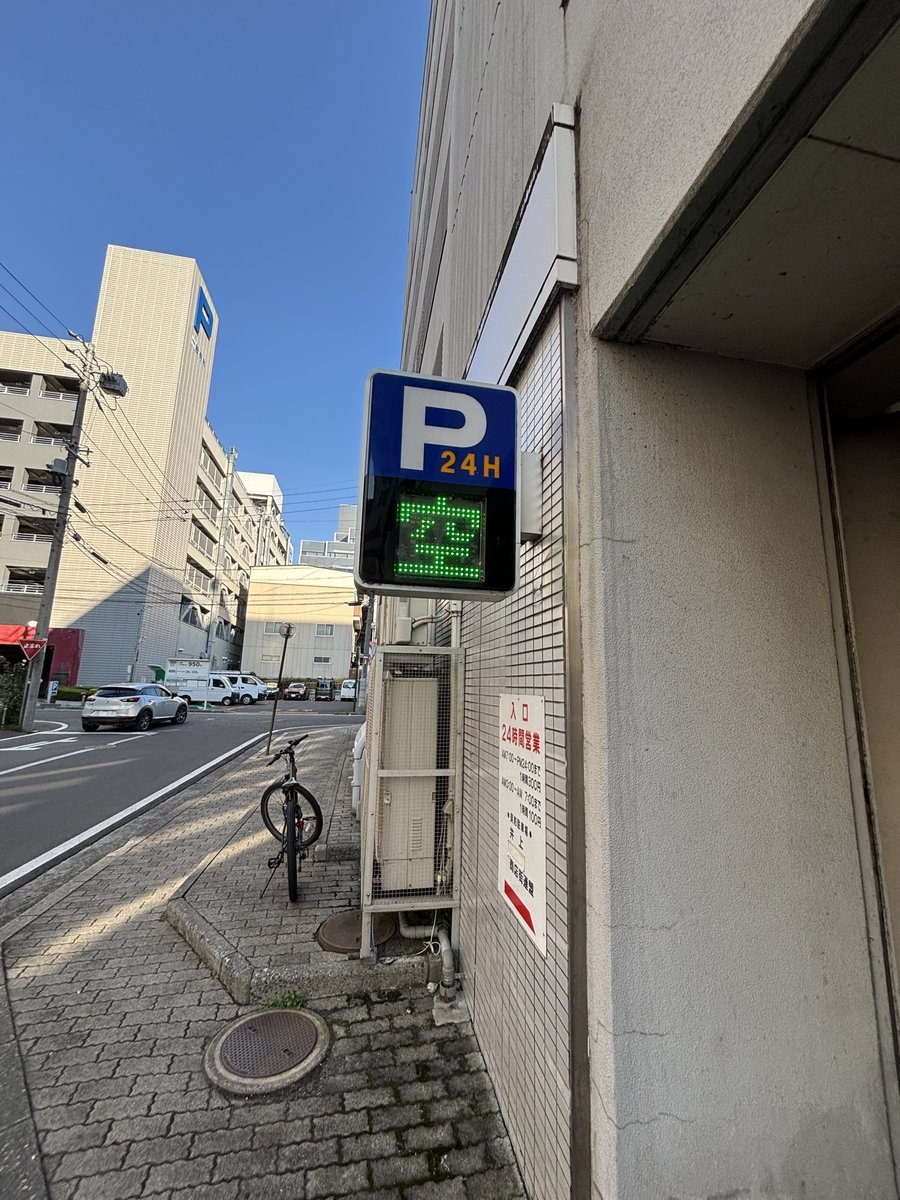
    Entrance sign "P 24H" showing 空 in green: spaces are available

    If the entrance says 空車, there’s space available.

    満車 = it’s full

    満車

    It means there’s no space left to park in.

    In English, Full.

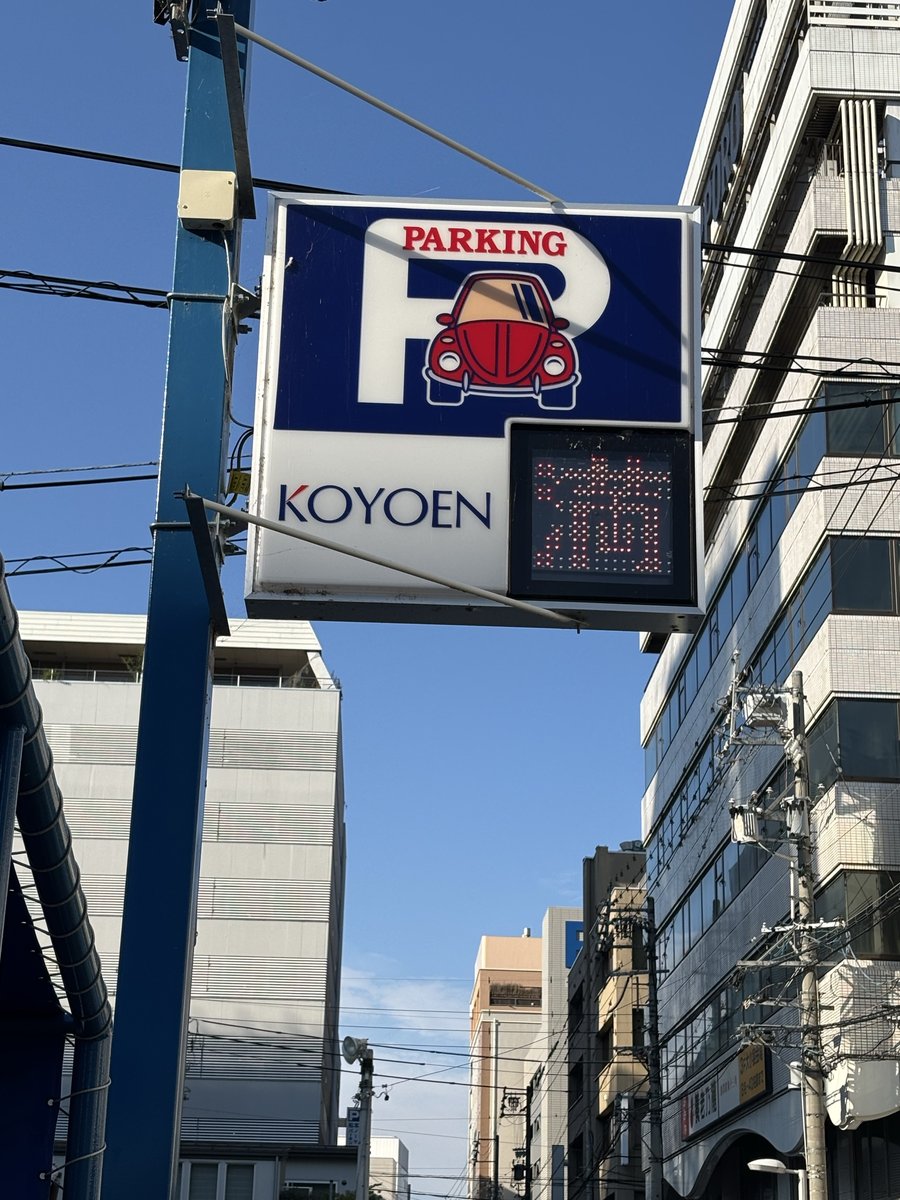
    Parking sign showing 満 in red: the lot is full

    If it says 満車, look for another parking lot.

    Inside a building, just the one character 空

    In a multi-story or underground garage, you look for a space once you’re in.

    The signs there sometimes use just the one character 空.

    It means the same as 空車.

    It says 満車, but you can see an empty space

    That happens.

    The space you can see may be marked

    月極 — for people with a monthly contract

    カーシェア専用 — car-share only

    or something similar, and ordinary cars can’t use those.

    When the entrance says 満車, driving on to the next lot is quicker.

    Go by the characters, not the color

    Electronic signs use color differently from one parking lot to the next.

    What’s worth learning is the characters: 空車 and 満車.

    ※ How 空車 and 満車 are displayed, and how you drive in, differ from one parking lot to another. If there’s a signal, a gate or an attendant at the entrance, follow their guidance.

  • Parking in Japan Comes in Three Types (駐車場) — This Is All You Need to Start

    If you’re renting a car in Japan, it helps to know a little about parking first.

    You don’t have to learn every little rule.

    Parking in Japan comes in three main types.

    1 Flat, ground-level parking (平置き駐車場)

    The spaces are simply marked out on the ground, in the open.

    You see them in town, near stations and at sightseeing spots.

    You park your own car in an empty space.

    Some have a flap in the floor; others read your license plate with a camera.

    2 Multi-story and underground parking (立体・地下駐車場)

    You find these at shopping malls, department stores, stations and office buildings.

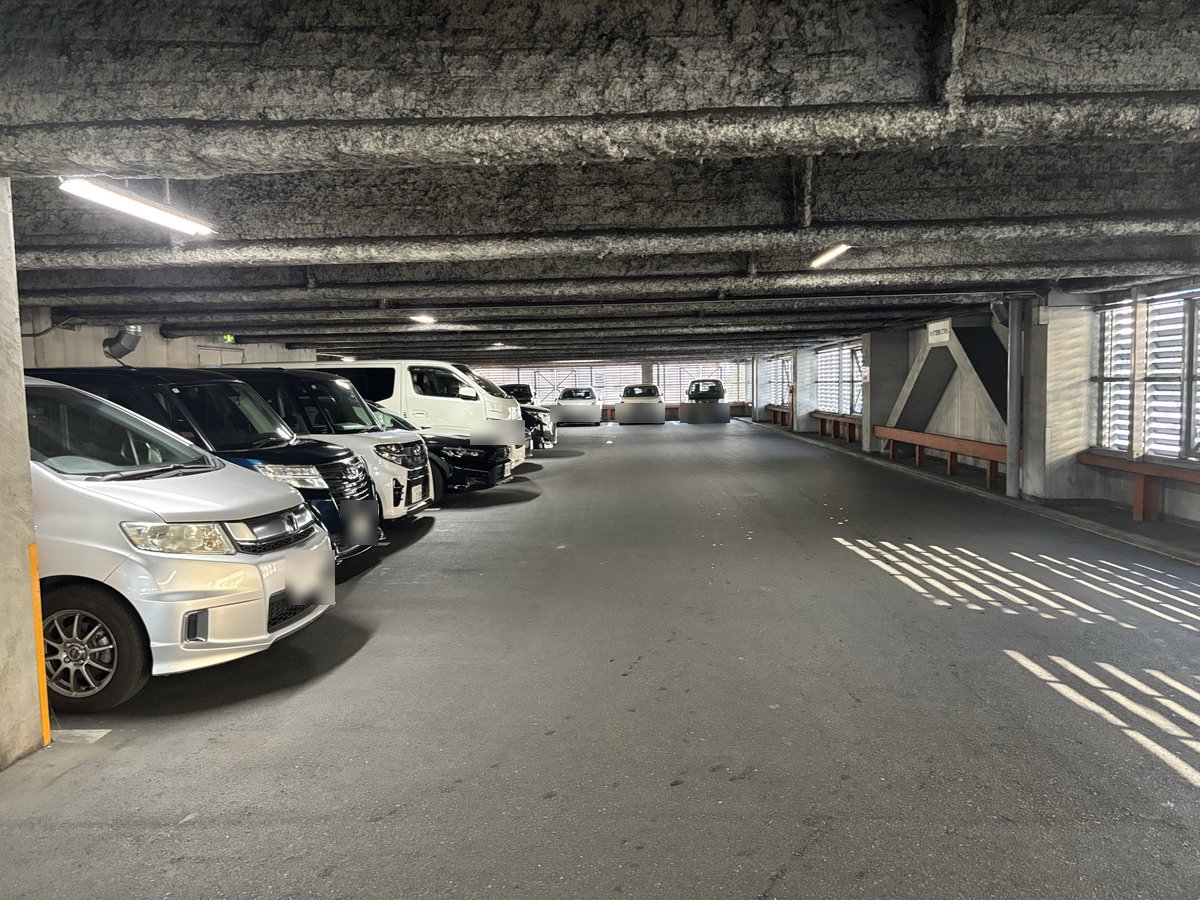
    Inside a multi-story parking garage: the driving lane and parked cars

    You drive around inside the building yourself and park in an empty space.

    Some have a gate at the entrance, where you take a parking ticket (駐車券).

    3 Mechanical and tower parking (機械式・タワーパーキング)

    This is the type you see in cities.

    You get out at the marked spot, and the machine carries your car to a space.

    This isn’t the type where you drive around inside looking for a space.

    There are limits on height and width, so check the sign at the entrance.

    What about the street?

    In Japan, it’s hard to tell whether you’re allowed to park on the street, and it’s generally prohibited.

    So that an accident or some other trouble doesn’t spoil your trip, make a parking lot your default. There’s more on this in “Free Parking and 月極”.

    How do you find a parking lot?

    Japanese parking companies’ websites and apps are almost all in Japanese only.

    Google Maps’ “find parking near your destination” feature covers select US cities only.

    What you can lean on is the car’s own navigation system. Some of them switch to English.

    Ask for an English navigation system when you book.

    It depends on the company. At least one says it can’t guarantee an English system.

    Some parking is free

    Not every parking lot in Japan costs money.

    Supermarkets, restaurants, hotels and tourist sites sometimes have free parking.

    At shopping malls, buying something can get you a certain amount of free parking.

    There’s a separate article about free parking.

    For now, just these three

    Flat (平置き) / multi-story and underground (立体・地下) / mechanical and tower (機械式・タワーパーキング).

    Know those three and you’re ready to go.

    The articles that follow go through each type in turn, and then how you pay.

    ※ Names, equipment, how you use them, prices and vehicle size limits differ from one parking lot to another. When you actually use one, check the signs on site and the guidance from the operator.