Category: Food & Dining

  • Ramen — Choose by Flavor Name and the Look of the Noodles. Leave the Soup or Drink It All

    Outside the shop, menus with photos are lined up. Clear golden soup, almost black soup, red soup. Some photos show the noodles and soup in separate bowls.

    Ramen became popular as a dish of wheat noodles eaten in soup made from meat or fish. Today it is eaten throughout Japan, and each region and shop has its own take on a bowl.

    If you are unsure what to choose, start with two things.

    ・The flavor name — shoyu, shio, miso, tonkotsu. These four are a starting point

    ・The look of the noodles — thin or thick? If the noodles and soup are in separate bowls, it is tsukemen

    Then there is ordering, and finishing your meal.

    ・At many shops, you buy a meal ticket from a machine first

    ・You can leave a little soup or drink it all

    The photos in this article were taken at the ramen shop 麺肴ひづき (Hizuki) in Matsumoto, Nagano Prefecture.

    1 Choose by Flavor Name — Shoyu, Shio, Miso, Tonkotsu

    Ramen flavors are often called by four names. Shoyu (soy sauce), shio (salt), and miso name the soup’s seasoning. Tonkotsu names a soup made from pork bones.

    But not every bowl fits neatly into one of these four. The Japan National Tourism Organization (JNTO) writes that soup bases such as chicken, fish, and seafood are combined with seasonings differently from region to region and shop to shop. The menu at the shop in these photos also had sesame and chili oil tantanmen, soupless tantanmen, and a bowl combining tonkotsu and shoyu.

    The four names are a starting point when you cannot decide. From there, you can look at the photos and choose a color you would like to try.

    Even with shoyu, the colors can differ this much. The bowl above is clear gold; the one below is almost black. At this shop, both were shoyu ramen.

    If you see 「中華そば」 on the menu

    「中華そば」 (chuka soba) is another name for ramen. In general, an old-style ramen may be called this.

    The name alone does not tell you the flavor, though. At the shop in the photos, 「手もみ中華そば」 came with a choice of shoyu or shio (on the menu in October 2026). The English listing said “Traditional Chinese soba.”

    2 Choose by the Look of the Noodles — Thin, Thick and Wavy, or Tsukemen

    You can also see the shape of the noodles in the photo menu.

    The noodles in the clear shoyu bowl were fairly thin. Lift the noodles of the 手もみ中華そば with chopsticks and you see that they are wide and wavy.

    Which tastes better is up to you. JNTO writes that enjoying small differences, from noodle firmness to how the green onions are cut, is part of the pleasure of ramen.

    If the noodles and soup come in separate bowls, it is tsukemen

    With 「つけ麺」 (tsukemen), the noodles and soup come separately. You dip the noodles into the richer soup to eat them. Some shops also serve a bowl of 「汁なし」 (soupless noodles).

    On the menu at the shop in the photos, the tsukemen photo showed a bowl of noodles beside a bowl of soup.

    For more noodles, look for 「大盛」 or 「替玉」

    When you want more noodles, look for 「大盛」 (large). 「替玉(かえだま)」 is a refill of noodles only. If you plan to order 替玉, keep some soup: only the noodles will arrive.

    You can also look up these characters in the “A Mini Japanese Dictionary for Eating Out” article.

    3 Order First at the Ticket Machine

    According to JNTO, many ramen shops have you buy a meal ticket from a ticket machine before eating. At some shops, you order from a staff member.

    At the shop in the photos, the numbers on the menu outside matched the numbers on the ticket machine buttons. The screen was only in Japanese, but choosing a number from the outside menu before entering meant you did not have to decide at the screen.

    The “Restaurants with a Ticket Machine” article covers how to use the machine, as well as bills and coins.

    4 Slurp and Eat

    You can slurp your noodles. JNTO writes that slurping is not rude; it is, in fact, a normal way to eat ramen. If you cannot manage it, there is no need to worry.

    5 When You Finish — Leave the Soup or Drink It All

    Once you have eaten the noodles and toppings, what about the soup? You can leave it or drink it all; either is fine.

    You can leave a little soup. It is also fine to drink it all.(The writer lives in Nagano Prefecture and loves soba.)

    JNTO also writes that if you want to drink it all, go ahead; you can even lift the bowl to drink. Eating the noodles and toppings and leaving a little soup still counts as finishing your meal.

    When you are done, get up rather than sitting for a long time, especially if people are waiting outside.

    6 What Goes into the Soup, and Things You Cannot Eat

    Ramen soup may be made from pork, chicken, fish, or seafood. What goes into it varies by shop and by bowl.

    The appearance or the English listing may not tell you everything in the soup base. On the menu at the shop in the photos, the English listing for 「イリヤマノニボシソバ」 said “Soy sauce-based soup.” The 「ニボシ」 in its name means 「煮干し」, small fish that have been boiled and dried.

    Ramen noodles became widespread as wheat noodles. Whether the soup or toppings contain egg, milk, or other ingredients also varies by shop and by bowl. Some shops add a seasoned egg (味玉). And food served in restaurants is not required to carry the allergy labeling required for packaged foods.

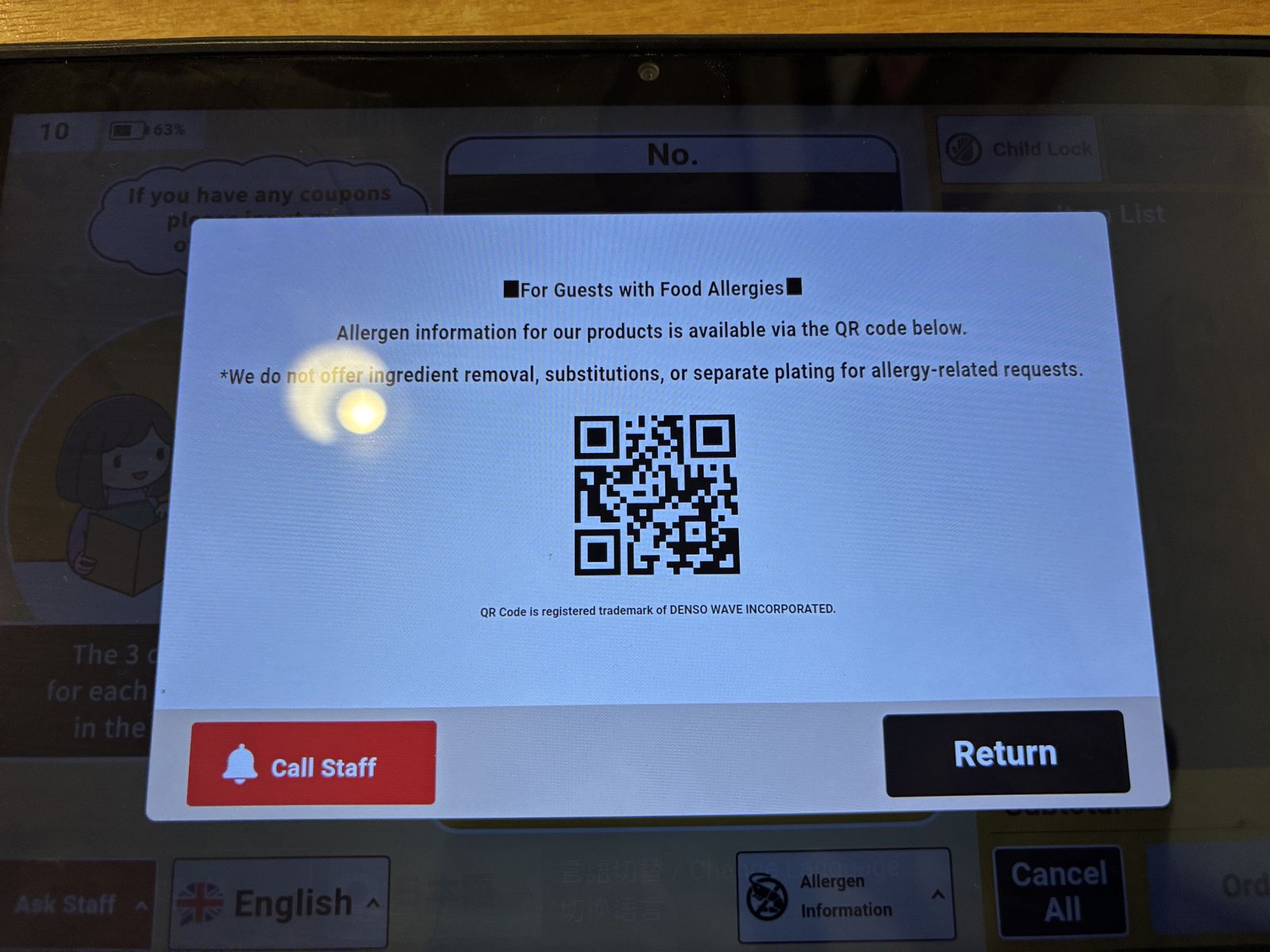
    If there is something you cannot eat, try showing the staff a card that lists it, including soup base ingredients, and asking them, as described in the “Allergy Card for Japan” article.

    JNTO writes that some chefs are also developing dishes without animal-derived ingredients as alternatives to ramen. If you ask with your card and find a bowl you can eat, that too can be a bowl to remember from your trip.

    For now, just this

    If you cannot decide, start with shoyu, shio, miso, or tonkotsu. Then look at the colors in the photos.

    「中華そば」 is also a name for ramen. Check the menu for the flavor.

    If the noodles and soup are in separate bowls, it is tsukemen.

    Buy your ticket first. For the buttons, see the “Restaurants with a Ticket Machine” article.

    You can leave a little soup or drink it all. If ordering 替玉, keep enough soup for the extra noodles.

    If there is something you cannot eat, ask with a card that includes the soup base.

    Official sources we checked (5)

    ・Japan National Tourism Organization (JNTO): Ramen (in English)

    ・Japan National Tourism Organization (JNTO): A Guide to Ramen in Japan (in English)

    ・Japan National Tourism Organization (JNTO): Vegetarian Guide (in English)

    ・Consumer Affairs Agency: Pamphlet for Consumers on Food Allergies (PDF, in Japanese)

    ・Consumer Affairs Agency: About Allergy Labeling (PDF, in Japanese)

  • How to Eat Tonkatsu — The Cabbage Comes First, So Have a Plate While You Wait

    You order a tonkatsu set meal, settle into your seat, and sometimes a mountain of shredded cabbage and a little bowl of pickles (お新香, oshinko) show up first. The cutlet comes after that, once it’s done frying.

    Tonkatsu (とんかつ) is a breaded, deep-fried pork cutlet: pork coated in panko breadcrumbs and fried in oil. It’s often ordered as a “とんかつ定食” (tonkatsu teishoku, a pork cutlet set meal), which comes with rice, soup, cabbage and pickles.

    If you don’t eat pork, take a look at the “Allergy Card for Japan” article too.

    There are four things to keep in mind.

    ・The cabbage may come first. Dig into your first plate while you wait for the cutlet

    ・When the cutlet arrives, add sesame to the sauce

    ・If there’s 練り辛子 (neri-karashi), try a little

    ・At places with refills, have one more round of rice and cabbage

    Tonkatsu mainly comes in two cuts, depending on which part of the pig it’s from: “ロース” (rosu, loin) and “ヒレ” (hire, tenderloin). Rosu has some fat and is rich; hire is lean and tender. The set meal in this article’s photos is a rosu katsu set meal.

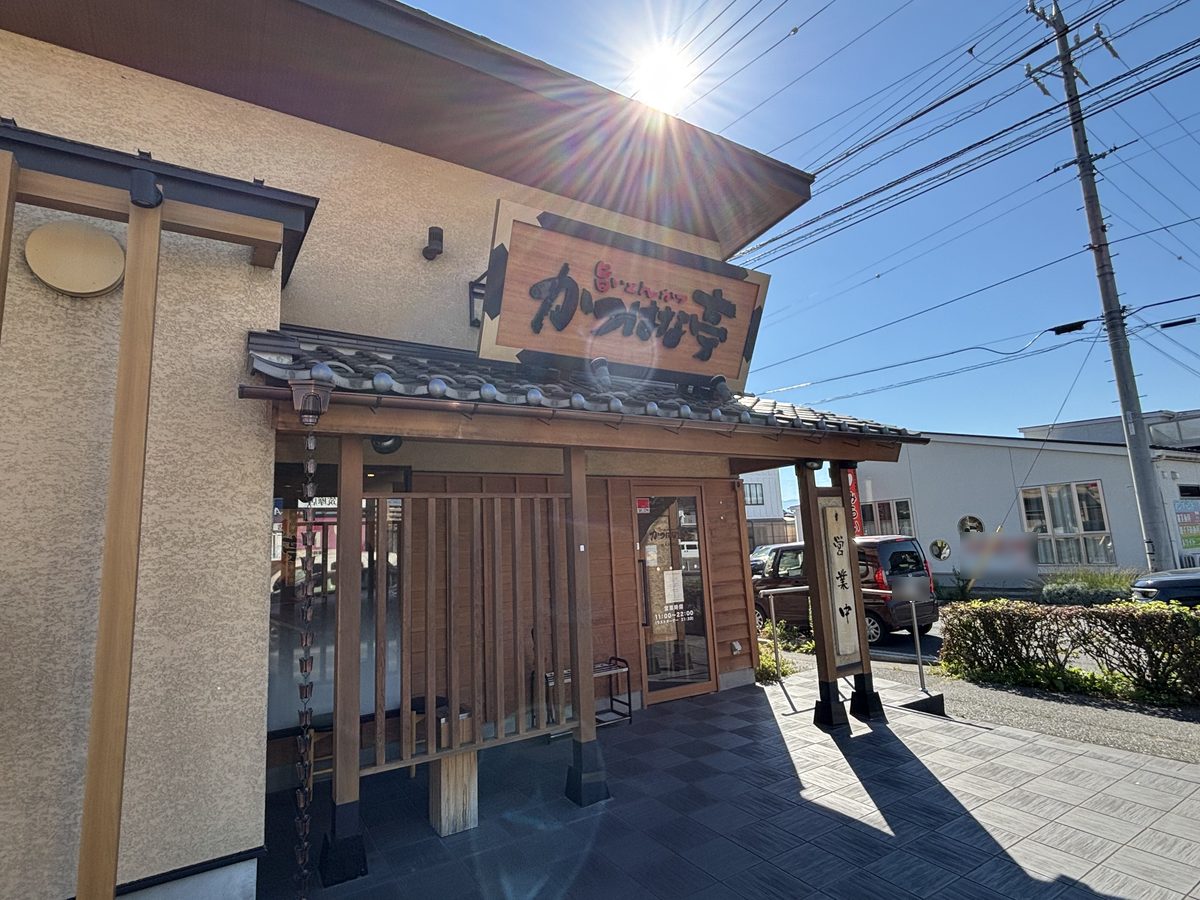
    Exterior and entrance of a tonkatsu restaurant

    1 First Up, the Cabbage — Have a Plate While You Wait

    While you wait, go ahead and polish off a plate of cabbage. The time it takes the cutlet to fry simply becomes cabbage time.

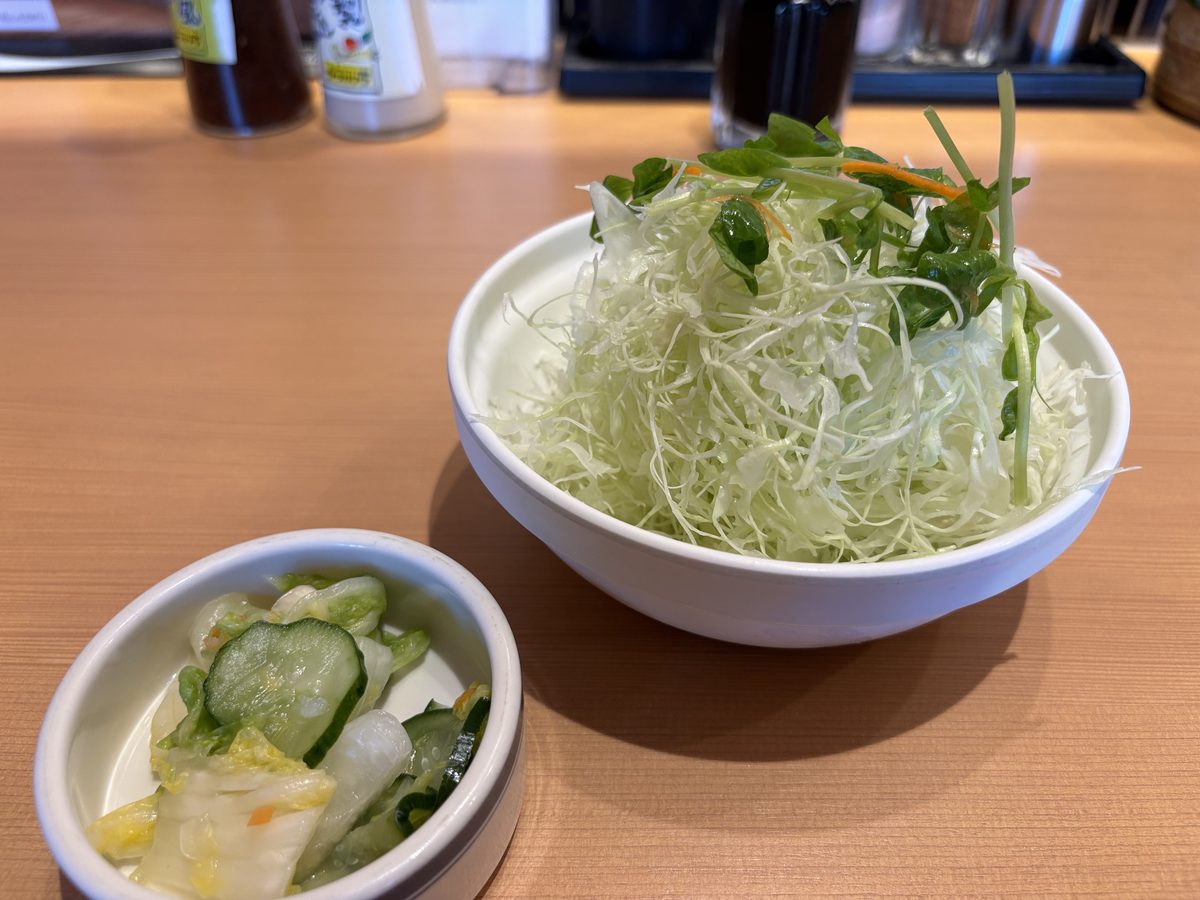
    A big bowl of shredded cabbage and pickles served first

    At Katsuhanatei (かつはな亭) in Matsumoto, the cabbage and oshinko came out first. Before my rosu katsu set meal even arrived, I’d already eaten a whole plate of cabbage

    Pour the dressing from the table over the cabbage. If there are two kinds of dressing, use the other one on your second plate. Same cabbage, two flavors. Tonkatsu sauce on the cabbage is good too, so give it a try.

    Two bottles of dressing on the table

    2 When the Cutlet Arrives — Add Sesame to the Sauce

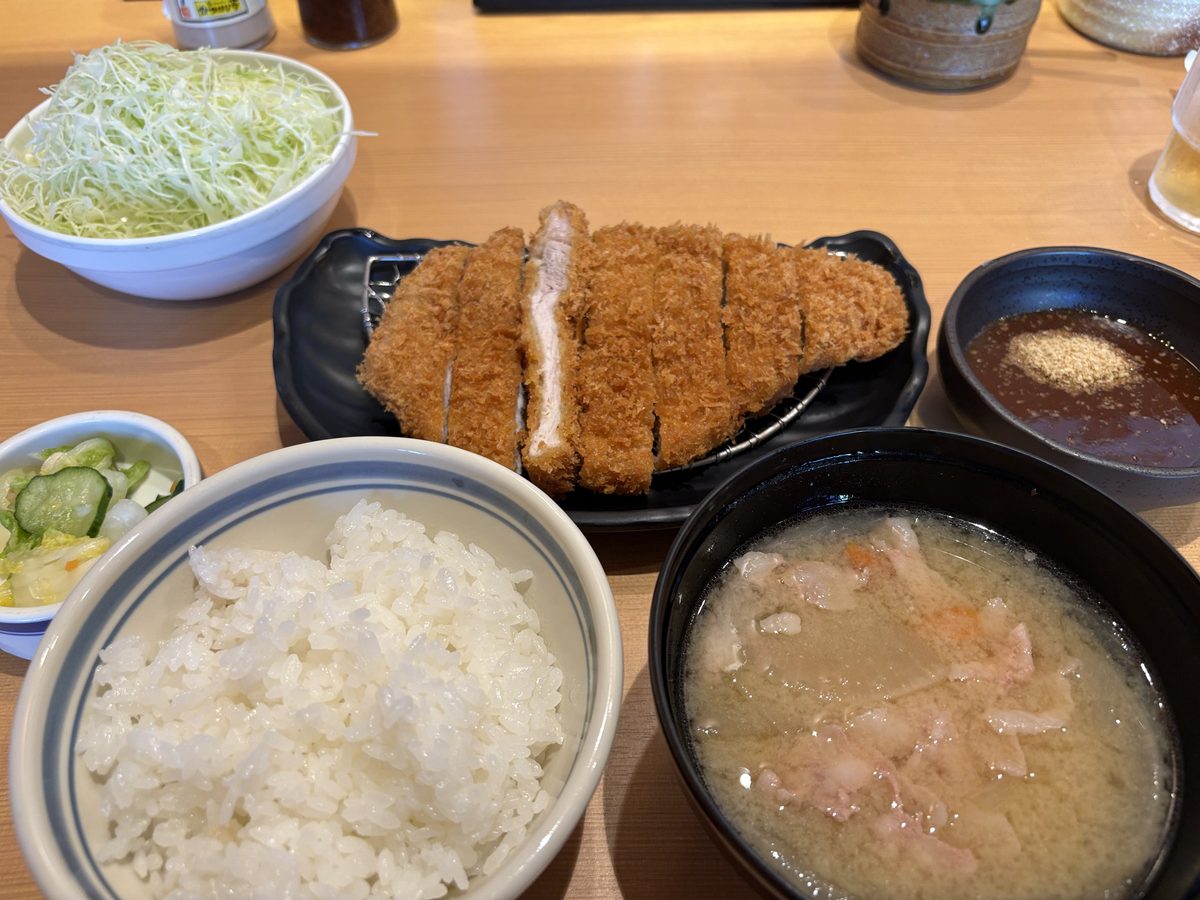
    Once the cutlet arrives, your set meal is complete. Sliced cutlet, rice, soup, cabbage and oshinko. At Katsuhanatei, the soup was 豚汁 (tonjiru, miso soup with pork and vegetables).

    Bite into a freshly fried cutlet and the coating goes crunch, then the sweetness of the pork and the rich flavor of the fat spread through your mouth. That’s the real treat of tonkatsu.

    A full tonkatsu set meal: cutlet, rice, pork miso soup, cabbage, pickles and sauce

    You eat the cutlet dipped in sauce. Add sesame to that sauce, and it brings out more flavor.

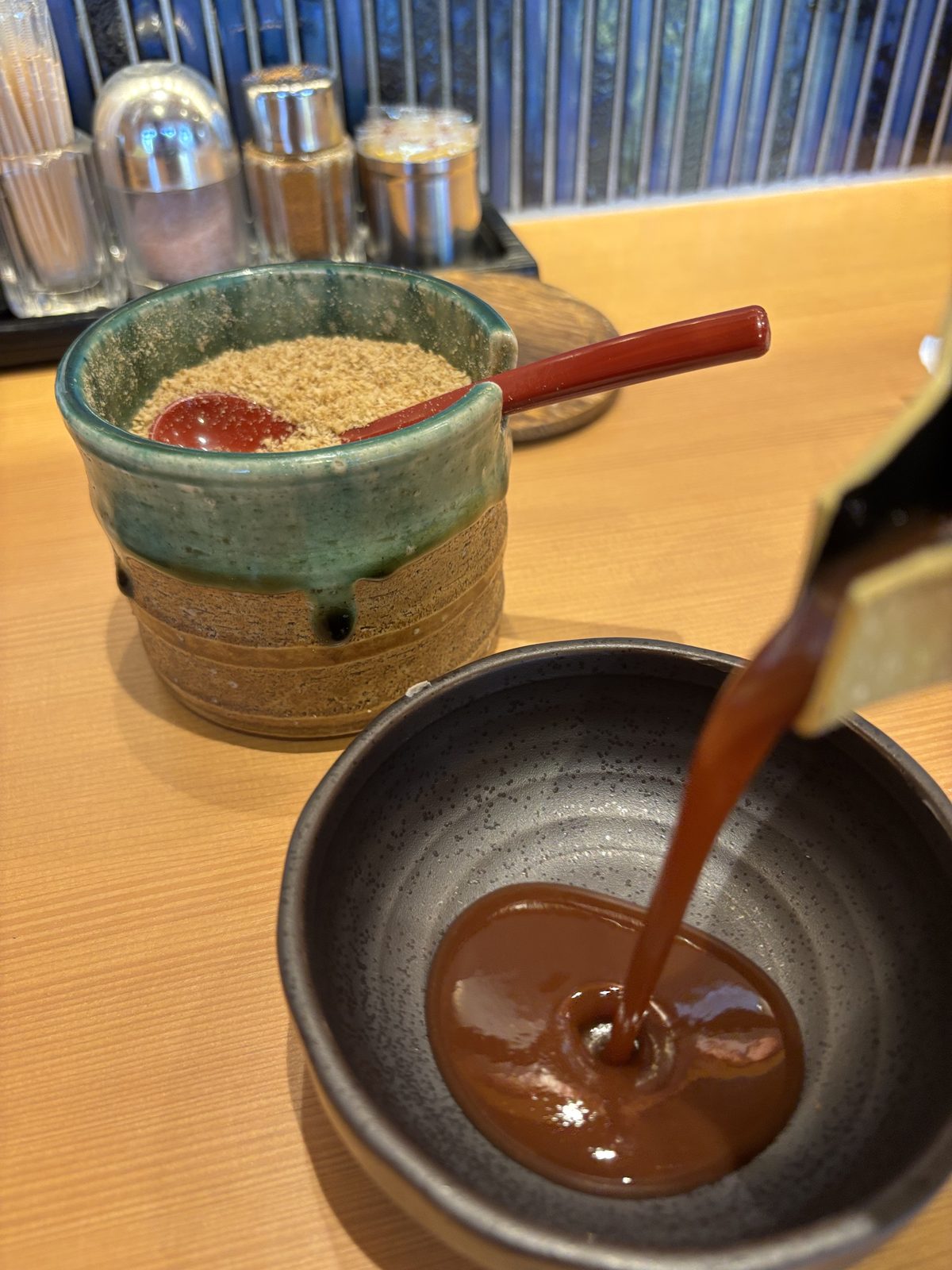
    How the sesame is served depends on the place. Some places have you grind the sesame yourself in a すり鉢 (suribachi, a grinding bowl) and add it, while others set out sesame that’s already ground (すりごま, ground sesame). If you get to grind it yourself, that’s one more thing to enjoy.

    Ground sesame pot and sauce being poured into a small bowl

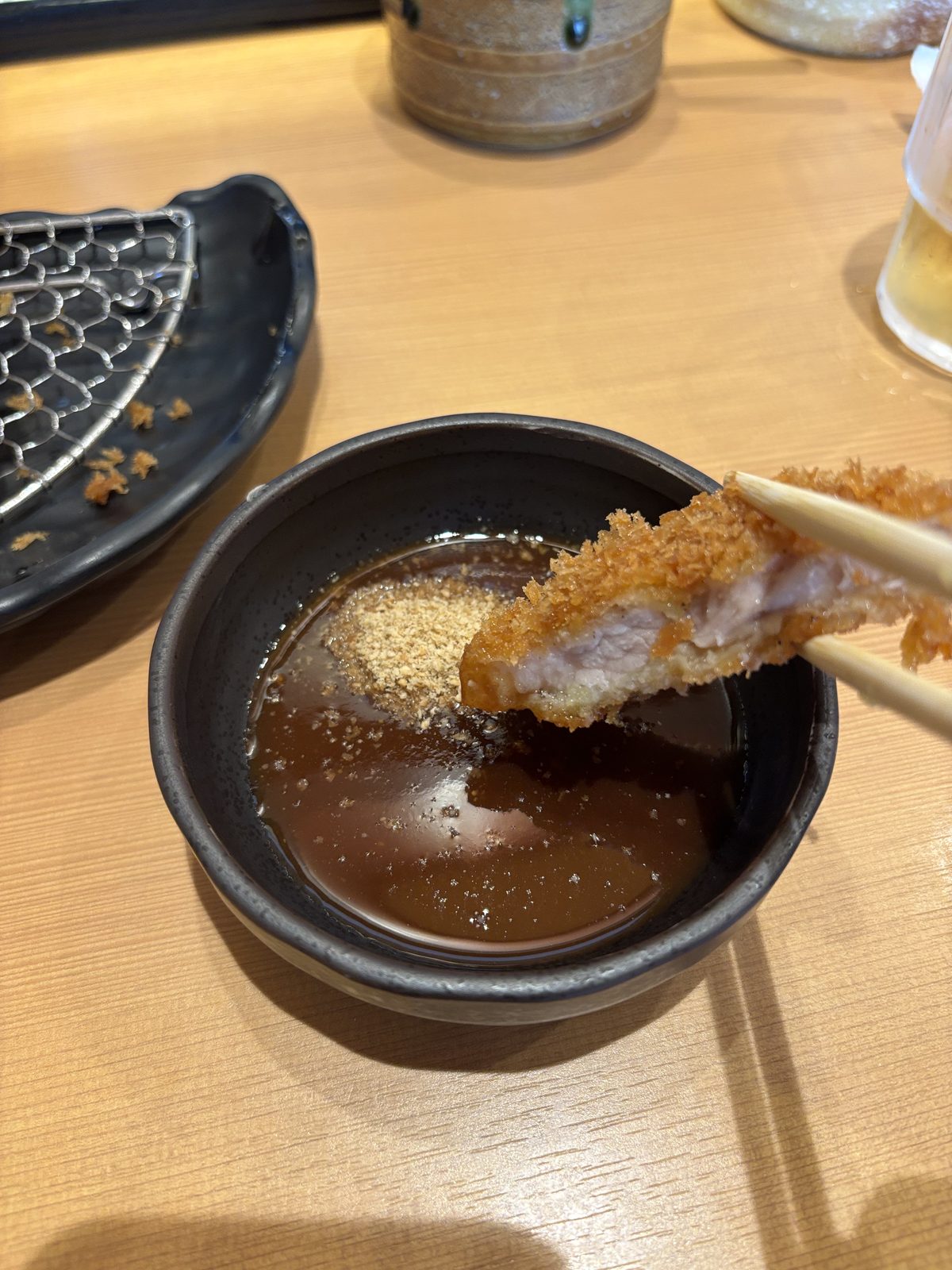
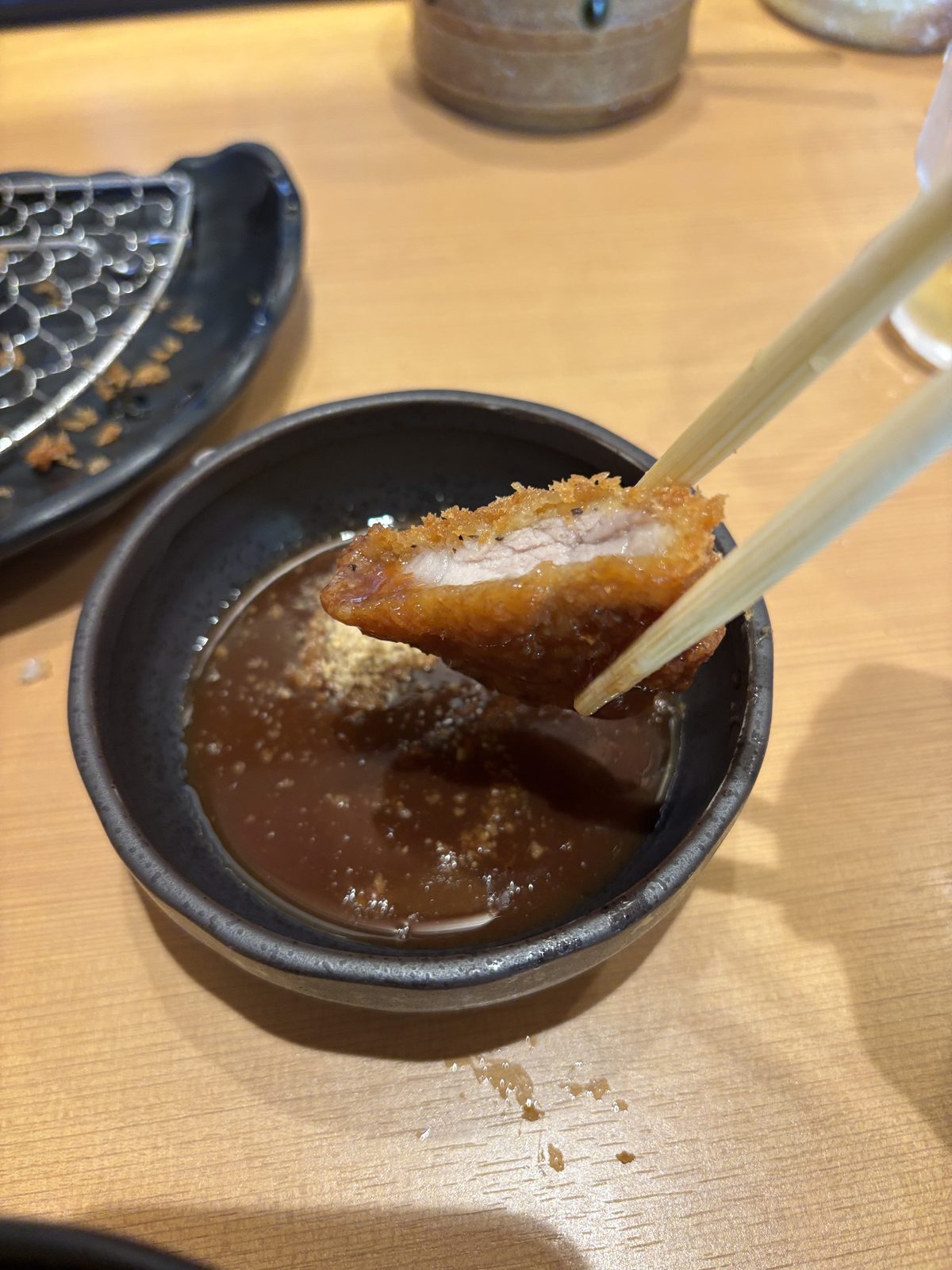
    Dip as much as you like. Just a little, or plenty. Piece by piece, find the way you like it best.

    A piece of tonkatsu before dipping in the sauce
    A piece of tonkatsu after dipping in the sauce

    3 A Little 練り辛子 — Japanese-Style Mustard

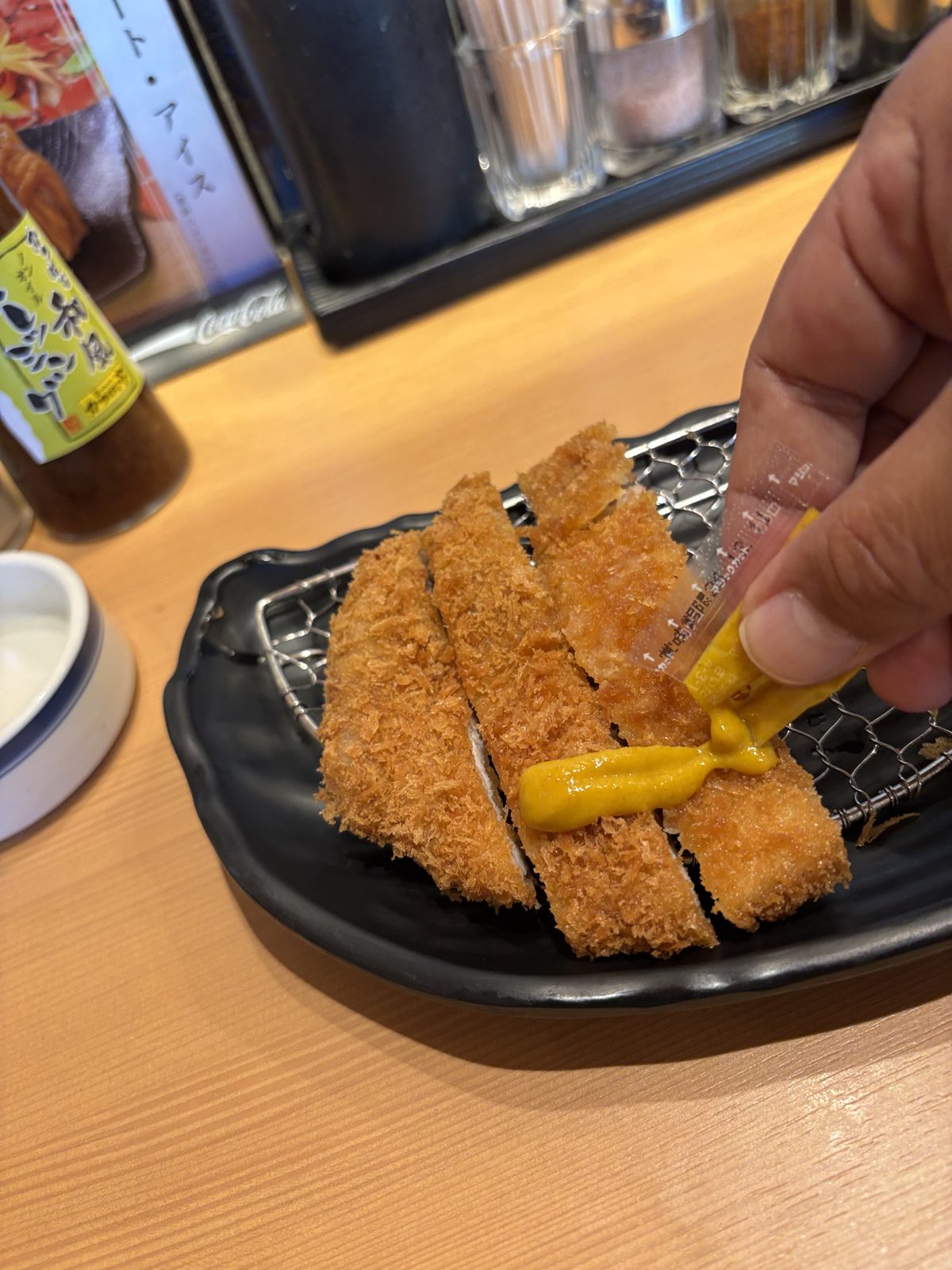
    If there’s 練り辛子 on the table, go for it. 練り辛子 is Japanese-style mustard, and it’s perfect with tonkatsu. It has a distinctive kick that shoots right up your nose, so start with just a little.

    Squeezing Japanese mustard from a small packet onto the tonkatsu

    Some places also have rock salt (岩塩) or tonkatsu soy sauce (とんかつ醤油) on the table. If they do, try a bite with each. Each one tastes different from the sauce. Trying 味変 (ajihen: changing the flavor partway through a meal) and finding your own favorite way to eat it is fun in itself.

    4 At Places with Refills — One More Round

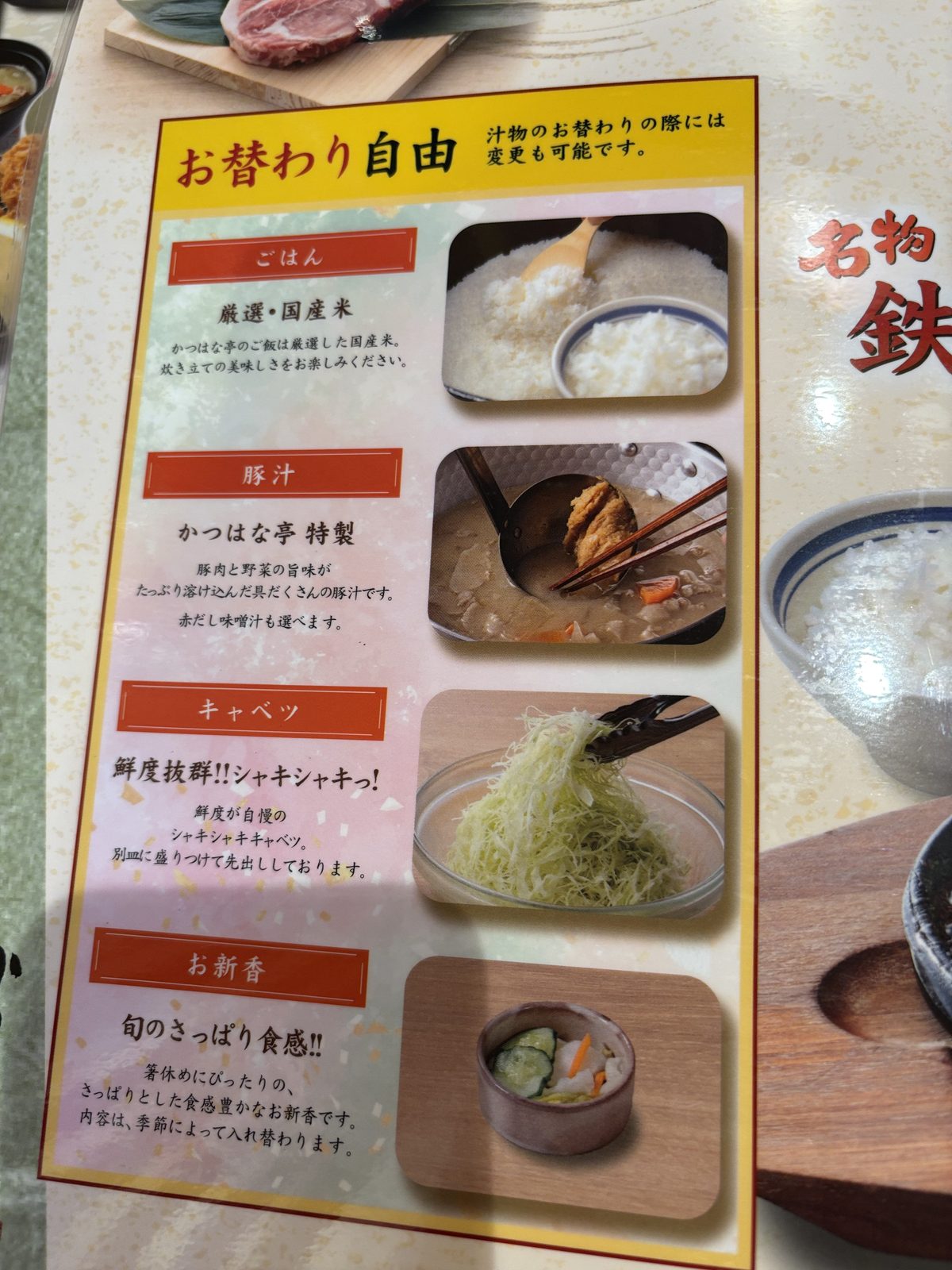
    Some places let you have more rice and cabbage. At Katsuhanatei, for example, refills of rice, tonjiru, cabbage and oshinko are free.

    Wako (和幸) and Saboten (さぼてん) are chains famous for delicious tonkatsu. If you spot one of their signs on your travels, why not pop in? Wako generally offers refills of rice and cabbage. That said, what’s offered differs from place to place, so check the menu or signs where you are and look for the characters “おかわり自由,” “お替わり自由” or “お替り自由” (refills allowed).

    Menu panel showing free refills of rice, pork miso soup, cabbage and pickles

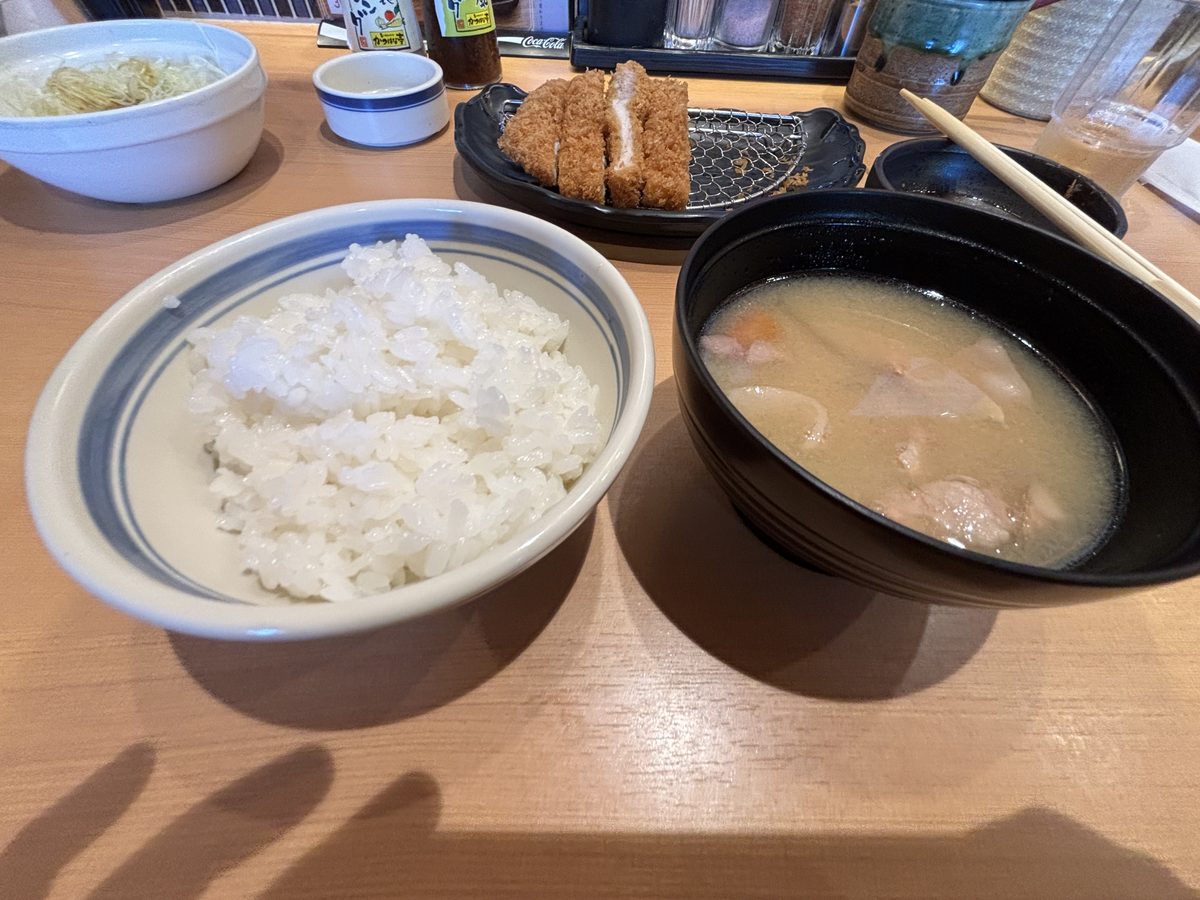
    One more plate of cabbage, one more bowl of rice. At places with refills, you can keep going until you’re full.

    Refilled rice and pork miso soup

    At this place, the miso soup was — get this — tonjiru! I had more rice, tonjiru and cabbage, and walked out completely full

    How to order and pay is covered in the “Teishoku Restaurants and Donburi (Gyudon) Shops” article. If there’s a ticket machine at the entrance, take a look at the “Restaurants with a Ticket Machine” article too.

    For now, just this

    If the cabbage comes first, have your first plate while you wait for the cutlet.

    If there are two kinds of dressing, give your second plate the other flavor.

    Eat the cutlet with sesame added to the sauce. Dip as much as you like.

    If there’s 練り辛子, try a little.

    If there’s rock salt or tonkatsu soy sauce, try a bite of each and find your favorite way to eat it.

    To see whether you can get refills, look for the characters “おかわり自由” on the menu.

    Official sources we checked (6)

    ・RDC Group: Katsuhanatei (in Japanese)

    ・Wako Group: Hospitality with Flavor and Heart (in Japanese)

    ・Wako Group: Katsu Kobo Wako (in Japanese)

    ・Tonkatsu Shinjuku Saboten: Haoju Saboten (in Japanese)

    ・Tonkatsu Shinjuku Saboten: Ebisu Katsusai (in Japanese)

    ・Tonkatsu Shinjuku Saboten: Sakaechika Store (in Japanese)

  • Banya no Sushi (番やのすし), Conveyor-Belt Sushi in Toyama | A 2.5-Hour Drive for Fish from the Sea of Japan

    番やのすし (Banya no Sushi) is a local conveyor-belt sushi chain with 4 restaurants, all in Toyama Prefecture. The fish arrives every day from ports on Toyama Bay, and the sushi chef (板前さん, itamae-san) right in front of you makes your sushi by hand.

    And that’s where our family goes once a month, driving 2.5 hours each way from landlocked Nagano.

    We live in Nagano, a prefecture with no sea, so our family is starving for good fish. Lately we’re totally hooked on sashimi from Hokuriku (on the Sea of Japan coast) (The writer lives in Nagano Prefecture and loves soba.)

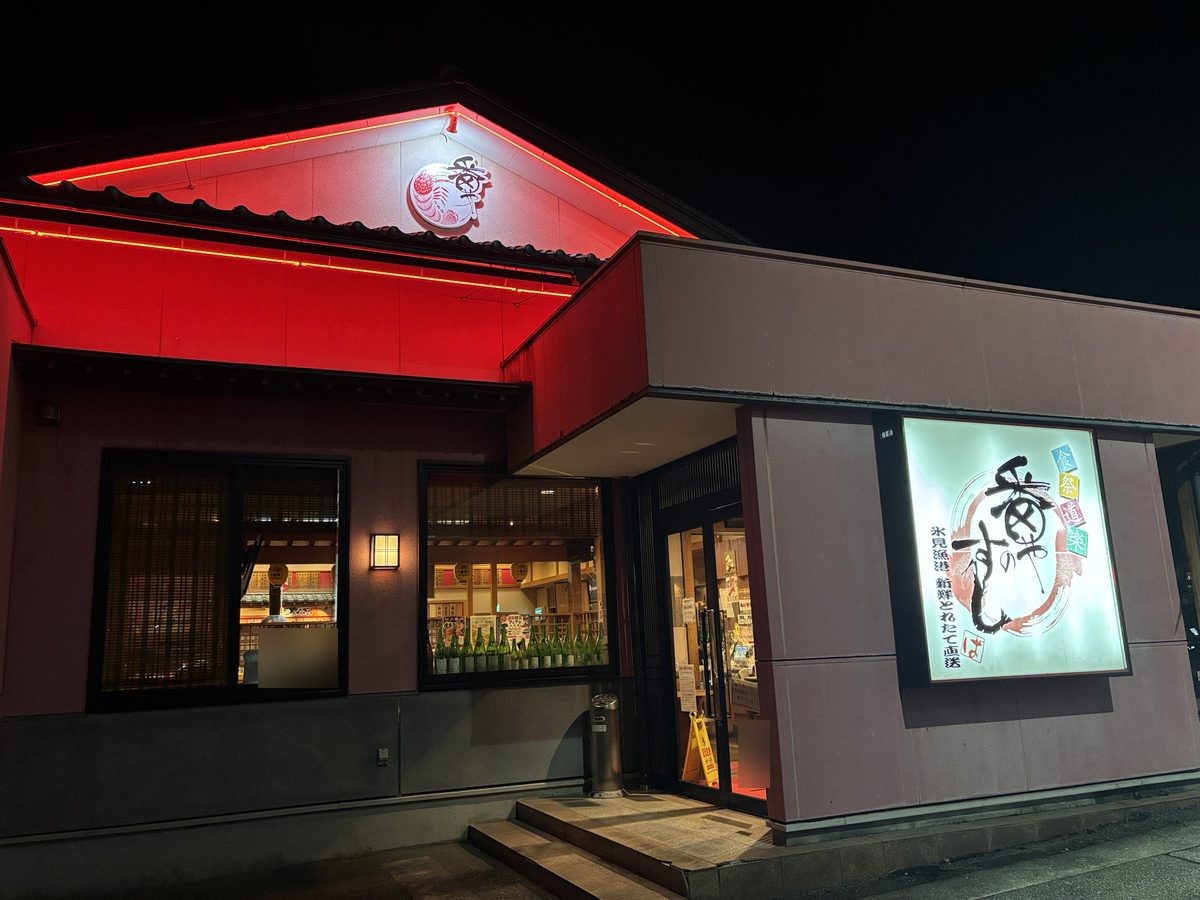
    Our destination: the 大沢野店 (Osawano branch) in Toyama City. It has a parking lot, so it’s easy to get to by car. The sign out front reads “番やのすし.” You can find where each restaurant is on the store page of the official website.

    Banya no Sushi at night: the entrance and sign

    1 Once You’re Seated — Make Your Own Tea

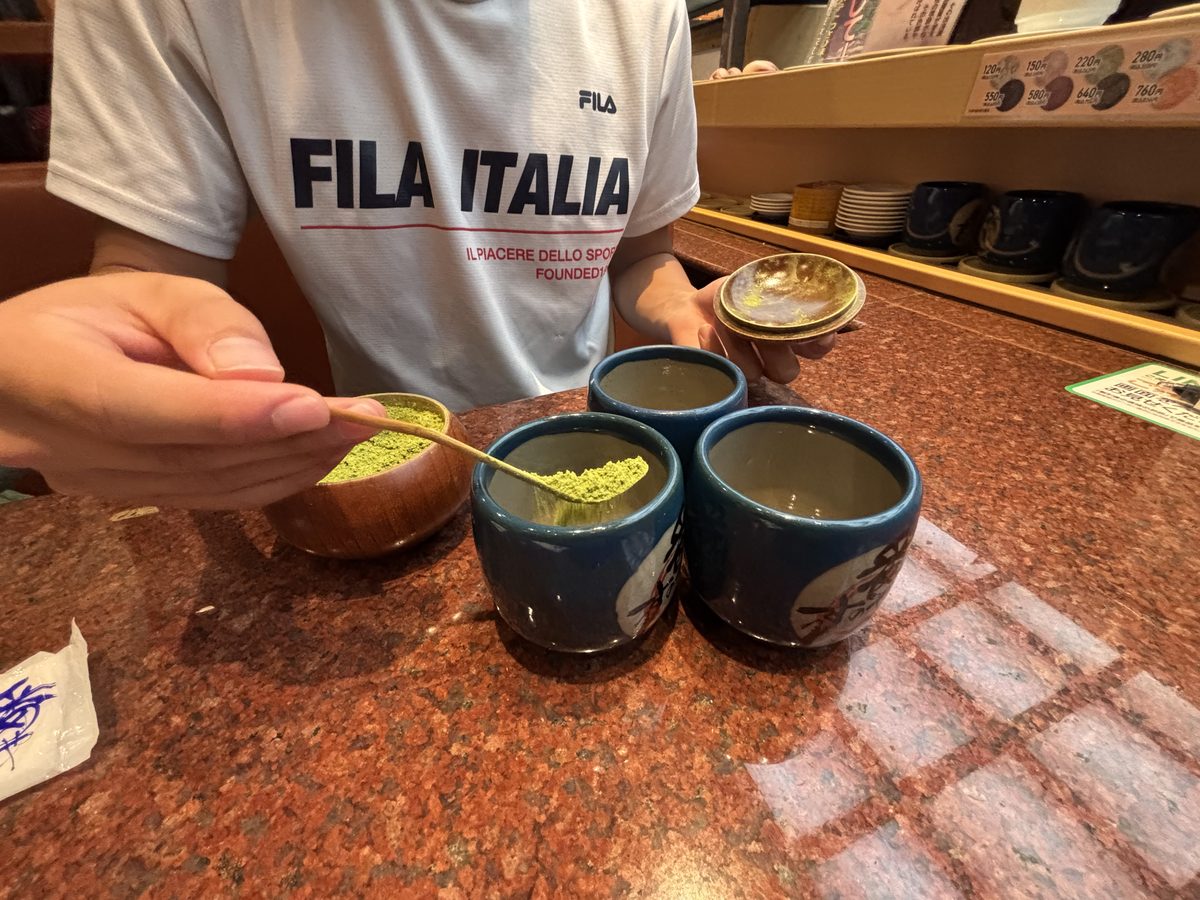
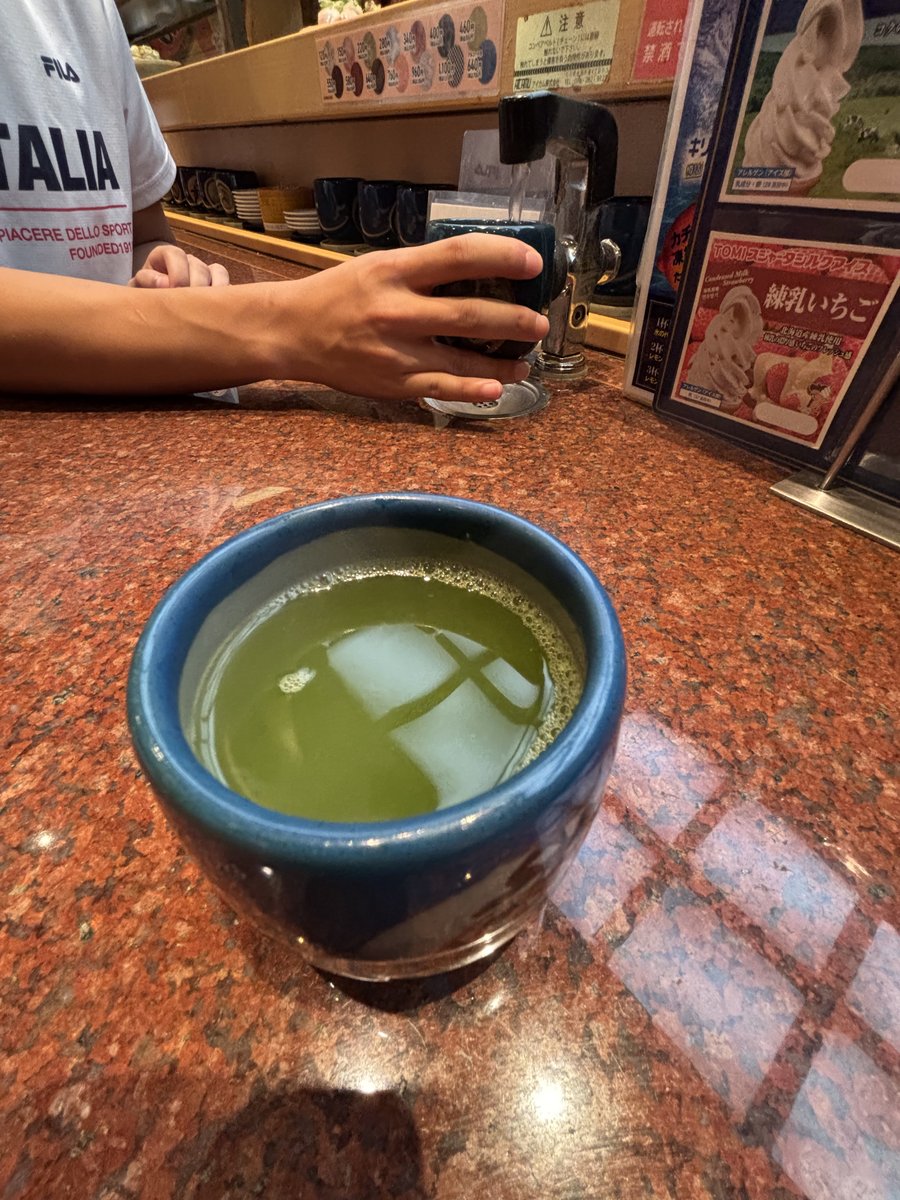
    Tea is self-service. Put powdered green tea in a teacup, then pour in hot water from the tap at the counter.

    Putting powdered green tea into a cup
    The green tea, ready after adding hot water

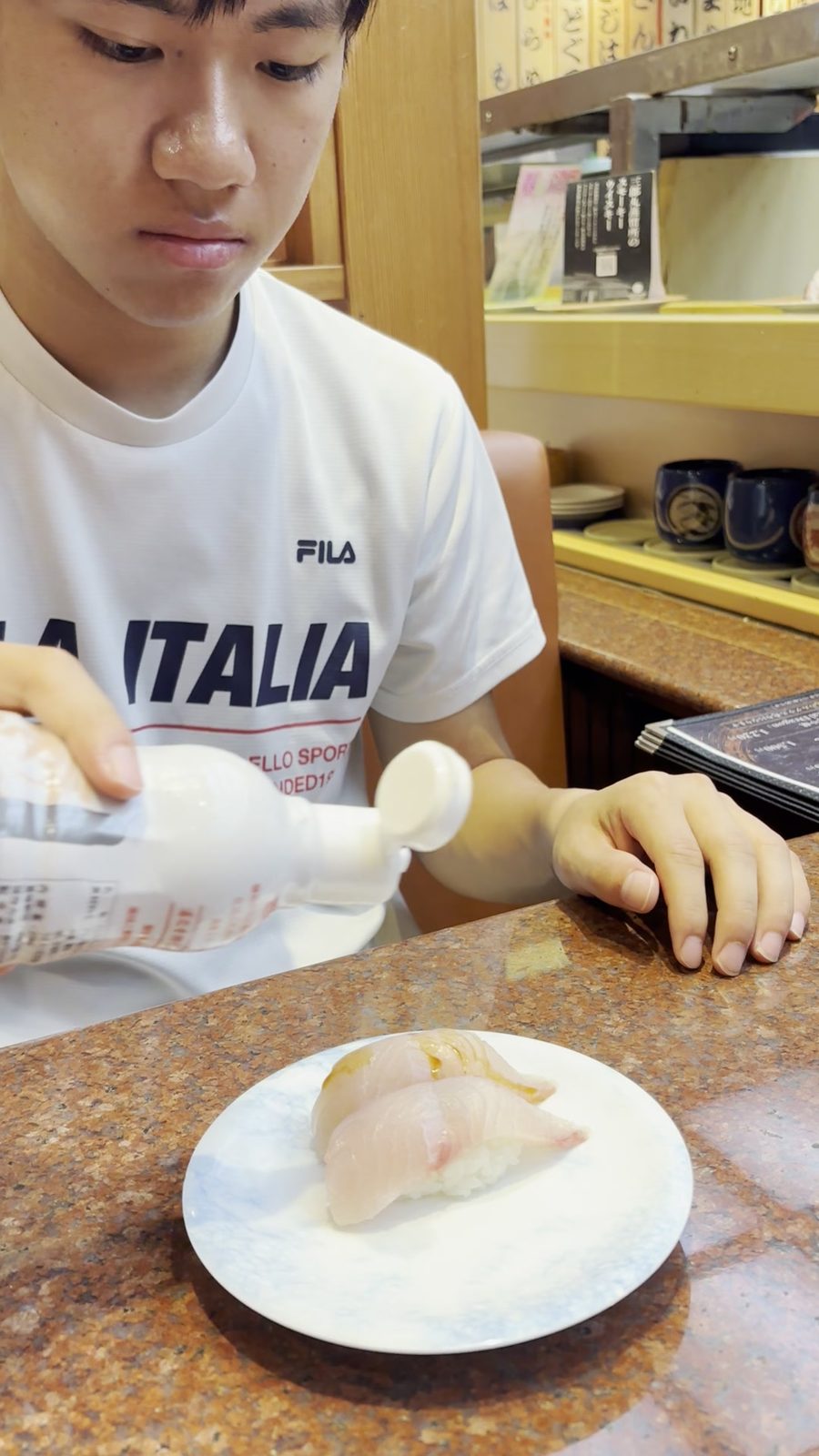
    The soy sauce bottle lets you drip it out one drop at a time. That way you don’t overdo it, which we found reassuring.

    For how to eat sushi, see our Conveyor-Belt Sushi article.

    2 Order from the Sushi Chef

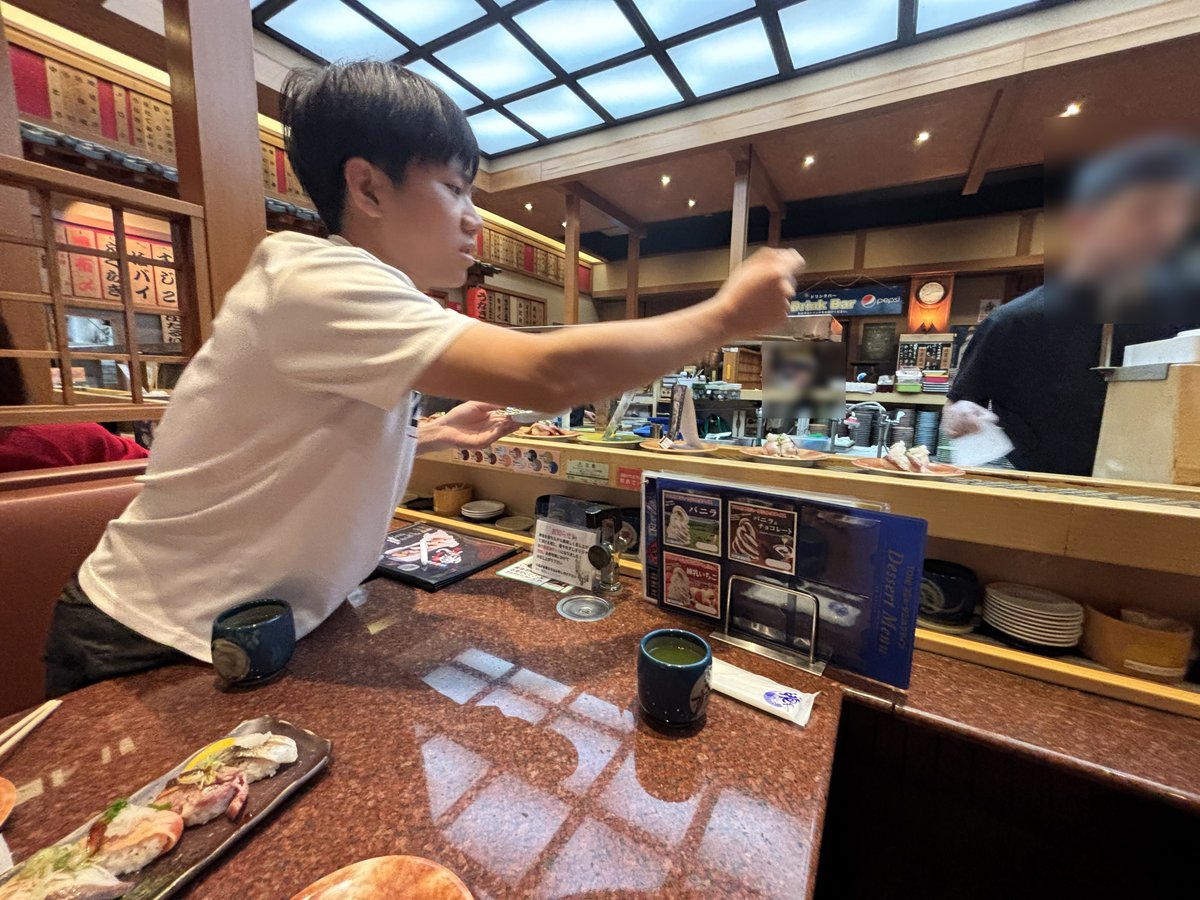
    Across the lane, the sushi chefs are making sushi. Whatever you want to eat, you ask them for it. The restaurant’s own guidance says, “Feel free to ask our staff.” Just saying it out loud works fine.

    Reaching for a plate on the lane, with a sushi chef working behind it

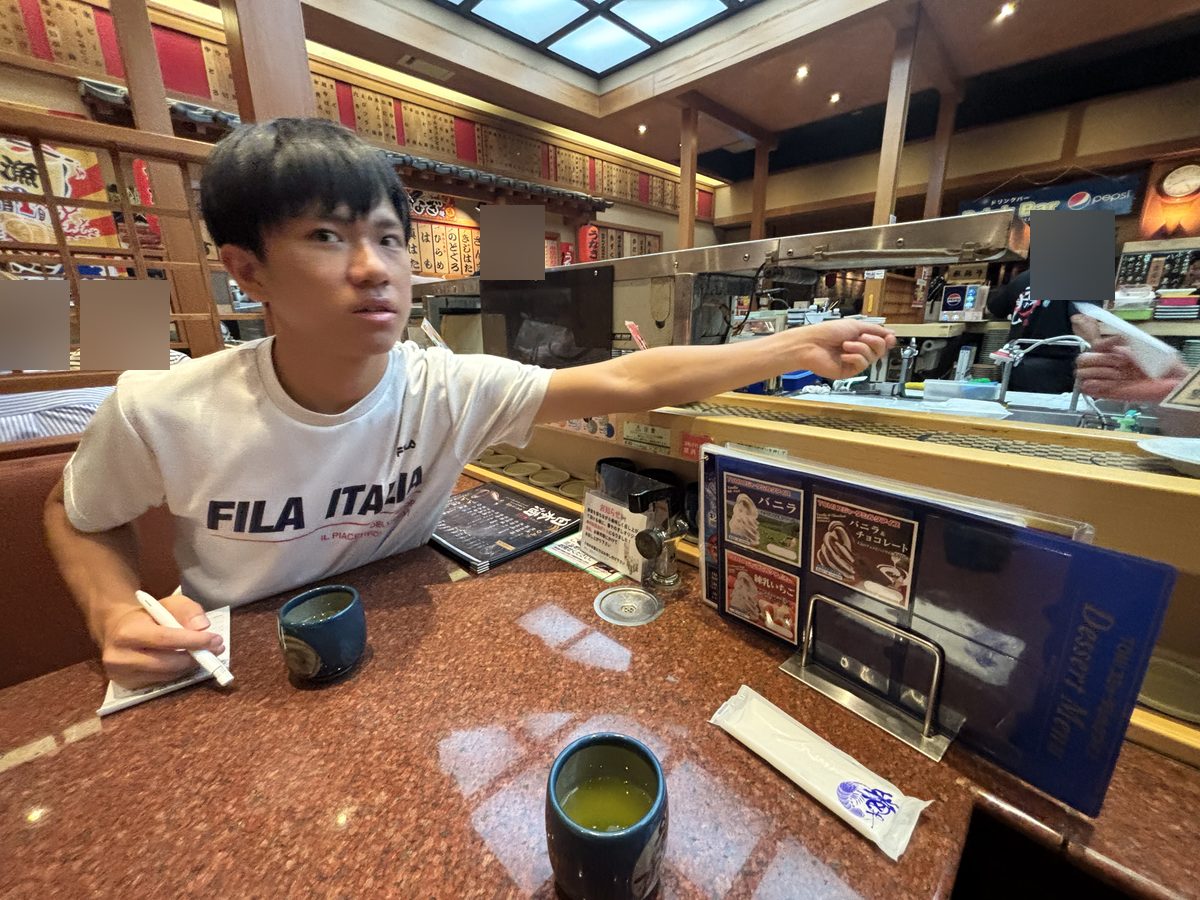
    On the day we went, we looked at the menu, wrote what we wanted on a piece of paper, and handed it to the chef. If it’s hard to say out loud, this makes things easy.

    Handing a written order slip to the chef
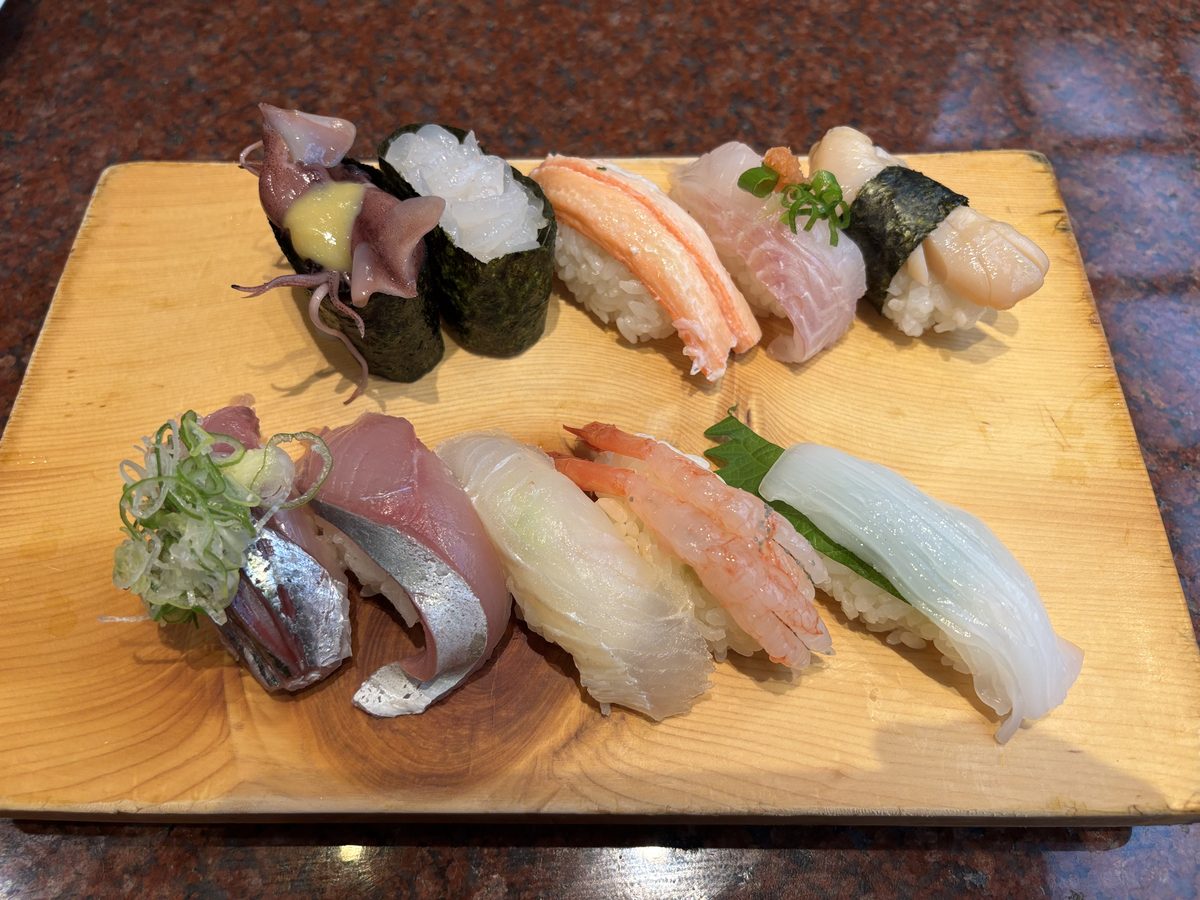
    Five-piece nigiri sushi platter
    Pouring soy sauce for sushi

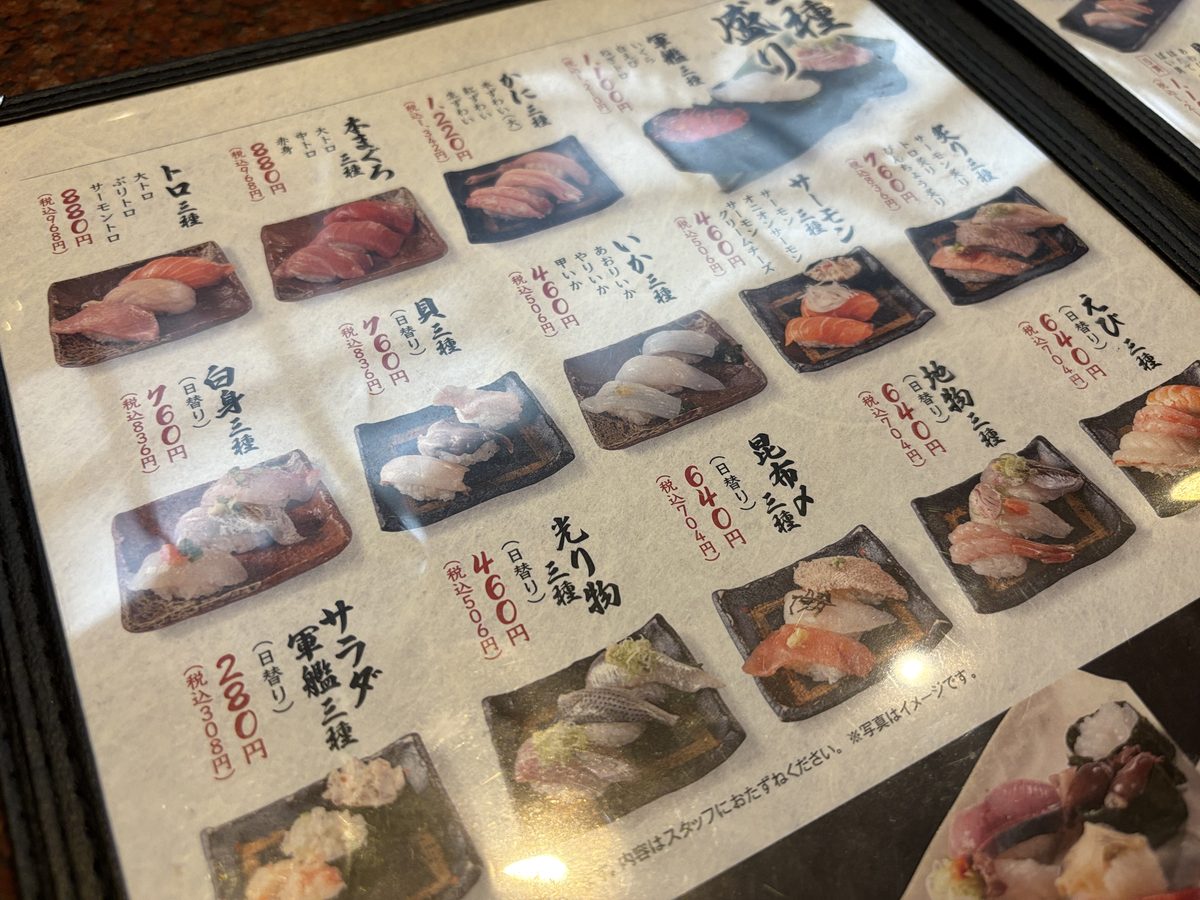
    The menu we saw was in Japanese. If you can’t read it, another option is to point at a set on the menu, or at the sushi going around on the lane.

    Japanese menu page of three-piece sushi sets

    If you can’t figure out the menu, it’s totally fine to just order a set that looks tasty. A set packed with their recommendations? You can’t go wrong. Even Japanese people get the recommended set when they can’t decide

    As a rough guide to sets, the most affordable one, the “桜セット” (Sakura Set), is ¥1,375. Until 15:00, there’s also lunch starting at ¥605 (both prices include tax; official menu, October 2026). You can also ask for “ワサビ抜き” (wasabi-nuki, no wasabi) or “シャリ小さめ” (shari chiisame, less rice).

    Ten-piece nigiri sushi set

    Plates on the lane are priced by their color and pattern. At the restaurant that day, a plate cost ¥120 to ¥1,100 (¥132 to ¥1,210 including tax; as of October 2026).

    3 Fish from the Sea of Japan — It Changes with the Seasons

    Banya no Sushi’s fish arrives every day, mainly from 氷見漁港 (Himi Port) and 新湊漁港 (Shinminato Port) on Toyama Bay.

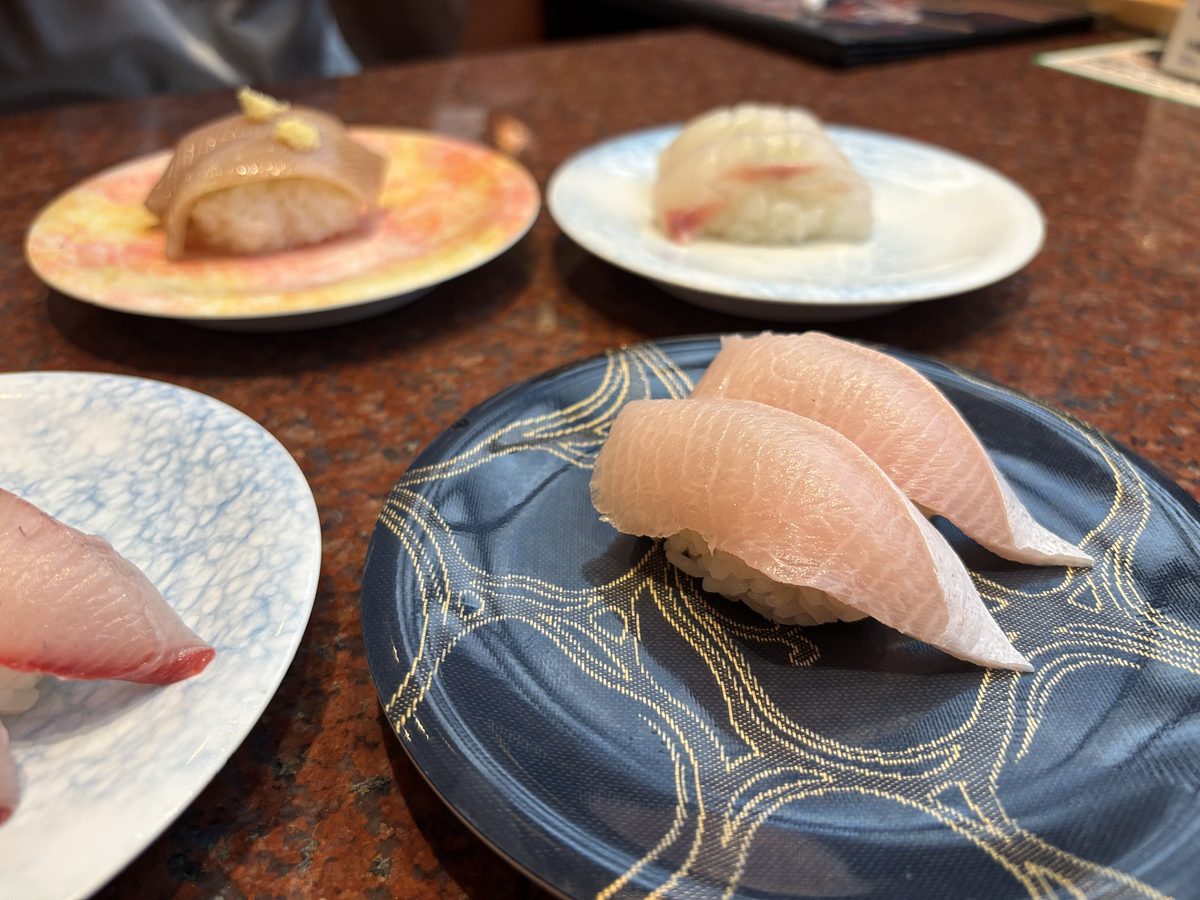
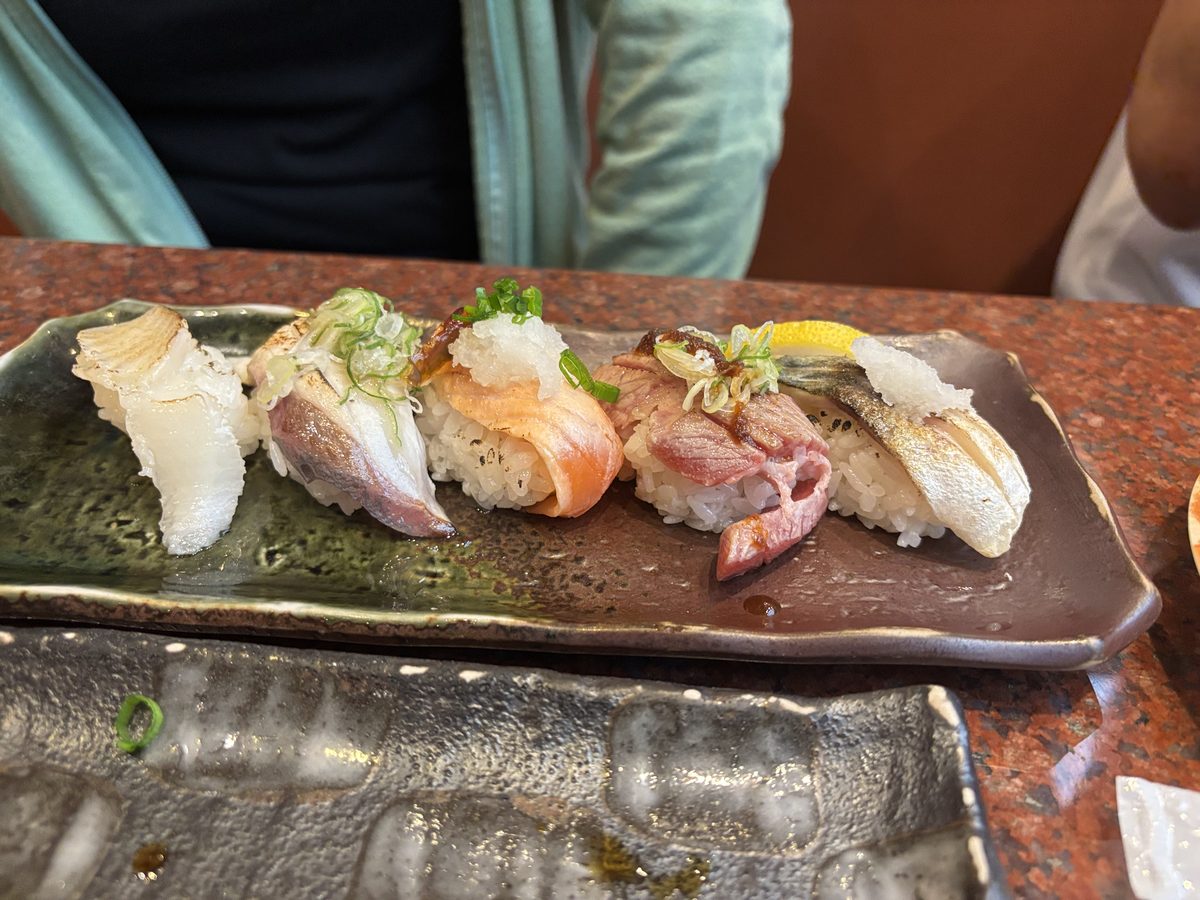
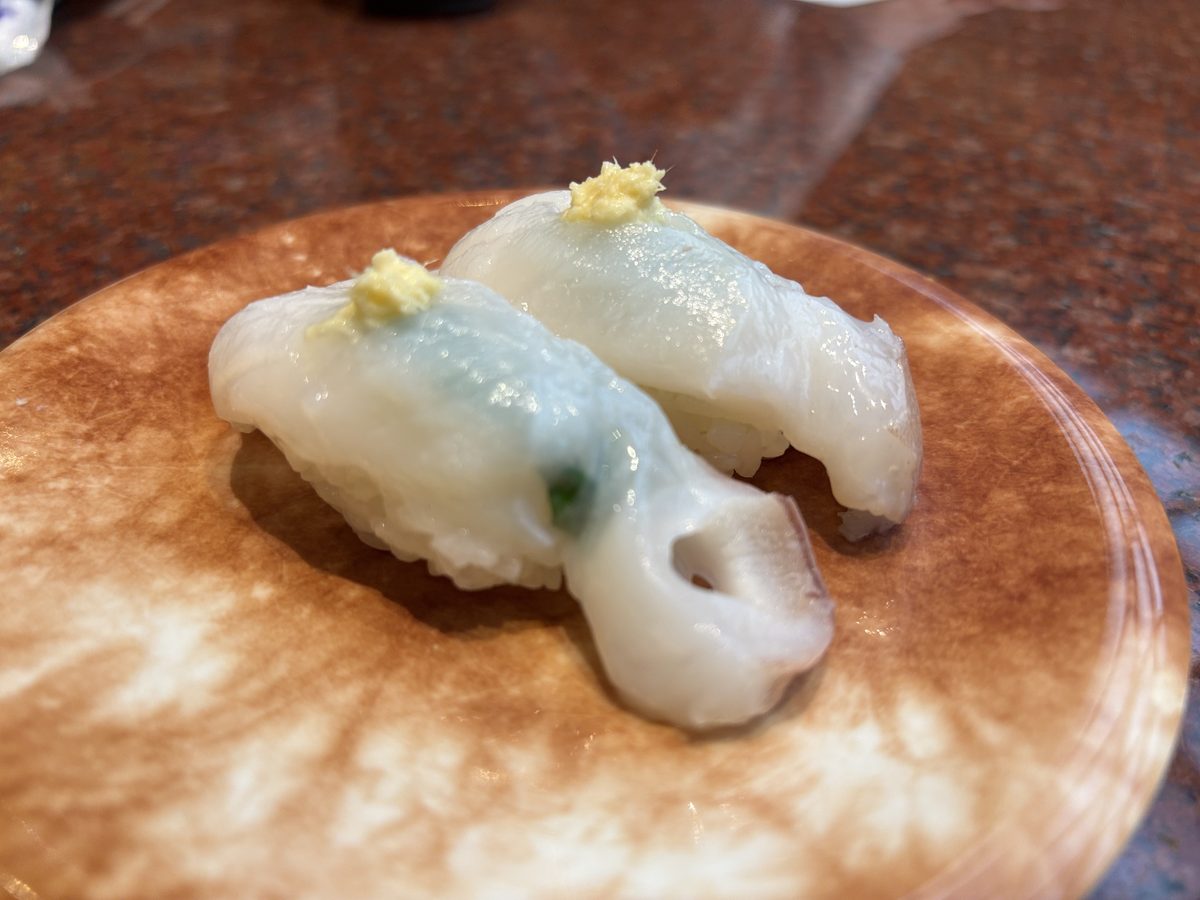
    In Toyama and Ishikawa, you can’t skip seared のどぐろ (nodoguro, blackthroat seaperch). Tuna’s great, of course, but in Hokuriku every fish is just bursting with flavor. Horse mackerel, sea bream, bonito, squid. And yellowtail. That day, the yellowtail and bonito were especially good! My son had yellowtail 3 times, and I had bonito 3 times (lol) My wife loves conger eel and freshwater eel. That day she had something unusual: straw-grilled eel. And her favorite, conger eel, she ordered 2 times (lol)

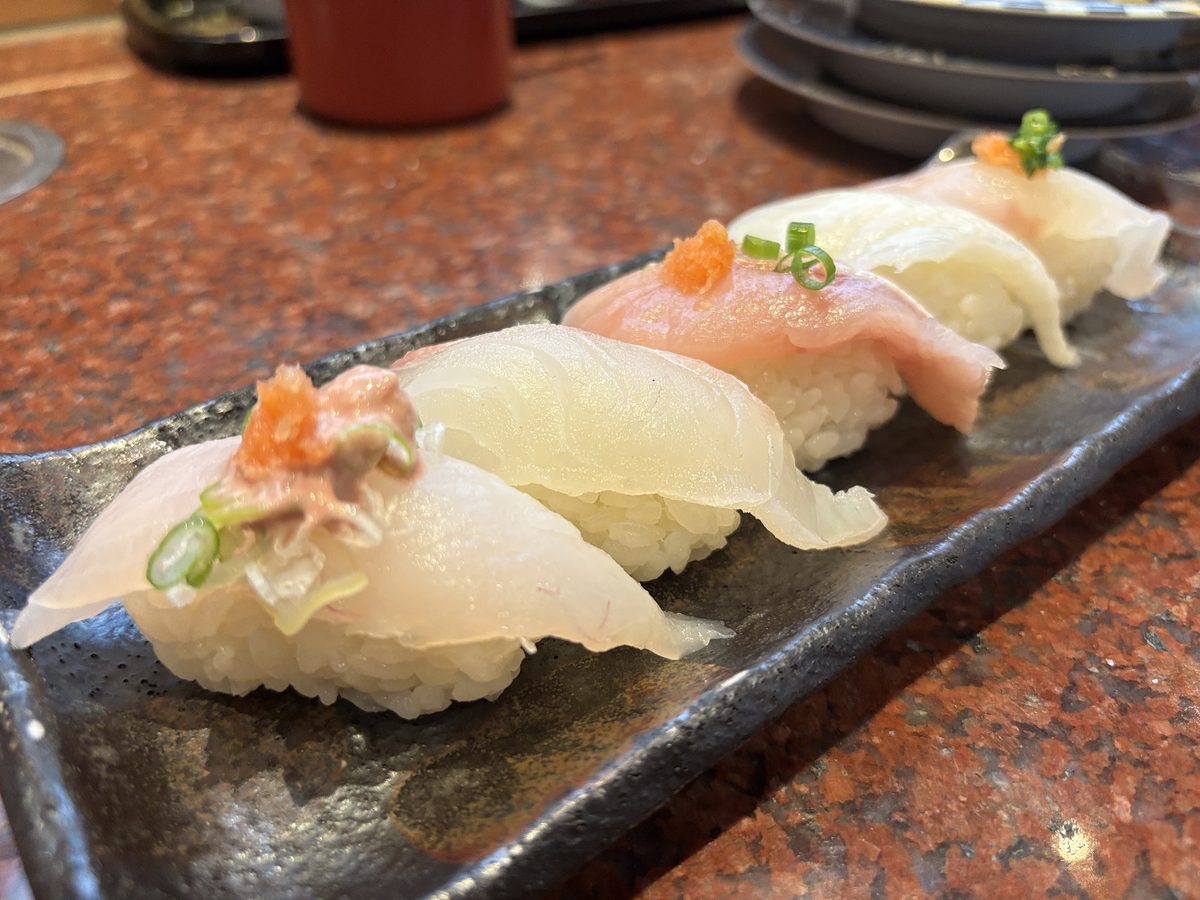
    Yellowtail nigiri on a navy-and-gold plate
    Five pieces of seared nigiri
    Two pieces of squid nigiri

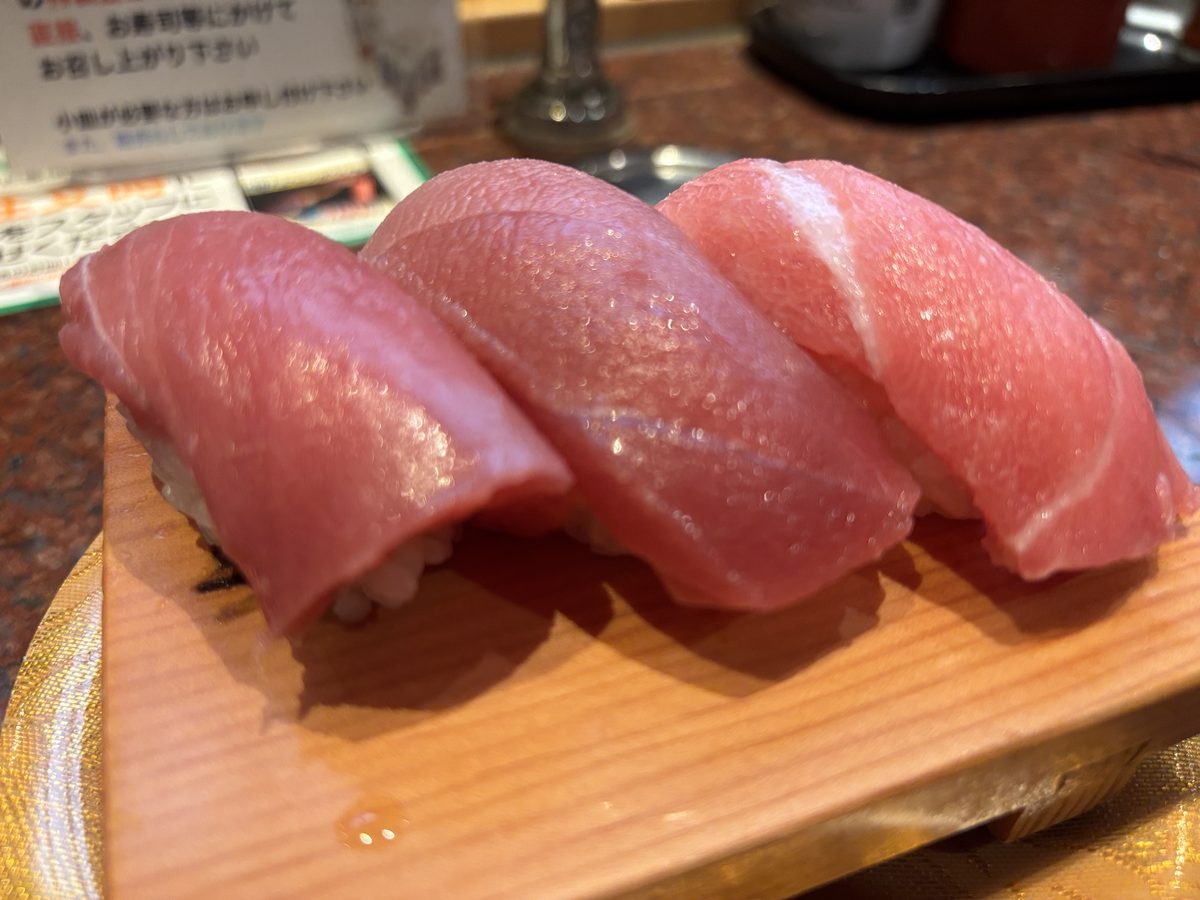
    We also ordered tuna and horse mackerel.

    Three pieces of tuna nigiri
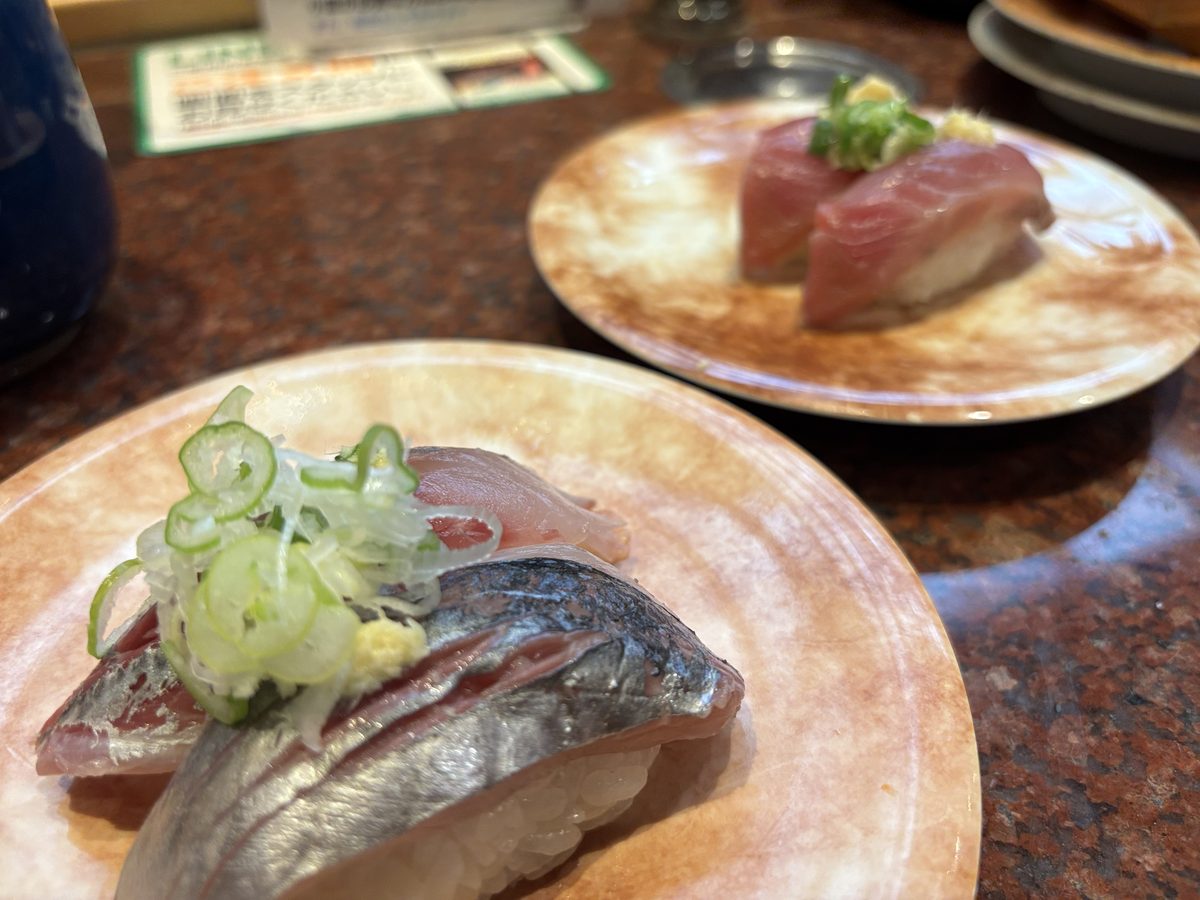
    Horse mackerel (aji) nigiri topped with green onion and ginger

    Each season has its stars, too. In winter, it’s “ひみ寒ぶり” (Himi kan-buri): big, fatty yellowtail landed at Himi from around late November to February. In spring, it’s ホタルイカ (hotaru-ika, firefly squid; around March to May). 白えび (shiro-ebi, white shrimp), called “the jewel of Toyama Bay,” is another spring catch the restaurant lists.

    That day, we also ordered あら汁 (ara-jiru). It’s a miso soup with fish ara (the head and the parts around the bones) in it.

    Miso soup with fish trimmings (ara-jiru)

    We stacked our plates on the table as we ate. Then, at the end, it was time to pay.

    Stack of empty sushi plates

    Handy for Times Like These

    For local fish in Toyama, without any fuss. Banya no Sushi has 4 restaurants in Toyama Prefecture: 大沢野店 (Osawano branch), 古沢店 (Furusawa branch), 小杉店 (Kosugi branch) and 高岡野村店 (Takaoka Nomura branch). They’re open 11:00–15:00 and 17:00–21:00, and each restaurant closes on different days, so check the official website before you go.

    Roadside sign with opening hours

    Getting takeout? Orders and reservations are taken by phone or in person at the restaurant. On Saturdays, Sundays and holidays, reserving early can cut down your wait. (For reserving a table, check the official website.)

    For people who can’t eat certain foods: we couldn’t find any allergen information on the official website. If you have allergies, contact the restaurant before you go.

    Satisfied face after eating sushi

    The food in Ishikawa (Kanazawa) and Toyama is seriously delicious. I really want you to try the sashimi from the Sea of Japan. When you’re in Ishikawa or Toyama, skip the nationwide chains and try a local conveyor-belt sushi chain. And I especially recommend Banya no Sushi!

    Official sources we checked (9)

    ・Banya no Sushi (official): Restaurants (in Japanese)

    ・Banya no Sushi (official): Menu (in Japanese)

    ・Banya no Sushi (official): Takeout (Including Reservation Information) (in Japanese)

    ・Banya no Sushi (official): Our Commitment to Flavor (in Japanese)

    ・Banya no Sushi (official): Toyama’s Seasonal Fish (in Japanese)

    ・Travel Japan (Japan National Tourism Organization): Treasures from the Bay of Toyama

    ・Visit Toyama (Toyama Prefecture Tourism Organization): 11 Must-Try Local Delicacies of Toyama

    ・Tripa (Nippon Travel Agency): Great Quality, Unbeatable Value! 7 Recommended Conveyor-Belt Sushi Restaurants in Toyama (in Japanese)

    ・Retty: Banya no Sushi Osawano (Toyama City / Conveyor-Belt Sushi) (in Japanese)

  • Marugame Seimen (Marugame Udon, 丸亀製麺) | The Udon That Soba-Loving Nagano Locals Can’t Help Craving

    A Marugame Seimen in Nagano Prefecture. Step inside, and steam is rising beyond the counter as the staff boil one batch of noodles after another. What Marugame Seimen promises is 打ち立て・茹でたて (uchitate, yudetate: “freshly made, freshly boiled”). Their signature 釜揚げうどん (kamaage udon), in particular, is proud of its savory wheat flavor and faint aroma.

    Open kitchen where the udon is boiled

    We Nagano people just love our soba. But every now and then, what I get a real craving for is Marugame udon (The writer lives in Nagano Prefecture and loves soba.)

    Freshly boiled noodles have 2 sides. Straight out of the pot, they’re plump, soft and chewy. Rinsed in cold water, they firm up, with sharp edges and real bite. “Chewy, with a good bite” is something you often hear from people who’ve eaten here.

    It’s simple: order your udon, take your tempura, and pay. Point at a photo on the menu board, and you can eat here even if you can’t read Japanese.

    Exterior and entrance of a Marugame Seimen restaurant

    1 First, Order Your Udon — You Can Just Point at the Board

    Move along with the line, and the first stop is the udon counter. Here you tell them 3 things: the type of udon, the size, and whether you want it cold or hot.

    Sizes are 並 (regular, 1 portion), 大 (large, 1.5 portions) and 得 (extra-large, 2 portions). Some menu items also come in 小 (small, 3/4 portion).

    Can’t read the menu names? No problem. Just point at the big photo menu board above the counter, and they’ll understand.

    Picture menu board above the counter

    As a rough guide, a 並 of かけうどん (kake udon, noodles in hot broth) or ざるうどん (zaru udon, cold noodles you dip in a sauce) is ¥440, and a 並 of きつねうどん (kitsune udon, udon topped with sweet simmered fried tofu) is ¥640 (official menu, October 2026). Prices can vary by store and over time.

    釜揚げうどん (kamaage udon) is hot, freshly boiled udon that you dip in dashi broth.

    There’s a great variety, and it’s all good, but if it’s your first time, go for 釜揚げ (hot) or ざるうどん (cold). You get to taste what udon is really all about. Oh, and the かき揚げ (kakiage, a crispy fritter of mixed vegetables in tempura batter) is out of this world

    2 The Tempura Shelf — Look and Take

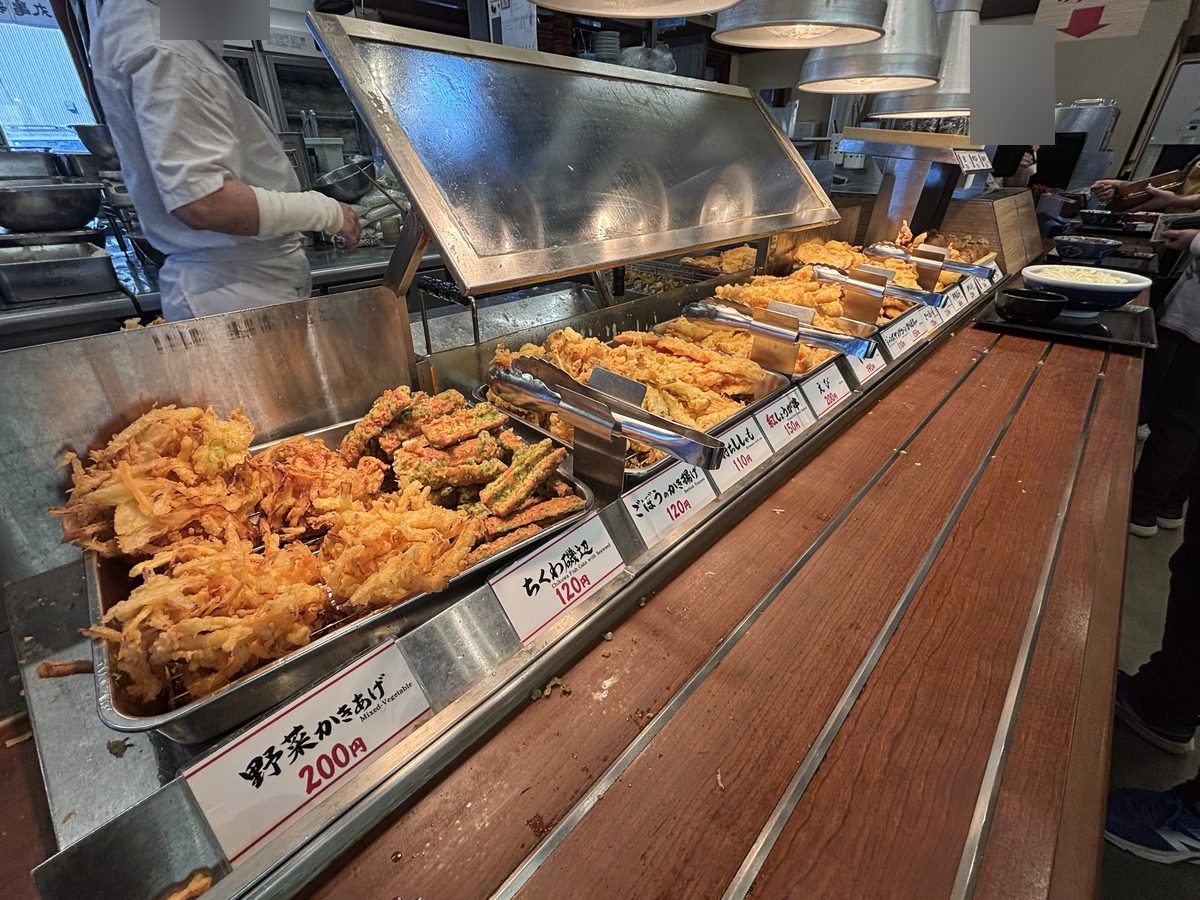
    Once you have your udon, set it on your tray and head to the tempura shelf. かき揚げ, shrimp, chikuwa (fish cake), かしわ (chicken)… a whole row of tempura, all lined up.

    Tempura counter with price tags

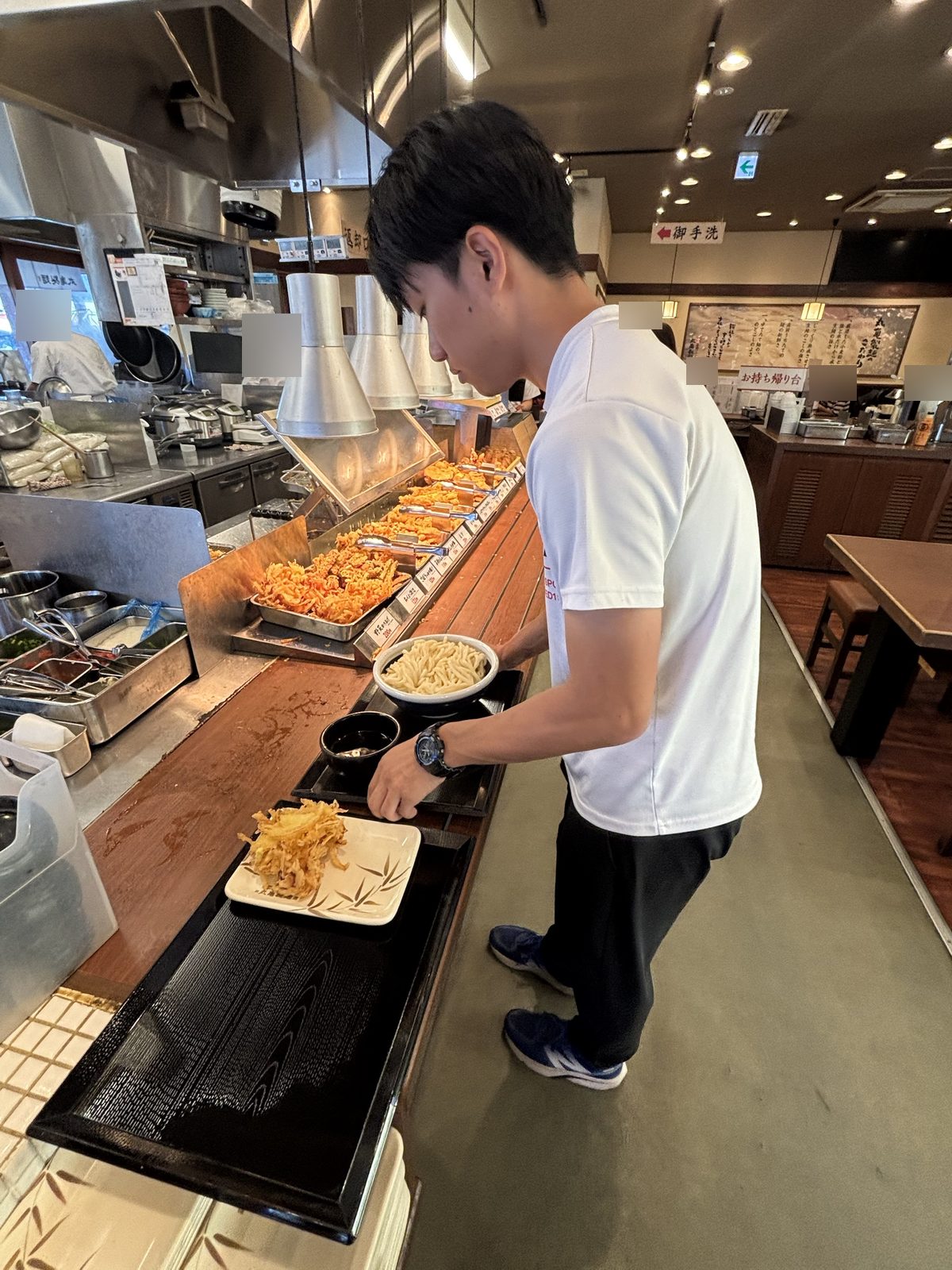
    No words needed here. Just use the tongs to put what you want on a plate. At this store, the price tags had the English name in small letters under the Japanese name (foreign-language labels differ from store to store).

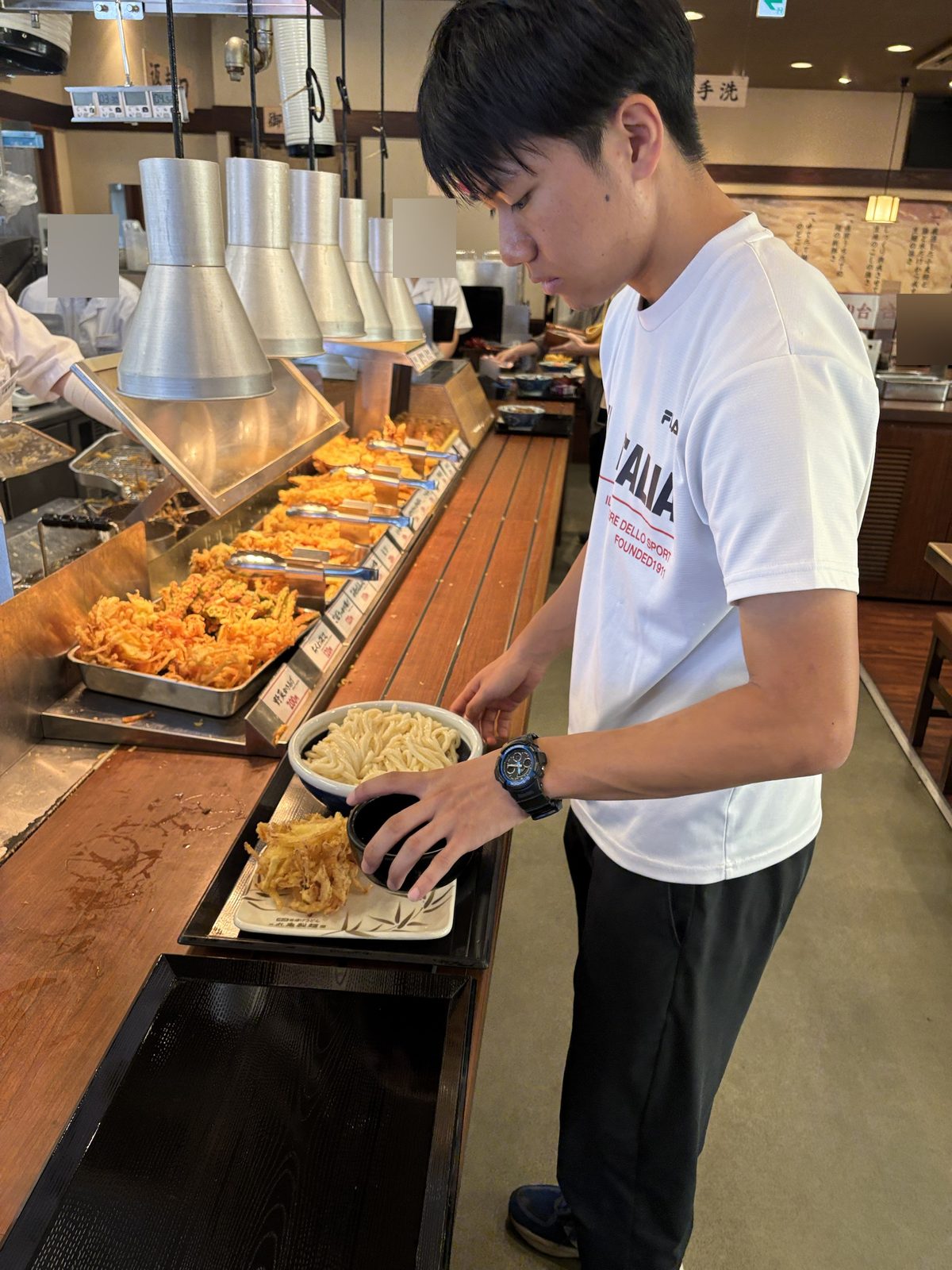
    Taking tempura with tongs onto a plate
    Placing the dipping sauce bowl on the tray

    Tempura runs about ¥120 to ¥220 apiece. Some people say it’s freshly fried and crispy. You pay at the register for however many pieces you took.

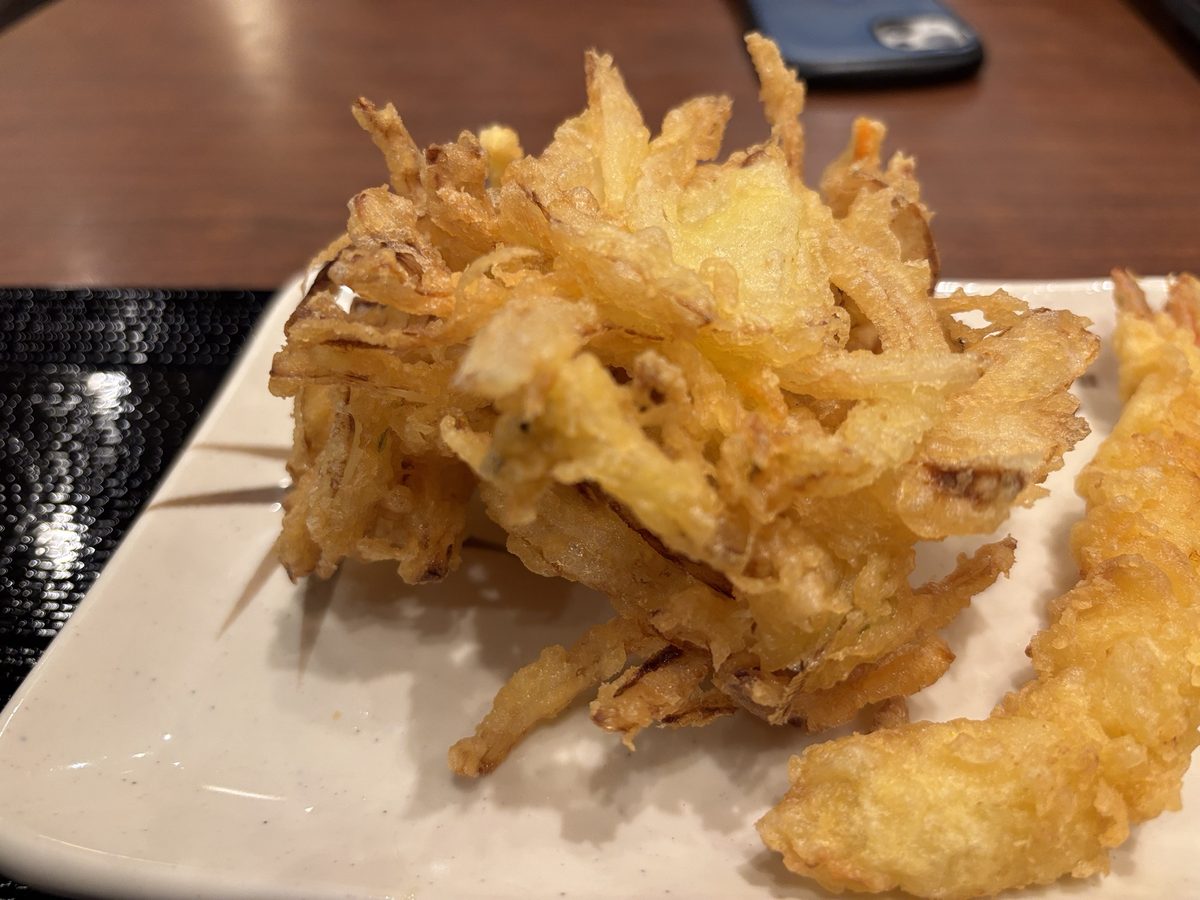
    Vegetable kakiage and shrimp tempura

    3 After You Pay — Condiments, as Much as You Like

    Once your tray is ready, head to the register. Many stores accept credit cards and transit IC cards (such as Suica), but it’s reassuring to have a little cash on you too.

    After you pay, there’s a condiment corner. Green onions, tenkasu (crunchy bits of tempura batter), grated ginger, ground sesame and more: there are 8 kinds of free condiments and toppings. Put them on your udon and make the bowl your own. You can help yourself to water or tea here, too.

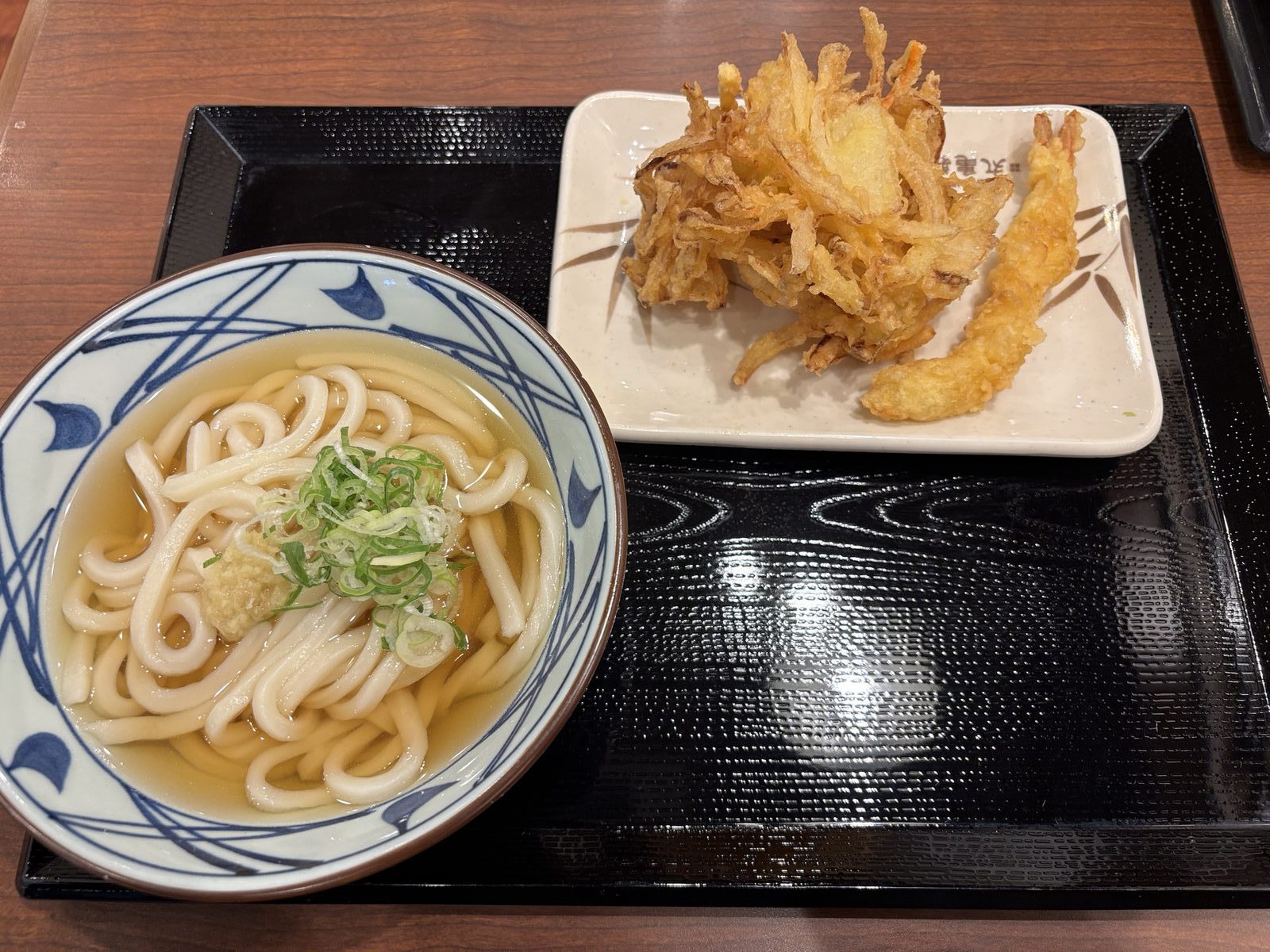
    Tray with kake udon and tempura

    4 At Your Seat — Itadakimasu

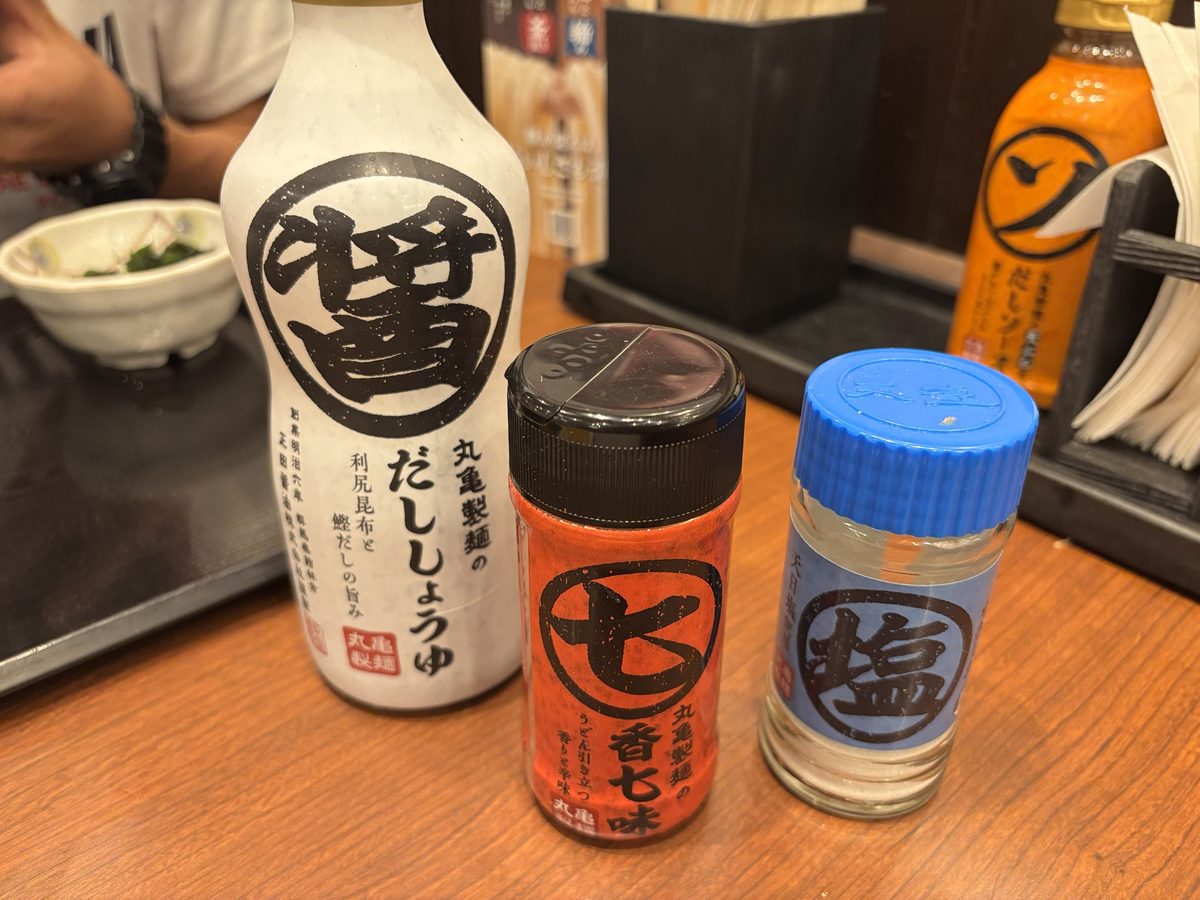
    At the tables, you’ll find chopsticks, shichimi (a seven-spice chili blend), dashi soy sauce and more.

    Table condiments: dashi soy sauce, shichimi, salt

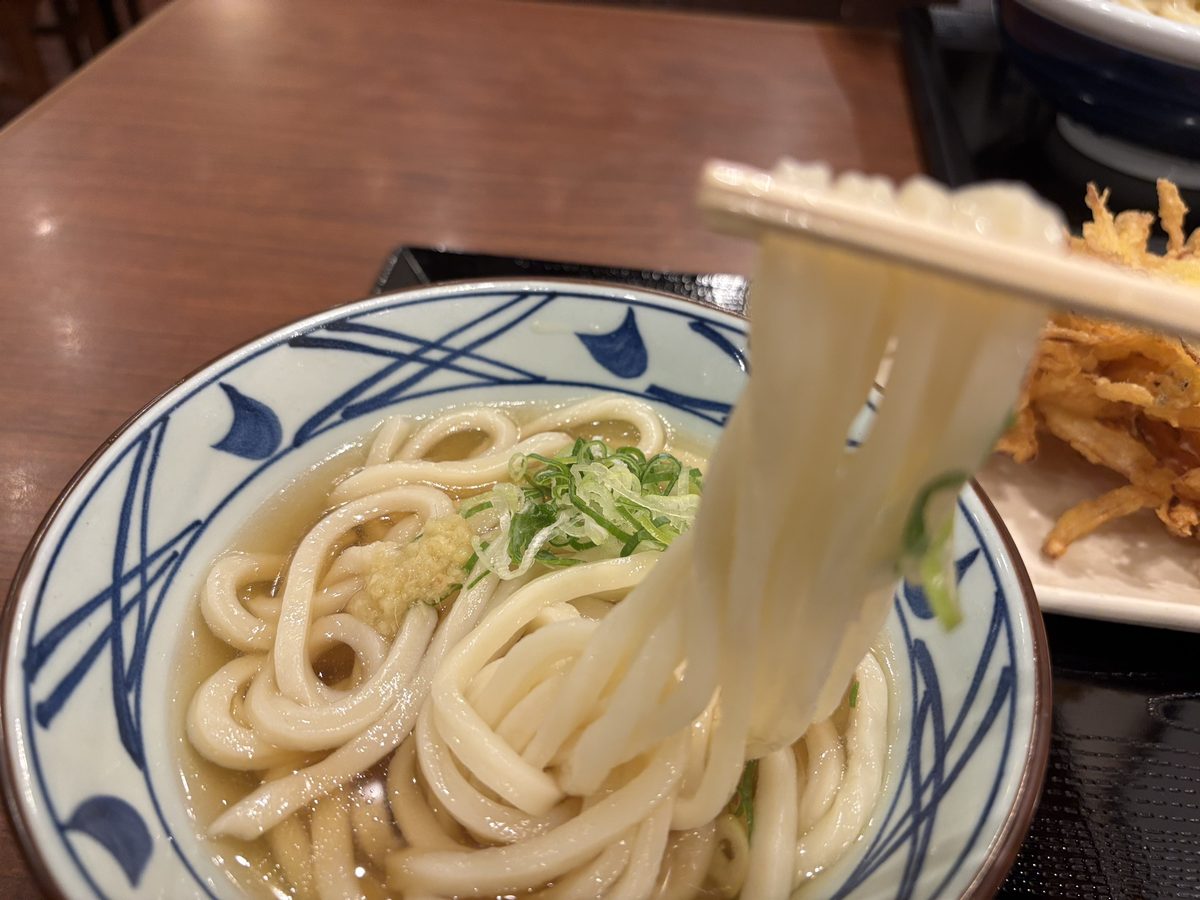
    With かけうどん, you get chewy noodles in hot broth.

    Lifting kake udon noodles with chopsticks

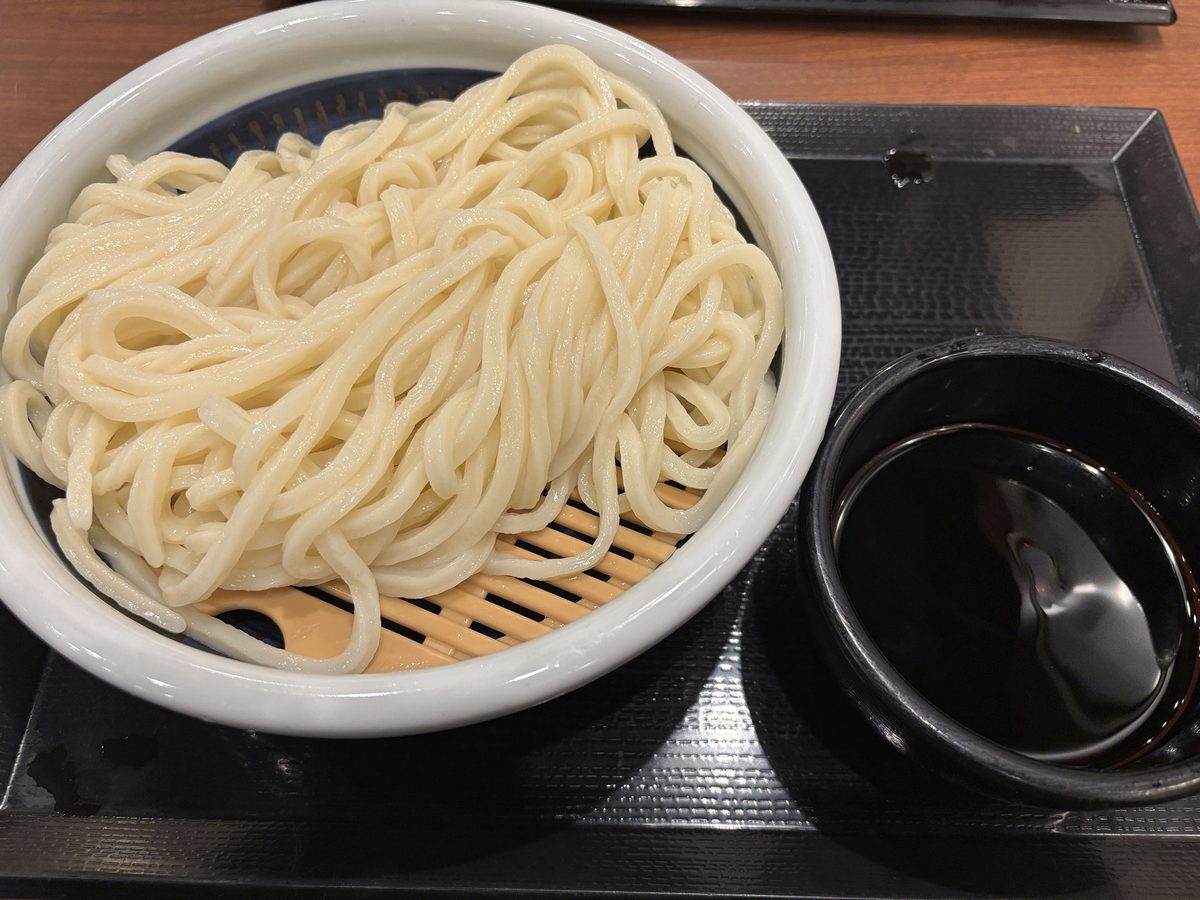
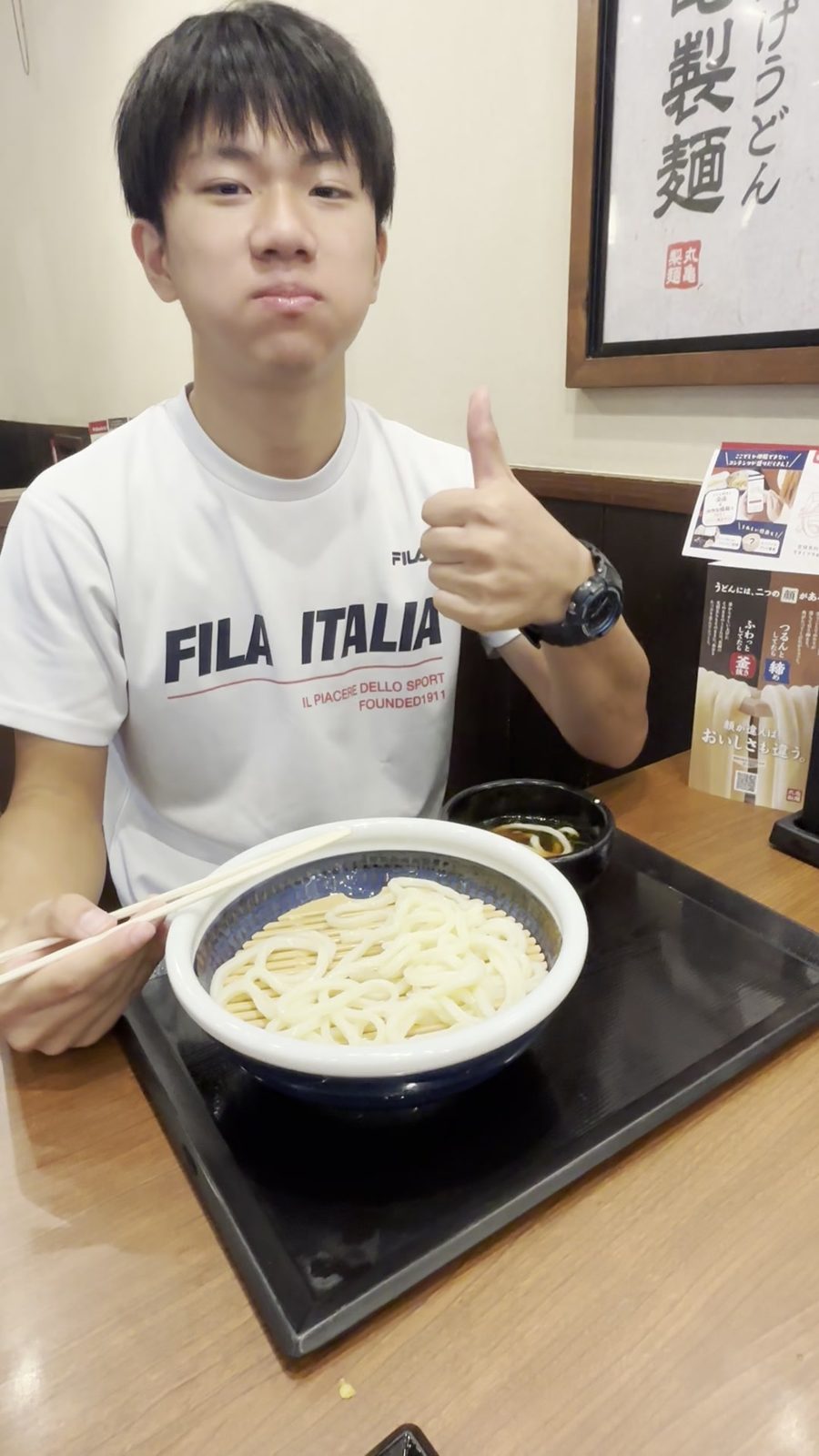
    With ざるうどん, you dip the cold noodles in the sauce and eat them.

    Cold zaru udon with dipping sauce

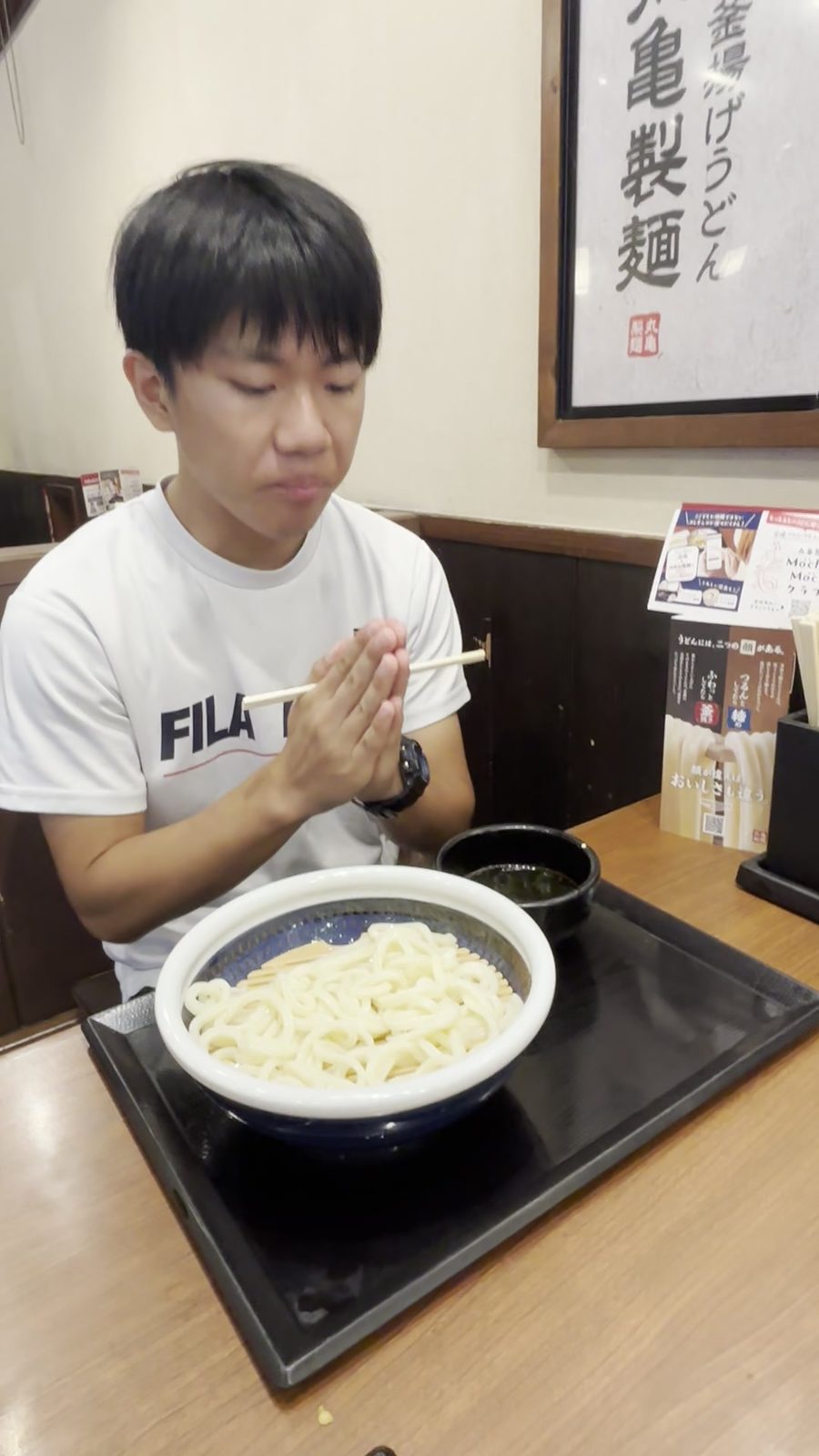
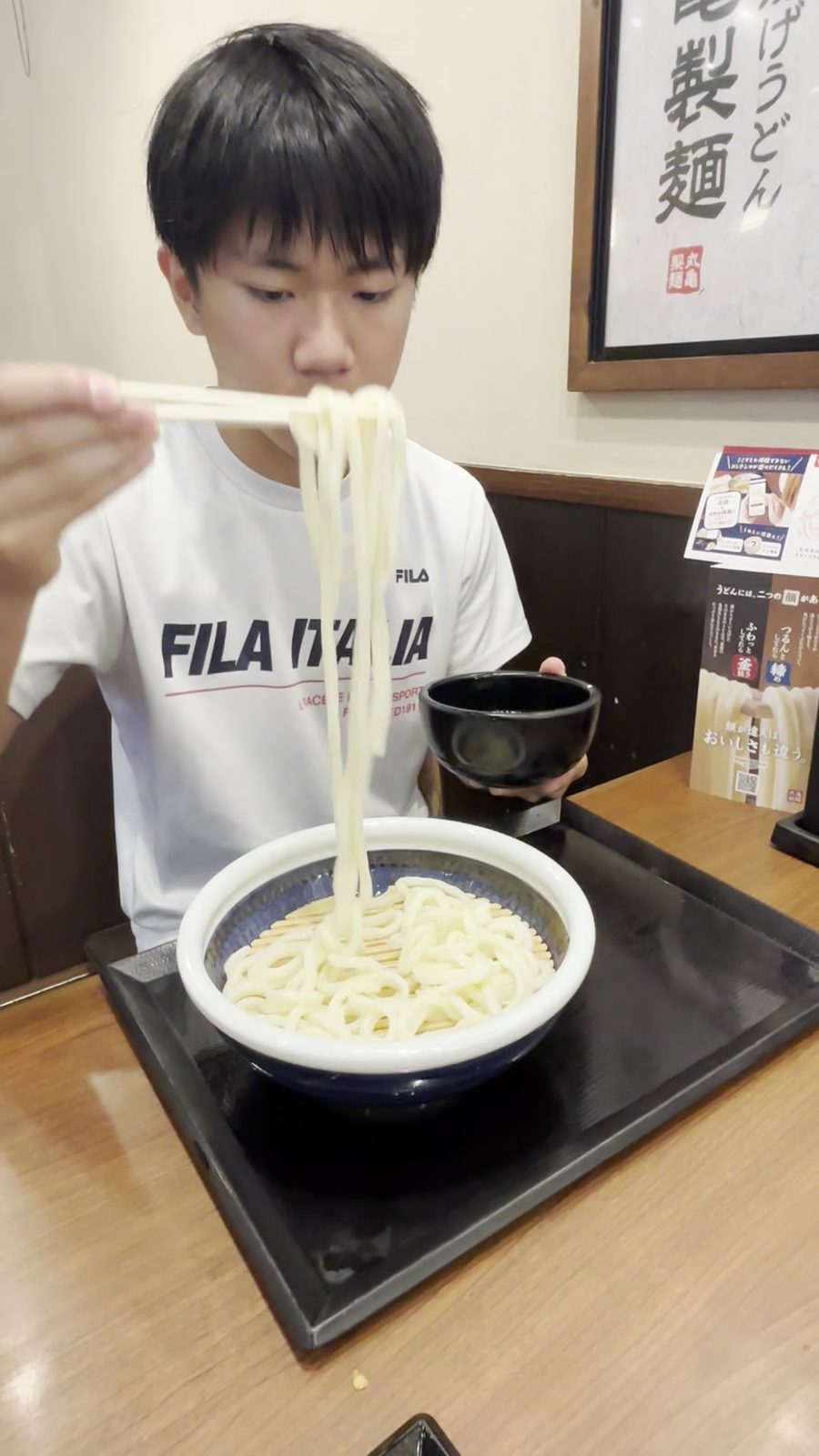
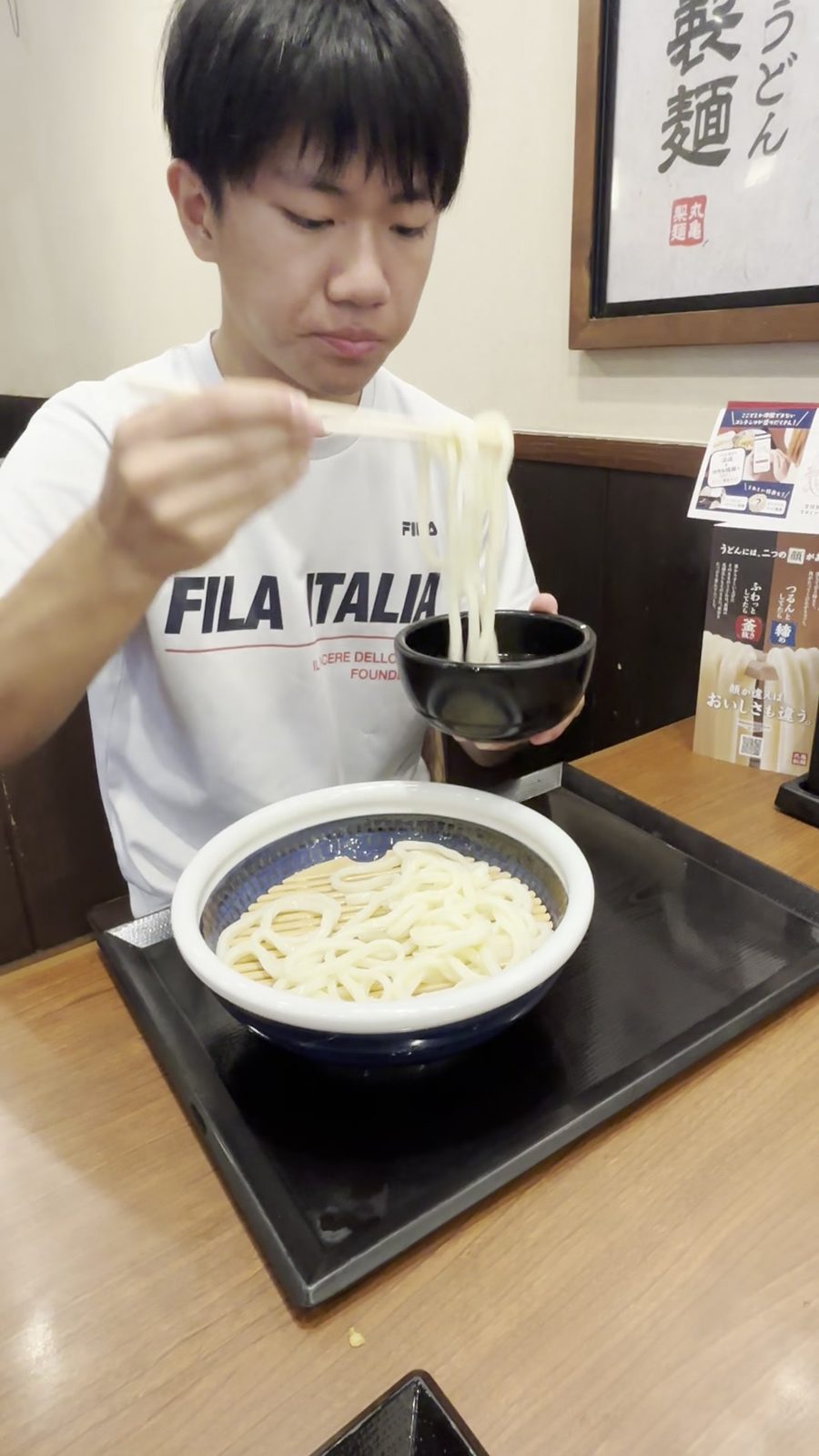
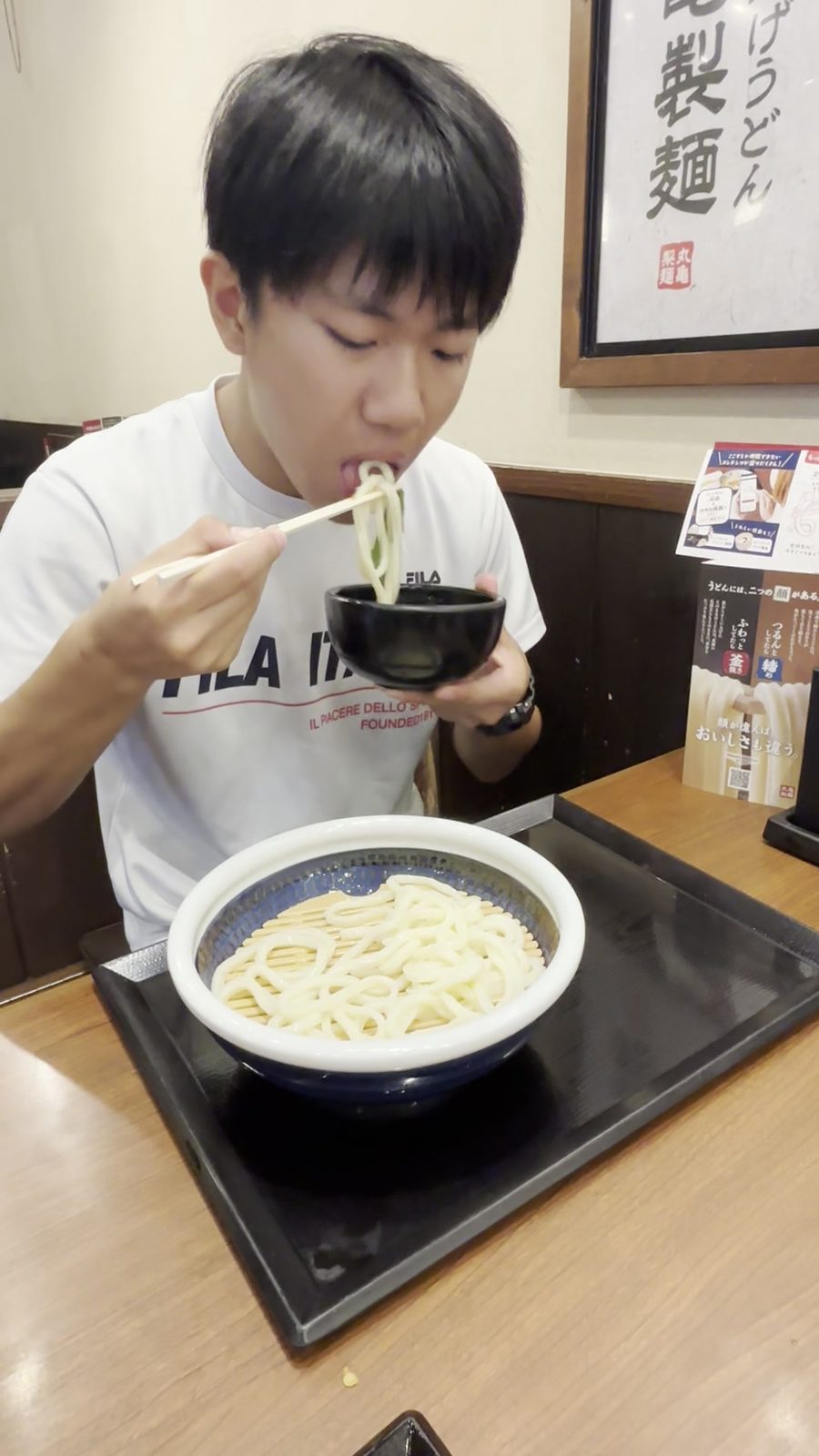
    My son ordered ざるうどん. Hands together: “Itadakimasu” (what people say before a meal). He lifted the noodles, dipped them in the sauce, and slurped them up.

    Saying "itadakimasu" with hands together
    Lifting cold udon noodles
    Dipping the noodles into the sauce
    Slurping the udon

    He chewed and chewed, then gave a thumbs-up.

    Thumbs up while eating

    How to eat udon is a story for another article.

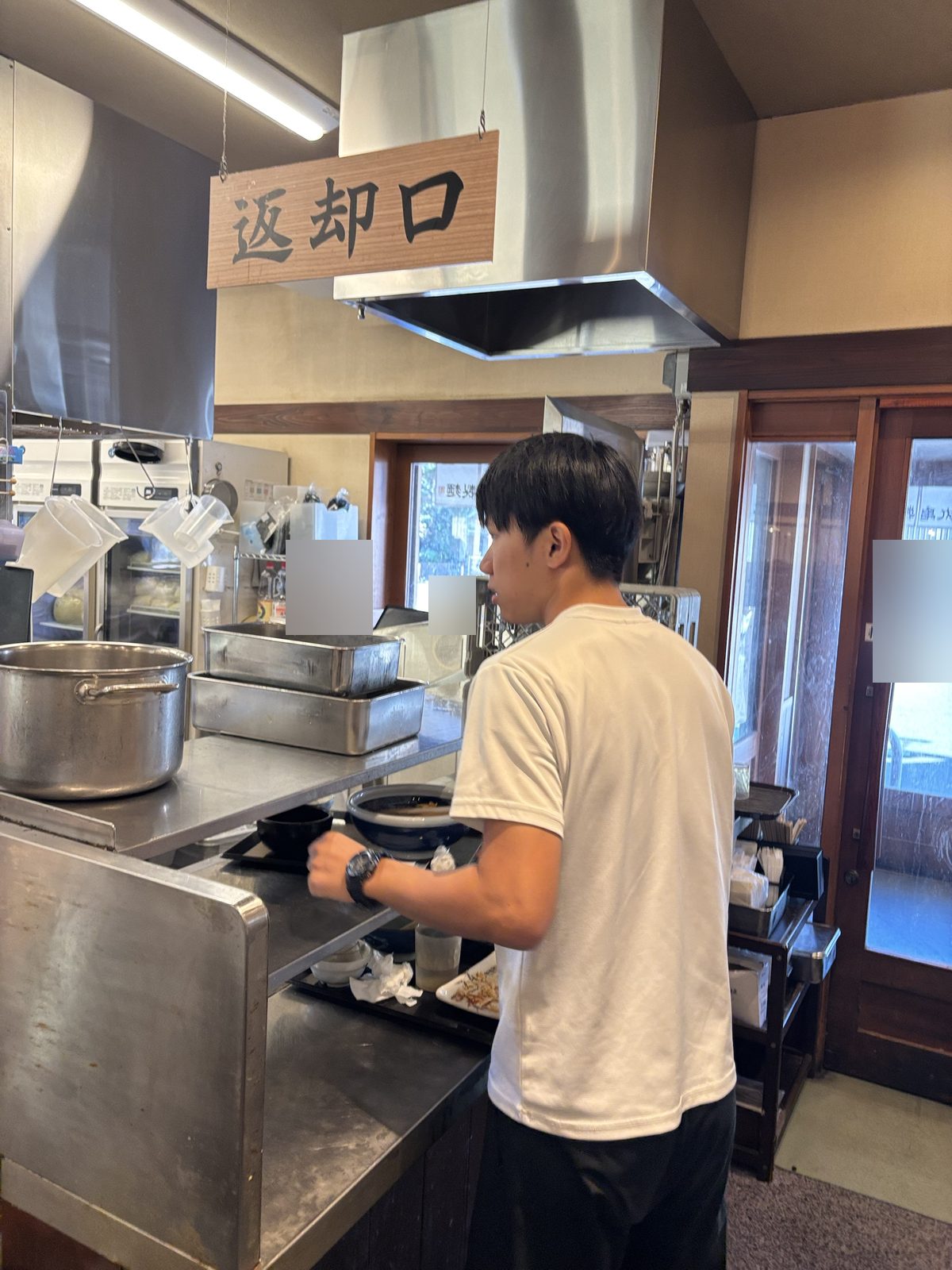
    5 When You’re Done — To the 返却口

    When you’ve finished, take your tray and dishes to the 返却口 (henkyakuguchi, the counter where you return your dishes).

    Returning the tray at the return counter

    Handy for Times Like These

    For when you want to eat your fill without spending much. A lot of people say it’s reasonably priced. There’s also a set for kids, the “お子さま まんぷくセット” (okosama manpuku setto, a filling set for children), for ¥290.

    On the 1st of every month except January 1, it’s “釜揚げうどんの日” (Kamaage Udon Day). 釜揚げうどん is half price (some stores don’t take part).

    For people who can’t eat certain foods: Marugame Seimen’s official website has an allergen chart (in Japanese). It says all the tempura is fried in the same oil, and that even the free tenkasu may contain allergens from the tempura. It also says that because the kitchen shares utensils and equipment, allergens from ingredients not used in a dish may come into contact with it. If you can’t check something on the chart, it’s safer for people with allergies to skip it.

    For now, just this

    For udon, point at the photo on the menu board and order.

    For tempura, look and take.

    After you pay, add condiments. When you’re done, take your tray to the 返却口.

    Official sources we checked (10)

    ・Marugame Seimen: How to Enjoy Marugame Seimen (in Japanese)

    ・Marugame Seimen: Udon (in Japanese)

    ・Marugame Seimen: Tempura (in Japanese)

    ・Marugame Seimen: Condiments and Toppings (in Japanese)

    ・Marugame Seimen: Cashless Payment (in Japanese)

    ・Marugame Seimen: Allergen Information (in Japanese)

    ・Marugame Seimen: Frequently Asked Questions (in Japanese)

    ・Tabimania Japan: How to Order at Marugame Seimen

    ・Wanderlog: Marugame Seimen Miyajimaguchi

    ・MATCHA: Marugame Seimen — How It’s Made at a Store in Japan, Revealed (in Traditional Chinese)

  • A Mini Japanese Dictionary for Eating Out (食事の日本語ミニ辞典) — Look Up the Words You See in Restaurants and on Menus, Right There

    This is the Japanese you see most often at restaurants in Japan, for checking quickly on the spot.

    Besides the meaning, for some words it also tells you what to do there.

    Signs differ from restaurant to restaurant, so if there are signs in the restaurant or the staff tell you something, go by that first.

    The words in this dictionary

    Words you see before you go in

    Words you see when you order

    Words you see while you eat

    Words you see when you pay

    Words you see before you go in

    営業中 (open)

    It means the restaurant is open.

    準備中 (closed for now)

    It means the restaurant isn’t open right now, because it’s before opening time or a break.

    定休日 (regular closing day)

    The day the restaurant is regularly closed.

    本日貸切 (reserved for a private party today)

    It means the restaurant is reserved for a private party that day, so other customers can’t go in.

    現金のみ/各種カード使えます (cash only / cards accepted)

    「現金のみ」 means you can pay only in cash, and 「各種カード使えます」 means various cards are accepted. If you want to pay by card, look at the signs at the entrance or the register. If you can’t find one, show your card to the staff when you go in and check.

    → “How to Order at a Restaurant in Japan — It Starts at the Entrance: Look for Just 3 Things“

    喫煙可能店 (smoking allowed)

    These are the characters on a sign posted at the entrance or elsewhere, and they mean the whole restaurant is a room where you can smoke (喫煙可能室). People under 20 can’t go in, even if they don’t smoke.

    → “How to Order at a Restaurant in Japan“

    禁煙/全席禁煙 (no smoking / no smoking at any seat)

    「禁煙」 means no smoking, and 「全席禁煙」 means no smoking at any seat in the restaurant. As a rule, smoking is banned indoors at restaurants in Japan.

    券売機/食券 (ticket machine / meal ticket)

    A 券売機 is a vending machine for meal tickets, and a 食券 is the ticket for the food you bought. At a restaurant with a ticket machine, buy your ticket before you sit down.

    → “Ramen Shops and Other Restaurants with a Ticket Machine — Buy Your Ticket First, Then Just Wait“

    Words you see when you order

    高額紙幣使えません (large bills not accepted)

    It means large bills, such as 10,000-yen and 5,000-yen bills, can’t be used in this machine. If you carry a few 1,000-yen bills and some coins, you’re less likely to get stuck at the ticket machine.

    → “Restaurants with a Ticket Machine“

    おつり/返却 (change / return)

    「おつり」 means the change from the money you paid, and 「返却」 means giving back the money you put in. Some machines have the two as one button, 「おつり・返却」. After you take your ticket, also check that your change has come out.

    → “Restaurants with a Ticket Machine“

    売切 (sold out)

    It means it’s already gone and you can’t order it.

    トッピング (topping)

    Extra ingredients that go on top of a dish. On a ticket machine, they may be lined up on smaller buttons.

    → “Restaurants with a Ticket Machine“

    替玉 (noodle refill)

    A refill of noodles only.

    → “Restaurants with a Ticket Machine“

    定食 (set meal)

    A set for one person, made up of rice, a main dish and so on, served all at once. You choose by the name of the main dish, as in 「とんかつ定食」.

    → “Teishoku Restaurants and Donburi (Gyudon) Shops — Pick a Main Dish, and It Comes on One Tray“

    丼 (rice bowl)

    A bowl of rice with a dish on top. At donburi shops, you choose how much rice you want by characters such as 「並盛」 and 「大盛」.

    → “Teishoku Restaurants and Donburi (Gyudon) Shops“

    牛丼/牛めし (beef bowl / beef bowl (Matsuya’s name))

    A rice bowl topped with beef. At Matsuya, gyudon is called 「牛めし」, so look for these characters on the menu and the ticket machine.

    → “Teishoku Restaurants and Donburi (Gyudon) Shops“

    並盛 (regular size)

    It means the regular size. The number of sizes and what they’re called differ from place to place, so compare the characters on the menu or the ticket machine and choose.

    大盛/特盛 (large / extra large)

    「大盛」 is more than the regular size, and 「特盛」 is even more. Some places use them for the amount of noodles, not just rice. On days you want to eat a lot, choose these characters.

    小盛/ミニ (small / mini)

    Less than the regular size. On days you want less, these characters let you choose an amount you can finish.

    おかわり自由 (free refills)

    It means you can have as many refills as you like. Whether you can get more rice differs from place to place.

    → “Teishoku Restaurants and Donburi (Gyudon) Shops“

    1人前 (one serving)

    The amount for one person. For yakiniku, hot pots and course meals, even if a price is shown for 「1人前」, you may only be able to order two servings or more.

    → “Eating Out in Japan Q&A — Look at the Entrance, and Ask When You’re Unsure“

    ドリンクバー (drink bar)

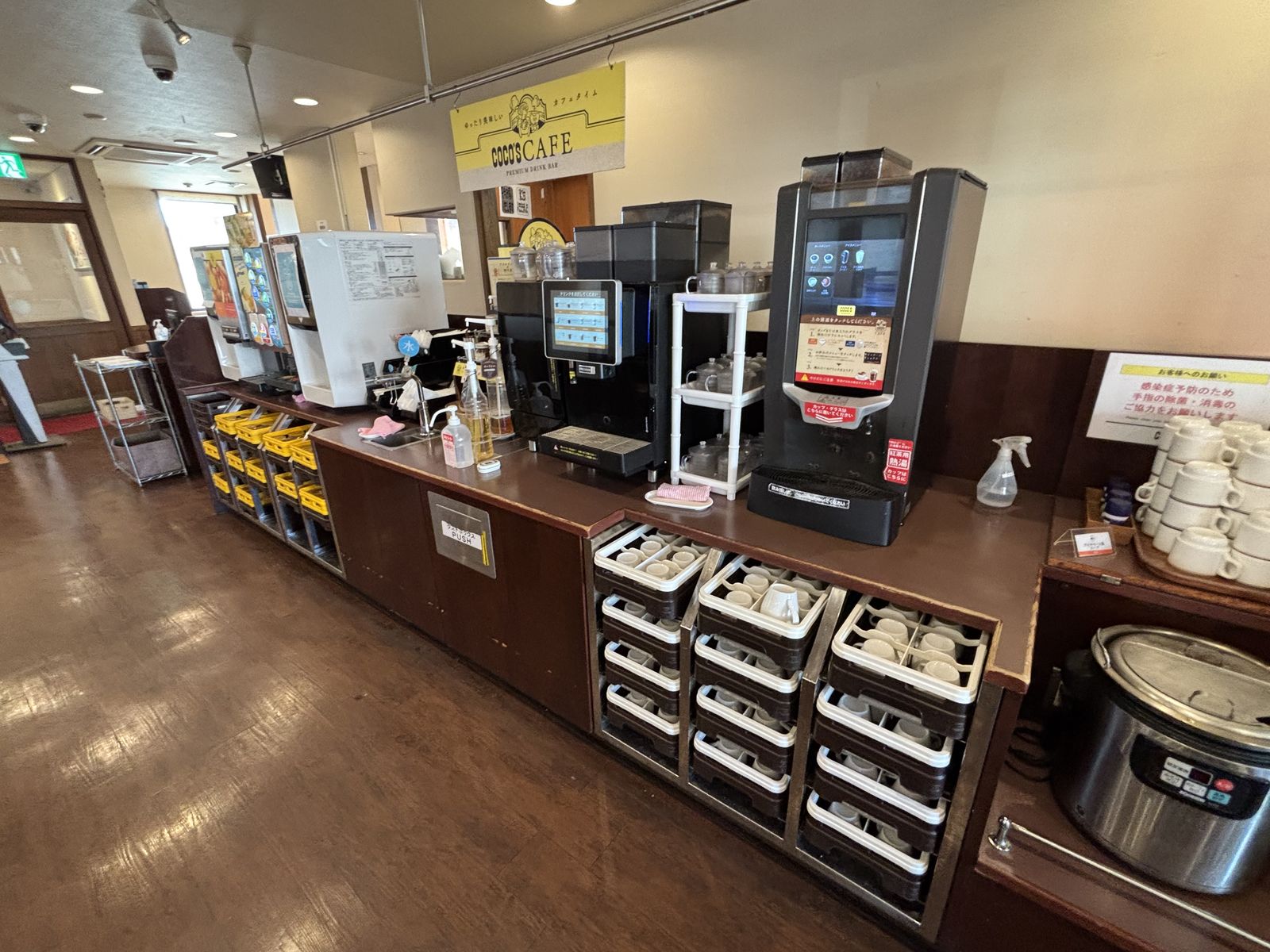
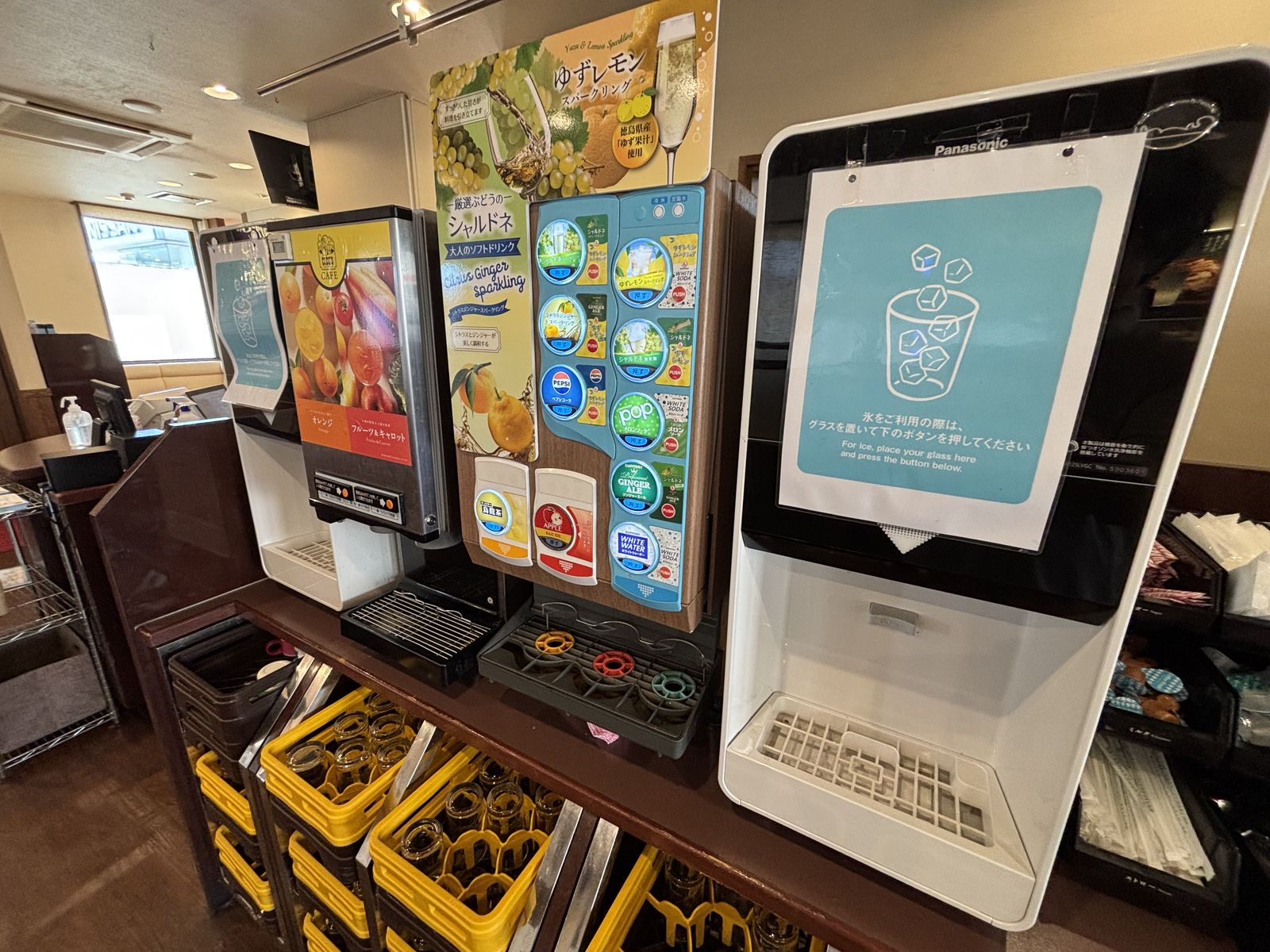
    A corner where, once you pay, you can choose what you like from the drinks lined up and pour your own, as many cups as you like. Whenever you want a drink, you can go and get it yourself without calling the staff.

    → “Family Restaurants in Japan (Gusto, Saizeriya, Denny’s) — Pour Your Own Drinks, As Many Cups As You Like“

    お冷 (water)

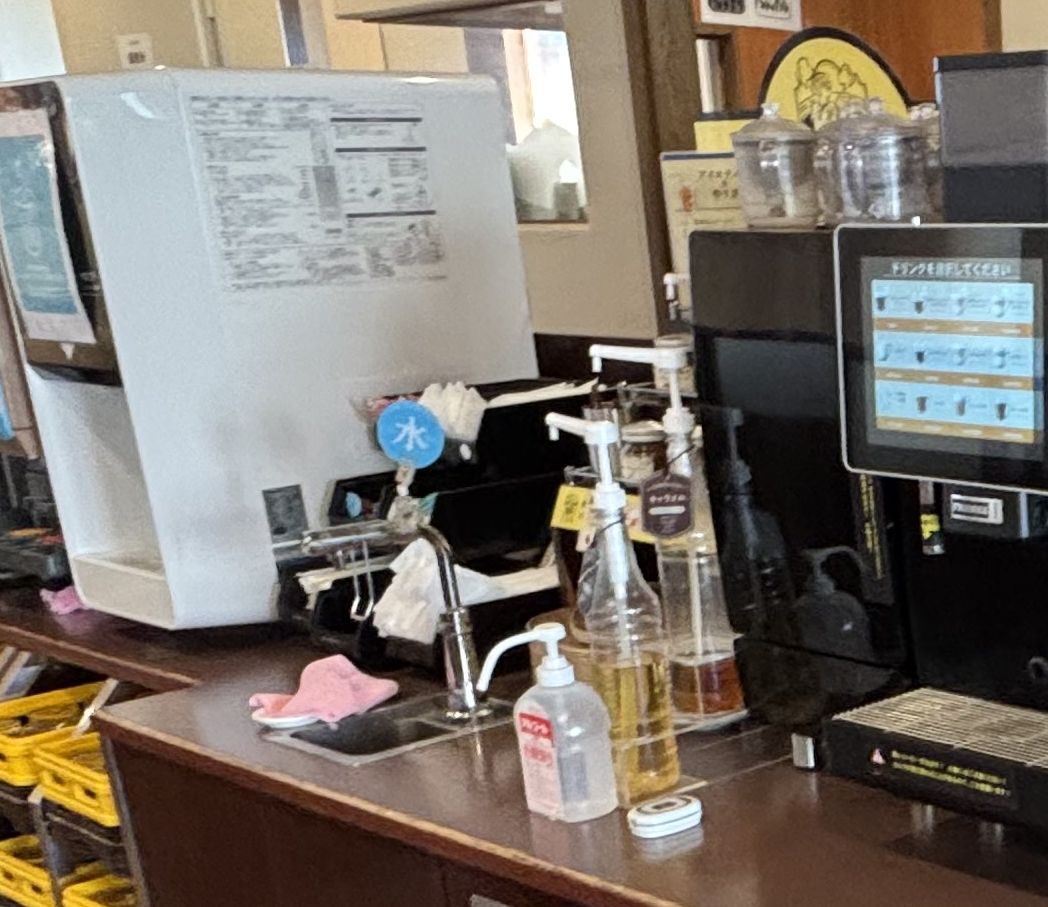
    Water. At some places, you get your water yourself, too, from the same corner as the drink bar.

    → “Family Restaurants in Japan“

    セルフサービス (self-service)

    It means you go and get it yourself, or pour it yourself. If you see 「お水はセルフサービス」, go and get your water yourself.

    → “Family Restaurants in Japan“

    飲み放題 (all-you-can-drink)

    A way of ordering where you can drink as much as you like from a separate drinks menu for a set time. Before you order, check the time limit and that menu.

    → “Izakaya (居酒屋) and the Otoshi Cover Charge — A Little Dish May Arrive Before You Order“

    ラストオーダー (last order)

    It means the latest time the restaurant takes orders. With all-you-can-drink, at some places the last order is a little before time’s up.

    → “Izakaya (居酒屋)“

    モーニング (morning service)

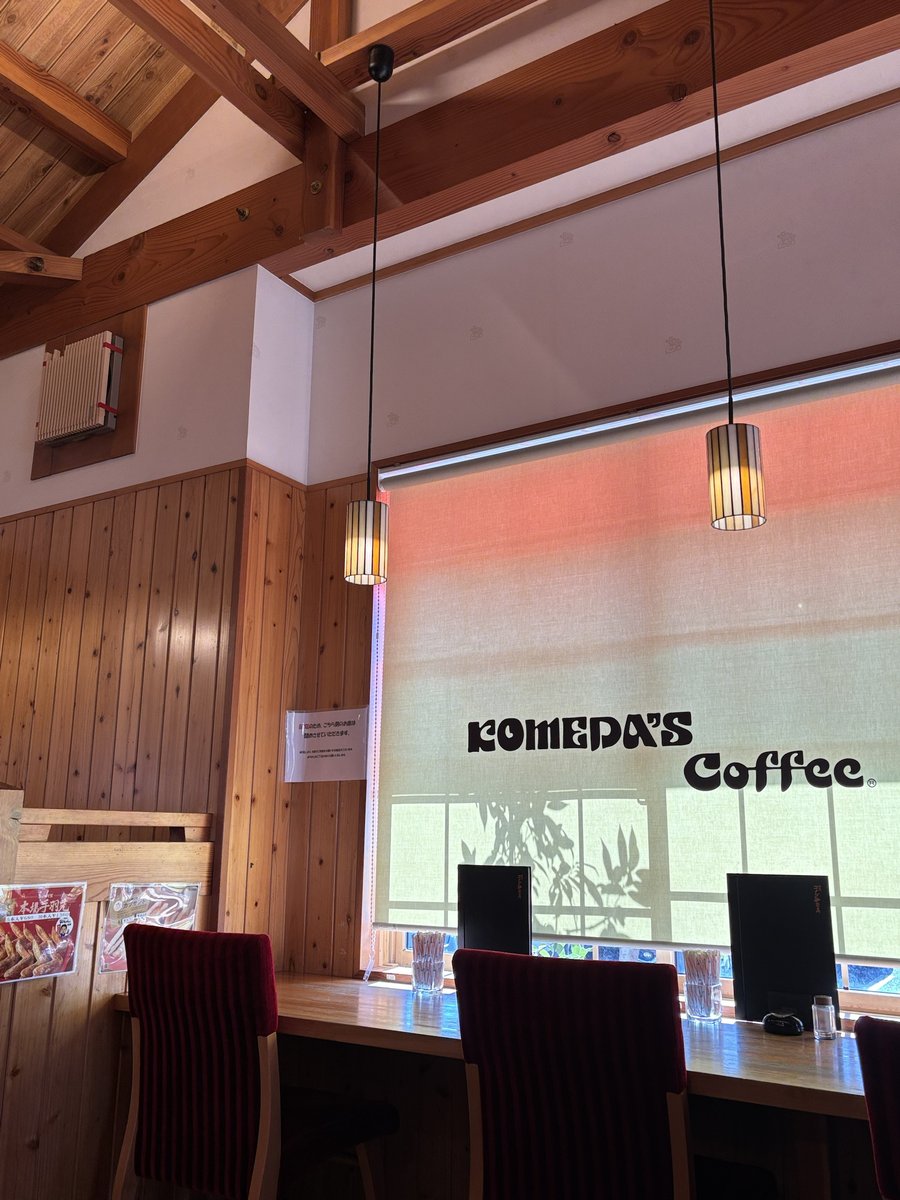
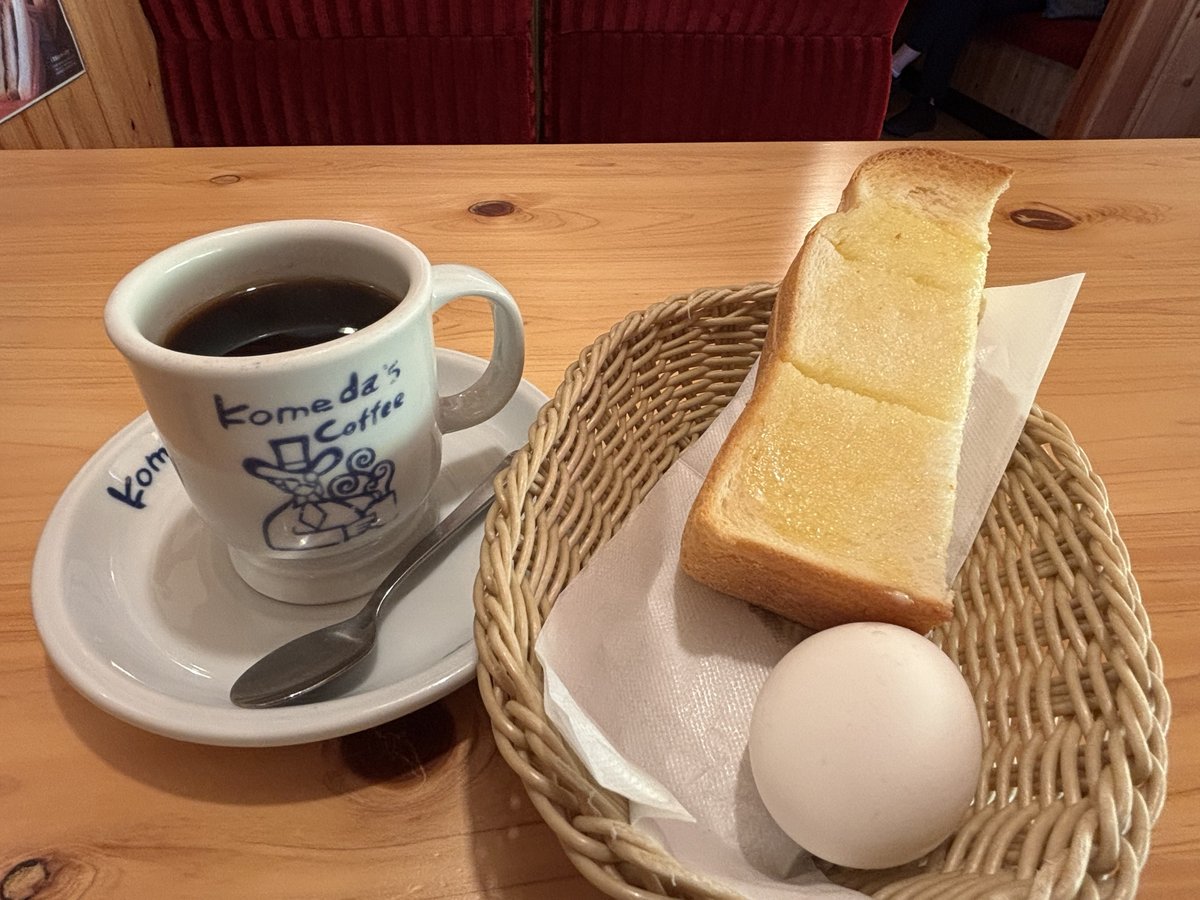
    A service that kissaten (Japanese coffee shops) offer in the morning hours. At some places, when you order a drink, things like toast or a boiled egg come with it. In Nagoya and Aichi, you can come across it at kissaten in the morning.

    → “Cafés and Kissaten (Japanese Coffee Shops) — Order at the Register First, or Sit Down First?“

    店内/お持ち帰り (eat in / take out)

    「店内」 means eating or drinking inside, and 「お持ち帰り」 means taking it with you (「テイクアウト」 also means taking it with you). If you’re asked at the register, say which one you want.

    → “Cafés and Kissaten (Japanese Coffee Shops)“

    時価 (market price)

    It means the price changes with what the restaurant pays for fresh fish and other items. Ask the staff for the price before you order.

    Words you see while you eat

    お通し (small starter dish)

    At an izakaya, a small dish of food that comes before you order. There may be a charge for it when you pay, so if you’re wondering, ask the staff when it’s served. Then you won’t panic if there’s an 「お通し」 line on your receipt.

    → “Izakaya (居酒屋)“

    おしぼり (wet hand towel)

    A small damp towel for wiping your hands (sometimes it’s paper). Some places bring it to your seat, and some keep them in the drink bar corner.

    取り皿 (small plate for sharing)

    A small plate for sharing food. Take your share from the dish in the middle onto your 取り皿, and eat from there.

    返却口 (dish return)

    The place where you return your dishes after eating. If the people around you are carrying their dishes back, do the same.

    Words you see when you pay

    会計/お会計 (paying / paying (polite))

    Paying for what you’ve had. 「お会計」 is the more polite way to say it. If there’s a line on the bill you don’t understand, ask the staff before you pay.

    → “Eating Out in Japan Q&A“

    伝票 (bill)

    A slip of paper with what you ordered and the amounts. At some places, you take it to the register near the exit and pay there.

    → “How to Order at a Restaurant in Japan“

    レジ (register)

    Where you pay. At a place where you bought a ticket from a ticket machine, you’ve already paid, so you can leave without stopping at the register.

    → “Restaurants with a Ticket Machine“

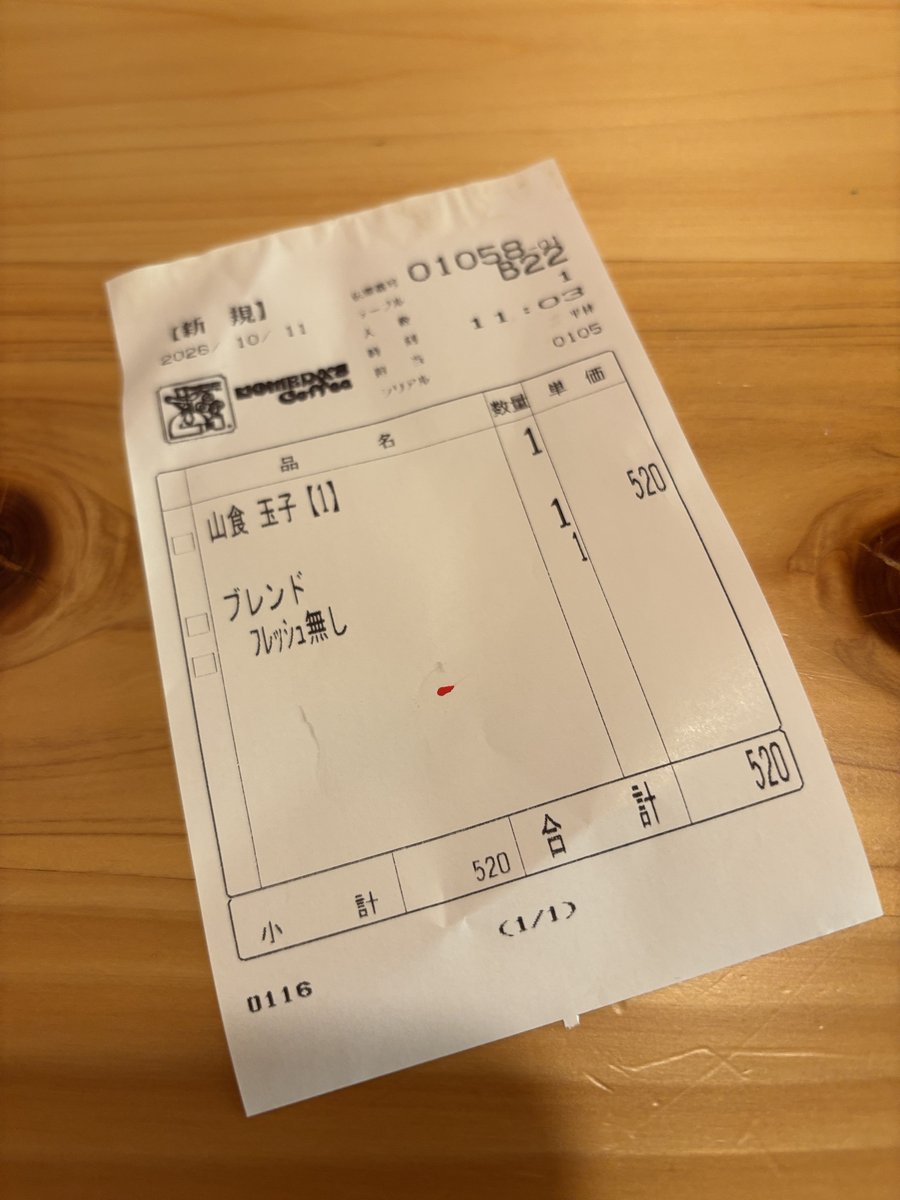
    レシート (receipt)

    A slip of paper showing what you paid for and the amounts.

    席料/テーブルチャージ (seat charge / table charge)

    A charge for using a seat. It’s also written 「お席料」. When there’s a seat charge, it’s often written on the menu or on a notice in the restaurant.

    → “Izakaya (居酒屋)“

    サービス料 (service charge)

    A charge for service, added on top of the price of what you order. If there’s a line on the bill you don’t understand, ask the staff.

    深夜料金 (late-night charge)

    A charge added late at night. If you go in late at night, check whether the menu mentions a late-night charge.

    税込/税抜 (tax included / tax not included)

    「税込」 is a price that includes consumption tax, and 「税抜」 is a price that doesn’t. When the characters 「税込」 or 「税抜」 are shown, you can tell which price it is.

    If you’re not sure

    If you can’t read the characters, or don’t know what they mean, ask the staff before you eat or before you pay.

    Show them the screen of your translation app, or point at the characters and ask.

    ※ The characters on signs, where things are placed and how charges work differ from restaurant to restaurant, and can change. When you actually eat out, check the signs in the restaurant and what the staff tell you.

    Official sources we checked (2)

    ・Ministry of Health, Labour and Welfare: List of signs for secondhand smoke measures (in Japanese)

    ・Ishikawa Prefecture: Restaurant guide creation tool for foreign visitors (in Japanese)

  • Eating Out in Japan Q&A — Look at the Entrance, and Ask When You’re Unsure

    This is based on guidance from public bodies and restaurant companies, as of October 2026 (it isn’t medical advice).

    For now, just this

    For the next four, the answer is the same.

    ・Do you pay first, or after?

    ・Can you use a card?

    ・Is smoking allowed?

    ・Do you take off your shoes and step up?

    Before you go in, look at the entrance.

    If there’s a ticket machine, it’s a place where you buy a ticket first. Card logos, the words 「現金のみ」 (cash only) and smoking signs may also be posted at the entrance. If you can tell before you go in, it’s easier to decide calmly, right there out front, whether to go in.

    For the next four, too, the answer is the same.

    ・A small dish you didn’t order has come out

    ・There’s a charge on the bill you don’t recognize

    ・You pressed the wrong button on the ticket machine

    ・You can’t read the menu

    Before you eat, and before you pay, ask the staff.

    Show them a screen on your translation app, or point, and you can ask the staff even if language is a problem.

    Choosing a place, and before you go in

    Do I need a reservation? Without one, will I have to wait in line?

    At most places for everyday meals, you can walk in without a reservation.

    Casual places like fast food restaurants, famiresu (family restaurants) and ramen shops usually don’t take reservations, and seat people in the order they arrive. If there’s a waiting list at the entrance, write your name and the number of people, wait, and you’ll be called. Some conveyor-belt sushi places let you get your place in line ahead of time with an app.

    Reservations are worth thinking about for popular places and restaurants serving course meals. Save reservations for the one place you’re looking forward to on your trip.

    → “Restaurant Reservations in Japan — Even If You Can’t Call, There Are 3 Ways to Book“/”Conveyor-Belt Sushi (回転寿司) — Order on the Tablet, and Your Plate Races to Your Seat“

    Is it OK to go in on my own?

    Yes. There are all kinds of places where people often eat on their own.

    For example, ramen shops, gyudon (beef bowl) shops and teishoku (set meal) places. At a place with a ticket machine, you just buy a ticket, hand it over and wait. Teishoku and donburi (rice bowls) arrive as a complete single serving, so there’s no need to share food with anyone. Some famiresu encourage casual meals on your own, too.

    On days when you’re traveling solo, you can use them without feeling awkward.

    → “How to Order at a Restaurant in Japan — It Starts at the Entrance: Look for Just 3 Things“/”Teishoku Restaurants and Donburi (Gyudon) Shops — Pick a Main Dish, and It Comes on One Tray“

    Can I go in with kids?

    Famiresu are places that are easy to go into with children. Some have children’s chairs and kids’ meal sets. What’s offered for children differs from place to place.

    If there’s a 「喫煙可能店」 (smoking allowed) sign at the entrance, people under 20 can’t go in, even if they don’t smoke. The sign is posted at the entrance or elsewhere, so you can tell whether it’s a smoking-allowed place before you go in.

    If you compare restaurant websites before you go, choosing where to eat together with your kids becomes even more fun.

    → “Family Restaurants in Japan (Gusto, Saizeriya, Denny’s) — Pour Your Own Drinks, As Many Cups As You Like“/”How to Order at a Restaurant in Japan“

    Can people smoke inside? What if I’m worried about smoke?

    As a rule, smoking is banned indoors at restaurants in Japan.

    Places where you can smoke put up an official sign at the entrance or elsewhere. 「喫煙可能店」 means a place where you can smoke anywhere inside.

    Whether you dislike smoke or want to smoke, you can tell before you go in.

    → “How to Order at a Restaurant in Japan“

    Do I need cash? Can I use a card?

    It depends on the place.

    The cards and e-money a place accepts are sometimes shown as logos at the entrance or the register. Some places say 「現金のみ」 (cash only) in writing. In rural areas, there are still many places that only take cash. Ticket machines, too, come in cash-only and card-accepting types.

    If you want to pay by card, check the signs at the entrance or the register, and if you can’t find any, show your card to the staff when you go in and check with them. Carry a little cash with you, too.

    → “How to Order at a Restaurant in Japan“/”Ramen Shops and Other Restaurants with a Ticket Machine — Buy Your Ticket First, Then Just Wait“

    Are there places where you take off your shoes? What if sitting on the floor is hard for me?

    Some places have you take off your shoes and step up.

    There’s often a shelf for your shoes, and you may be offered slippers. Just follow what the people around you do.

    At Japanese restaurants and similar places, if sitting on the floor is hard for you, you can ask the staff whether they can give you seats with chairs. They may not be able to arrange it at short notice on the day, so check when you book.

    → “How to Order at a Restaurant in Japan“

    When you order

    How do I order at a place with a ticket machine? What if it won’t take my bill, or I press the wrong button?

    Before you sit down, buy a ticket from the ticket machine.

    Some machines don’t take 10,000-yen or 5,000-yen bills, so carrying a few 1,000-yen bills and some coins makes things easier. On some machines, your change won’t come out unless you press the 「おつり」 (change) button.

    If you don’t have a bill the machine takes, or you realize you’ve pressed the wrong button, point to the machine or your ticket and ask the staff before you eat.

    It’s a place where you can order and pay without saying a single word of Japanese.

    → “Restaurants with a Ticket Machine“

    How does conveyor-belt sushi work?

    At the big conveyor-belt sushi chains, you order on the tablet at your seat, and your plate rides the lane all the way to your seat.

    You can check prices on the menu before you order. At some places, you can also take plates as they go around and eat them.

    The sushi you ordered comes racing right up to you. It’s a little treat you only get at conveyor-belt sushi.

    → “Conveyor-Belt Sushi (回転寿司)“

    The menu is only in Japanese. How do I order? Why are prices shown differently on the foreign-language menu?

    If there are food samples out front, you can order by pointing.

    Some ticket machines and tablets can be switched to English and other languages. Some places have menus where you choose by photo and number. If you can’t read it, use a translation app, or point to the menu and ask the staff.

    Prices on a foreign-language menu and on the Japanese menu may look different. The foreign-language menu may simply show prices in dollars or another currency. Some places also make their foreign-language menu by putting dishes that are popular with visitors from abroad into sets.

    You can also order things on the Japanese menu, so check with the staff.

    → “How to Order at a Restaurant in Japan“/”Family Restaurants in Japan“

    What about places where you order on a tablet or with a QR code? How do I call the staff?

    More and more places now have you order on a tablet at the table, or by scanning a QR code with your own smartphone. Many of these screens are multilingual and have photos. First, look for a language button on the screen.

    To call the staff, say 「すみません」 (sumimasen, “excuse me”), or press the call button on the table.

    At a place where you order on a screen, you can order without speaking.

    → “How to Order at a Restaurant in Japan“/”Family Restaurants in Japan“

    What’s the 「ドリンクバー」 (drink bar) at a famiresu?

    You pay for it, then pick whatever you like from the drinks lined up and pour your own, as many cups as you like. At some places, you also go to the same corner to get your own water.

    You don’t have to call the staff every time you want a drink. Choosing at your own pace is the fun of the ドリンクバー.

    → “Family Restaurants in Japan“

    At a café, do I go to the register first, or sit down first?

    When you go in, there are two things to look at.

    If there’s a line to order in front of the register, it’s a place where you order at the register first and pick up at the counter. If the staff show you to a seat, you order at your seat.

    Once you know which type it is, the only thing left to puzzle over is what to drink.

    → “Cafés and Kissaten (Japanese Coffee Shops) — Order at the Register First, or Sit Down First?“

    With all-you-can-drink, does everyone have to order it?

    It depends on the restaurant’s rules.

    All-you-can-drink is a way of ordering where, for a set amount of time, you can drink as much as you like from a special menu. You can try all kinds of drinks you’re curious about.

    Some places make it a rule that everyone has to order it. At the yakiniku (grilled meat) restaurant Yakiniku King, all-you-can-drink is only for when everyone in the group orders it. At the same restaurant, you can combine a soft-drink all-you-can-drink with an all-you-can-drink that includes alcohol (at some locations, what’s offered may differ).

    If you check the time limit and the rules on the menu before you order, you won’t be surprised when you pay.

    → “Izakaya (居酒屋) and the Otoshi Cover Charge — A Little Dish May Arrive Before You Order“

    Does each person have to order a dish? Is it OK to share food?

    It depends on the type of place.

    At izakayas and casual places, when you go as a group, it’s normal for everyone to share the food. Some places have each person order their own. Teishoku and donburi are meals that arrive as a complete single serving. Some famiresu recommend choosing dishes together and sharing them, and provide small plates for sharing.

    At yakiniku, hot pot and course-meal places, even if the menu shows a price for “one serving,” you may only be able to order two servings or more. The photos on the menu also often seem to show food for several people.

    Order lots of different dishes in small amounts and share them, and you can try many flavors in one meal.

    → “Izakaya (居酒屋)“/”Teishoku Restaurants and Donburi (Gyudon) Shops“/”Family Restaurants in Japan“

    How do I tell them what I can’t eat (allergies, vegetarian, pork, alcohol)?

    Show a single card written in Japanese.

    In Japan, there’s no requirement for restaurant dishes to be labeled with the ingredients that can cause allergies. The person who takes your order and the person who cooks are also often different people. Even if you can’t speak Japanese, the card tells them in Japanese.

    Just saying 「ベジタリアン」 (bejitarian, “vegetarian”) may not get everything across. Write down the names of the things you can’t eat, one by one, including ingredients you can’t tell by looking, like dashi (soup stock) and mirin (sweet rice wine for cooking).

    The card is a tool for checking with the staff whether you can eat something. Showing it doesn’t guarantee that the food is safe.

    For people with allergies, there are also sheets made by the national government and a prefecture that communicate with pictures. The Consumer Affairs Agency writes that, in the end, the decision on whether you can eat something should be made by you or your family, not the restaurant. When eating out, it’s difficult to completely prevent foods that cause allergies from getting mixed in unintentionally. The Consumer Affairs Agency also says it’s important to make careful decisions about eating out and to follow your doctor’s guidance.

    If you don’t eat pork or drink alcohol, making a card in the same format is one option.

    → “Allergy Card for Japan (Allergies, Vegetarian, Halal): Show It, Don’t Say It“

    While you’re eating

    A small dish I didn’t order showed up. Do I have to pay for it?

    You might.

    At an izakaya, the small dish that comes before you order is 「お通し」 (otoshi). There may be a charge for it when you pay. It’s something like a seat charge (a table charge). If you’re unsure, ask the staff when it’s brought to you.

    What you get is a surprise until you sit down.

    → “Izakaya (居酒屋)“

    Are water and tea free?

    Water that comes without you asking is usually free.

    Some places charge for tea or water you order. If there’s a charge, it should be on the menu.

    Some conveyor-belt sushi places let you make your own tea at your seat. Some famiresu have you get your own water from the drink bar corner. When you’re thirsty, you can go get some yourself right away.

    → “How to Order at a Restaurant in Japan“/”Conveyor-Belt Sushi (回転寿司)“/”Family Restaurants in Japan“

    Could I be rude without realizing it? What if I’m not good with chopsticks?

    There are two things to know about chopsticks.

    The things people say you should especially avoid are standing your chopsticks up in rice, and passing food from one pair of chopsticks to another.

    With Japanese food, you’re encouraged to lift the bowl toward your mouth when you eat. Rather than bringing your face down to the bowl, pick the bowl up and bring it to your mouth. At conveyor-belt sushi, once you’ve taken a plate, don’t put it back on the lane.

    If chopsticks are hard for you, at many places you can ask for a fork or spoon.

    → “Teishoku Restaurants and Donburi (Gyudon) Shops“/”Conveyor-Belt Sushi (回転寿司)“

    Can I slurp ramen? What about the soup? Should I leave as soon as I’ve eaten?

    Slurping is fine.

    The Japan National Tourism Organization (JNTO) writes that slurping noodles isn’t rude at all, and that many people feel it makes noodles easier to eat with chopsticks. Do it not to make noise, but as a way of drawing the noodles into your mouth.

    You can drink all of the soup, and you can lift the bowl to your mouth. Even if you eat the noodles and toppings and leave a little soup, you’ve still “finished.”

    A ramen shop isn’t a place to stay long after you’ve finished eating. All the more so if there’s a line outside. Chatting while you eat is fine.

    → “Restaurants with a Ticket Machine“

    Is it rude to leave food? Can I take leftovers home?

    It’s considered good manners to finish your food as much as you can. At a table where people pour drinks for each other from bottles, it’s fine to leave your drink. An empty glass is a signal to top it up. If you don’t want any more, leave your glass full.

    Whether you can take leftovers home is up to the restaurant. More places are allowing it, but some don’t, for hygiene reasons. If you’d like to take food home, ask the staff.

    At places where you can choose the portion size, you can choose an amount you can finish from the start. 「小盛」 (small size) and 「ミニ」 (mini size) at donburi shops are one example.

    → “Teishoku Restaurants and Donburi (Gyudon) Shops“

    When you pay

    Do I pay first, or after? At the register, or at the table?

    It depends on the type of place.

    At a place with a ticket machine, you’ve already paid once you buy your ticket. Some cafés have you order at the register first. At places where you’re shown to a seat, you pay after you eat. Some have you take the bill to the register, and some have you pay at the table. Some conveyor-belt sushi places and famiresu let you start paying from a tablet or screen.

    Look at the entrance, and before you go in, you can start to see how you’ll order and when you’ll pay.

    → “How to Order at a Restaurant in Japan“

    Do I need to tip?

    No. Restaurants in Japan don’t have a custom of tipping.

    If you want to show your thanks, instead of a tip, say 「ありがとうございました」 (arigatou gozaimashita, “thank you very much”) with a smile.

    → “How to Order at a Restaurant in Japan“

    Can we pay separately?

    It depends on the place.

    Some places ask groups to pay together. At some famiresu, even if everyone orders from their own smartphone, it all goes on one bill.

    If you’d like to pay separately, ask the staff.

    → “Izakaya (居酒屋)“/”Family Restaurants in Japan“

    There’s a charge on the bill I don’t recognize

    Ask the staff before you pay.

    It might be an お通し charge, a seat charge or a service charge. Some places add extra charges late at night, such as a late-night charge. If you used a private room, there may be a separate charge, especially at dinnertime.

    Once you know about the お通し, you won’t panic when you spot an 「お通し」 line on your receipt.

    → “Izakaya (居酒屋)“/”Family Restaurants in Japan“

    After I ate, I was told I can’t use my card

    You can show the staff a screen on your translation app and talk it over with them.

    In rural areas, there are still many places that only take cash. Next time, check the signs at the entrance or the register, and if you can’t find any, show your card when you go in and check first.

    → “How to Order at a Restaurant in Japan“

    When you’re in trouble

    My reservation was turned down. Why?

    As for reservations, the consumer hotline for tourists run by the National Consumer Affairs Center of Japan answers that the restaurant may really have been full.

    If you felt you were treated badly, you can tell the person in charge at the restaurant what bothered you and ask them to set it right.

    → “Restaurant Reservations in Japan“

    I’m going to be late for my reservation / I can’t make it

    Contact the restaurant as soon as you know.

    If you can’t make a phone call, you could try contacting the restaurant through its social media. With course-meal reservations, depending on the restaurant’s rules, you may not get back what you paid if you’re late.

    If you can’t go, cancel as early as you can. If you booked on a reservation site, check the site’s cancellation rules. If you cancel on the day, once the food is ready, it will often be hard to get back what you paid.

    Even at the last minute, if you let them know, the restaurant may be able to welcome other customers to the empty seats.

    → “Restaurant Reservations in Japan“

    I felt sick after eating

    If you need an ambulance, call 119.

    According to the Fire and Disaster Management Agency, anyone in Japan can use an ambulance in case of a sudden illness or injury. If there’s someone around who speaks Japanese, ask them for help.

    If you have allergy symptoms, consult a medical facility. Check the ingredients of the food with the restaurant right then and there. They may be needed at the hospital to find the cause.

    The Japan National Tourism Organization’s “Japan Visitor Hotline” (050-3816-2787) offers help 24 hours a day, in English, Chinese and Korean, in situations such as accidents or illness.

    It’s handy to put your health information together in a note. Write that note on the back of your food card, and that one card can speak for you if anything happens.

    → “Allergy Card for Japan (Allergies, Vegetarian, Halal)“

    ※How restaurants work, how you pay and how charges are set vary from place to place and can change. When you actually use a restaurant, check its signs and what the staff tell you.

    Official sources we checked (15)

    ・Japan National Tourism Organization (JNTO): Japanese Food Etiquette Guide

    ・Japan National Tourism Organization (JNTO): Ramen

    ・Japan National Tourism Organization (JNTO): Japanese Customs and Etiquette

    ・Japan National Tourism Organization (JNTO): Japan Visitor Hotline

    ・Yakiniku King: Drinks and all-you-can-drink menu (in Japanese)

    ・National Consumer Affairs Center of Japan, Consumer Hotline for Tourists: The prices on the menu for Japanese customers and the menu for foreign customers seem to be shown differently. Why? (in Japanese)

    ・National Consumer Affairs Center of Japan, Consumer Hotline for Tourists: I told the staff at a restaurant that I wanted to take home the food I couldn’t finish, but they refused (in Japanese)

    ・National Consumer Affairs Center of Japan, Consumer Hotline for Tourists: I thought I ordered one serving, but I was charged for two (in Japanese)

    ・National Consumer Affairs Center of Japan, Consumer Hotline for Tourists: I was charged for tea and for using a private room, but I wasn’t told in advance (in Japanese)

    ・National Consumer Affairs Center of Japan, Consumer Hotline for Tourists: At the Japanese restaurant I booked, I was shown to a seat on the floor. I’ll have trouble without a chair. What should I do? (in Japanese)

    ・National Consumer Affairs Center of Japan, Consumer Hotline for Tourists: I had an allergic reaction caused by a meal at a restaurant. What should I do? (in Japanese)

    ・Consumer Affairs Agency: Pamphlet (Food allergies, for consumers, July 2026) (in Japanese)

    ・Consumer Affairs Agency: Food Labelling | CAA

    ・Osaka Prefecture: About the allergy communication sheets (in Japanese)

    ・Fire and Disaster Management Agency: Ambulance Usage Guide for foreign visitors to Japan (in Japanese)
  • Restaurant Reservations in Japan — Even If You Can’t Call, There Are 3 Ways to Book

    Late afternoon, in the kitchen of a small restaurant. The day’s ingredients are being set out to match tonight’s reservations. Some small restaurants buy and prep their ingredients based on reservations.

    In Japan, you can walk into most everyday restaurants without a reservation. The place to think about booking is the one spot you’ve picked as “the place for that night” on your trip. Even if you can’t make a phone call in Japanese, there are still ways to get a reservation.

    There are three things to know.

    ・Fast food places, family restaurants and ramen shops often seat you without a reservation, in the order you arrive. Reservations are for popular restaurants and places that serve set-course meals

    ・There are three ways to book: on a reservation website / by asking the front desk where you’re staying / by calling the restaurant

    ・Once you’ve booked, go at your reserved time. If you can’t make it, let the restaurant know as soon as you know

    1 Where You Need a Reservation and Where You Don’t — Everyday Places Seat You in the Order You Arrive

    Casual places like fast food chains, family restaurants and ramen shops usually don’t take reservations, and they seat people in the order they arrive.

    At places that don’t take reservations, there’s sometimes a waitlist sheet by the entrance. Write your name and the number of people in your group, then join the line, or take a seat if there are chairs. You’ll be called when your table is ready.

    How to tell what kind of restaurant it is from the entrance is covered in How to Order at a Restaurant in Japan. For places where you can save your spot in line with an app, see Conveyor-Belt Sushi.

    On the other hand, in the downtown areas of popular tourist destinations, many restaurants do require a reservation.

    One place to start looking for restaurants is the Japan National Tourism Organization’s “Restaurant Search” page. It lists sites where you can search for restaurants, along with the languages each one supports, and from there you can also check each restaurant’s reservation rules.

    For lunch or a light dinner, try a place you find while walking around. Save reservations for the one spot you’re looking forward to on your trip.

    2 Three Ways to Book — A Reservation Website, the Front Desk Where You’re Staying, or a Phone Call

    On a reservation website — Many restaurants can be booked in other languages

    Many restaurants take reservations online, and when they do, many of those sites also support other languages.

    Even for small or more traditional restaurants that only have a Japanese website, you may be able to use a translation feature to check how to book.

    Ask the front desk where you’re staying — Instead of making a call

    If you’re staying at a hotel or similar place, the front desk may be able to help you make a reservation. Before you head out, ask at the front desk.

    Hotel concierges or travel agents may also be able to help. They know the booking process well, so they may also be able to ask the restaurant any questions you have for you.

    Some places only take reservations by phone

    Some restaurants only take reservations by phone. If you’re not comfortable speaking Japanese, or you can’t make calls, remember the two options above, especially asking the front desk where you’re staying.

    Even if you don’t speak Japanese, there’s more than one way to get a reservation.

    3 Before You Press “予約する” (Reserve) — Read the Rules First

    Ordering a course, or just booking a table

    Some reservations are for a table only, and some also lock in a set-course meal.

    On Gurunavi, for example, there’s no advance payment for a table-only reservation, and you order your food after you arrive. For a course reservation, you choose the course online and pay in advance.

    Some reservation websites charge a fee just for making a reservation. Before you confirm, check the amount on the screen.

    Until when can you cancel?

    Travel plans can change along the way. Before you press “Reserve,” check until when you can cancel for free and whether there’s a cancellation fee and how it works. If you’re booking on a reservation website, the cancellation rules are often written on the site, so read them there. If you book by phone and they explain their rules, those rules apply.

    For a slow, relaxed evening, or if there’s something you can’t eat

    Some restaurants have a time limit for your table. It’s often around 2 hours, so if you want a slow, relaxed meal that night, you can check when you book. For more on 飲み放題 (all-you-can-drink) and time limits, see Izakaya.

    If there’s something you can’t eat, you can let the restaurant know when you book. How to tell them is covered in “Allergy Card for Japan.”

    Read the rules before you press the button, and on the day, all you have to do is wait for your food.

    4 Your Reservation Time — The Food Is Prepared for That Time

    At places that serve set-course meals and similar restaurants, the food is prepared so it comes out fresh right at your reservation time, and at some restaurants everyone at the sitting starts eating at the same time.

    That’s why, for set-course reservations, some restaurants will turn you away even if you’re only a little late.

    Japan’s cities are bigger than you might think, and getting around takes longer than you’d expect. Leave plenty of time between reservations.

    If you still think you’ll be late, contact the restaurant as soon as you know. If you can’t make a call, you could also try reaching out through the restaurant’s social media. With course reservations, depending on the restaurant’s rules, you may not get back the money you paid if you’re late.

    Arrive on time, and from the very first dish, you’ll be tasting food that was prepared for that moment.

    5 If You Can’t Make It — Let the Restaurant Know as Soon as You Know

    The National Consumer Affairs Center of Japan explains to travelers that in Japan, a reservation is a promise that the restaurant will keep your table for you the whole time. For set-course meals and similar food, restaurants may start preparing the day before.

    If you can’t make it, cancel as early as you can. At restaurants that prepare ingredients to match reservations, especially small or specialty places, letting them know early can help cut down on wasted food.

    As for how to cancel, on Gurunavi, for example, you cancel from the “About your reservation” page before the cancellation deadline. After the deadline, you can’t cancel on the site, and you’re expected to go to the restaurant. If you can’t go, contact the restaurant directly.

    Even if it’s at the last minute, if you let them know, the restaurant may be able to welcome other guests to the empty table.

    If you cancel on the day, when the food is already prepared, it will often be hard to get back the money you paid. Read the rules ahead of time, and you won’t be caught scrambling on the day.

    For now, just this

    Everyday places seat you in the order you arrive, no reservation needed. Save reservations for the one spot you’re looking forward to.

    There are three ways to book: a reservation website, asking the front desk where you’re staying, or calling the restaurant.

    Before you press “Reserve,” check until when you can cancel and whether you have to pay in advance.

    Leave plenty of travel time so you make your reservation time. If you think you’ll be late, contact the restaurant as soon as you know.

    If you can’t make it, cancel as early as you can.

    Official sources we checked (8)

    ・National Consumer Affairs Center of Japan, Consumer Hotline for Tourists: I didn’t go to a restaurant I had reserved, and was charged a cancellation fee (in Japanese)

    ・National Consumer Affairs Center of Japan, Consumer Hotline for Tourists: I want to reserve a popular restaurant, but I can’t make a phone reservation because I don’t speak Japanese (in Japanese)

    ・National Consumer Affairs Center of Japan, Consumer Hotline for Tourists: I canceled a restaurant reservation, but the money I already paid wasn’t refunded (in Japanese)

    ・National Consumer Affairs Center of Japan, Consumer Hotline for Tourists: I had reserved a set-course meal at a restaurant, but my reservation was canceled because I was just a little late (in Japanese)

    ・Japan National Tourism Organization (JNTO): Get Ahead of the Crowd: Making Reservations for a Seamless Trip

    ・Japan National Tourism Organization (JNTO): Japanese Customs and Etiquette

    ・Japan National Tourism Organization (JNTO): Restaurant Search

    ・Gurunavi: About Table Reservations

  • Allergy Card for Japan (Allergies, Vegetarian, Halal): Show It, Don’t Say It

    This site offers information to help with your trip, based on guidance from the Consumer Affairs Agency, the Japan National Tourism Organization and others (as of October 2026; this is not medical advice). On eating out for people with food allergies, the Consumer Affairs Agency says “it’s important to follow your doctor’s guidance.”

    When the staff come to take your order, you show them a small card. On it, in Japanese, it says: 「わたしは、肉と魚を食べません。かつお節のだしも食べません」 (“I don’t eat meat or fish. I don’t eat dashi made with bonito flakes, either.”)

    Whether you have an allergy, don’t eat meat or fish, or don’t consume pork or alcohol, this article suggests the same kind of card for everyone: one card with the things you can’t eat, written in Japanese.

    There are three things to know.

    ・Write it down and show it, rather than saying it. The person who takes your order and the person who cooks your food are often different people

    ・On the card, rather than a single word like 「ベジタリアン」 (bejitarian, the Japanese loanword for “vegetarian”) or 「ハラール」 (harāru, halal), write the names of the things you can’t eat, one by one

    ・Also write down ingredients you can’t see just by looking, like dashi (soup stock) and mirin (みりん, sweetened cooking sake)

    The card is a tool for checking with the staff whether you can eat something. Simply showing it doesn’t guarantee that you’ll be safe.

    For people with allergies, there are also sheets made by the national government and by a prefecture that let you communicate with pictures. You can use them together with the card in this article.

    1 Show It, Don’t Say It — Written Words Get Handed Over Without Changing Shape

    In Japan, the law sets out allergen labeling for packaged foods sold in stores. Restaurant dishes, on the other hand, have no such labeling requirement. So at a restaurant, it’s up to you to tell them.

    On how to tell them, the Consumer Affairs Agency writes that the staff member who takes your order and the person who cooks are often different people. Its advice is to check using something like a sheet, not by saying it out loud, so the information properly reaches the cook too.

    The Japan National Tourism Organization also recommends that people who don’t eat meat or fish print out a written explanation or card in Japanese that lists what they can’t eat.

    When to show it is the same as in the Izakaya article: as soon as you sit down. If you don’t eat meat or fish and you’re booking a restaurant that serves set-course meals, let them know when you make the reservation.

    Spoken words stay only in the memory of the person who heard them. Written words can be handed over exactly as they are. Even if you can’t speak Japanese, the card speaks for you in Japanese.

    2 What to Write on the Card — Names, One by One, Instead of a Single Word

    The single word 「ベジタリアン」 may not get the whole message across

    In Japan, 「ベジタリアン」 is a word that came from outside, its meaning isn’t clear-cut, and it’s often understood in a broad sense. Just asking for 「ベジタリアンの料理を」 (bejitarian food) may not get the whole message across.

    So say specifically what you can’t eat. That you don’t eat meat, seafood, or anything that comes from animals, including dashi and broth. If the staff seem unsure, add that “meat” also includes chicken and pork, and fish too.

    Even if the staff seem reluctant, it may just be that they don’t understand. With the names lined up on your card, everything the staff need to understand is right there in front of them.

    Write 「五葷」 as vegetable names, too

    Among Buddhist vegetarians, who are common in Taiwan, some also don’t eat the strong-smelling vegetables called 「五葷」 (gokun). But which vegetables are included differs slightly even between Japan’s public sources (green onions, onions, or both). So rather than the single word 「五葷」, write out the names of the vegetables you want to avoid, just as they are.

    Halal (ハラール) — For People Who Don’t Consume Pork or Alcohol, the Same Kind of Card

    For people who want to avoid pork or alcohol, too, this article suggests writing a card in the same way as for allergies or a vegetarian diet.

    On the card, you can write not only pork itself but also pork extract, pork fat such as lard, and pork-derived ingredients in seasonings and additives (such as gelatin). These are all ingredients restaurants are advised to watch out for. If you only eat halal meat, write that down too.

    How far you avoid things varies from person to person. On the card, write your own limits, not the words on a restaurant’s sign.

    Sample cards

    Turn your own words into Japanese with a translation app, then add or delete lines as you like. You can print it and keep it in your wallet, or show it on your smartphone screen.

    Example for someone with an allergy

    わたしは、えびとかにのアレルギーがあります。

    (I am allergic to shrimp and crab.)

    この料理に、えびやかにが入っていますか。

    (Does this dish contain shrimp or crab?)

    調理器具やトングを分けて作れますか。

    (Can you make it using separate cooking utensils and tongs?)

    Example for someone who doesn’t eat meat or fish

    わたしは、肉と魚を食べません。鶏肉と豚肉も食べません。

    (I don’t eat meat or fish. I don’t eat chicken or pork either.)

    かつお節や煮干しのだしも食べません。

    (I also don’t eat dashi made from bonito flakes or dried sardines.)

    昆布やしいたけのだしなら、食べられます。

    (I can eat dashi made from kombu or shiitake mushrooms.)

    Example for someone who doesn’t consume pork or alcohol

    わたしは、豚肉と、豚からとった物(ラード、ゼラチンなど)を食べません。

    (I don’t eat pork or anything taken from pigs (lard, gelatin, etc.).)

    お酒も口にしません。みりんや料理酒を使った料理も食べません。

    (I don’t consume alcohol either. I also don’t eat dishes made with mirin or cooking sake.)

    ハラールの肉(イスラームの決まりにしたがって処理した肉)でなければ、肉は食べません。

    (I don’t eat meat unless it is halal meat (meat processed according to Islamic rules).)

    If you add 「ありがとうございます。」 (“Thank you.”) as a last line, handing over the card turns into a small greeting.

    3 Hidden Ingredients — Dashi and Mirin

    Dashi is the base of flavor in Japanese cooking

    At the base of flavor in Japanese cooking is 「だし」 (dashi), a stock that draws the umami out of ingredients like kombu (昆布, kelp) and katsuobushi (かつお節, bonito flakes).

    For many people, dashi is where the deliciousness of Japanese food comes from. For people who can’t eat it, it’s an ingredient that’s hard to spot just by looking. Even dishes with no visible meat or fish often have things like bonito flakes hidden in them. The sauce that comes with natto is often dashi, too.

    In that case, instead of giving up on dashi altogether, write the kinds of dashi you can eat on your card. In dishes made without anything taken from animals, bonito or dried-sardine (煮干し, niboshi) dashi can’t be used, but dashi made from kombu, mushrooms such as shiitake, or vegetables can. If the dashi you can eat is written down, you can find dishes where you, too, can taste the umami base of Japanese cooking.

    Mirin and cooking sake are hard to spot, too

    Mirin and cooking sake (料理酒) are also hard to spot. Both are used in many Japanese dishes. The broth for soba and udon (めんつゆ, mentsuyu) is also based on mirin and soy sauce. Some miso, too, can contain alcohol unless it’s labeled 「無添加」 (mutenka, “additive-free”).

    Opinions differ on whether you should avoid even the small amount of alcohol contained in seasonings. That’s exactly why you write your own limits on the card. Do you write 「みりんや料理酒を使った料理も食べません」 (“I also don’t eat dishes made with mirin or cooking sake”), or just 「お酒を飲みません」 (“I don’t drink alcohol”)? With your limits written down, the staff can think with you about which dishes would work.

    4 For People with Allergies — Official Sheets and What the Consumer Affairs Agency Says

    There are two sheets that use pictures

    You tap the box under a picture of a food to mark it, then show it to the staff. That’s how the “Food Allergy Communication Sheet” (食物アレルギーコミュニケーションシート) that the Consumer Affairs Agency publishes for smartphones works. The languages are English, Chinese (Simplified), Korean and Japanese. To mark the boxes, you need to download it to your smartphone first. If you save it before you leave home, you can open it in front of a restaurant without worrying about a connection.

    You point to a picture of a food, and the restaurant points back to an answer. Osaka Prefecture’s “Food Allergy Communication Sheet” works that way, in 11 languages including Traditional Chinese and Indonesian. Osaka Prefecture made it so restaurants can communicate with customers from abroad.

    The strength of both sheets is that you can get your message across just by pointing at pictures. For anything that isn’t pictured, you can write it in words on your own card and show the two together.

    What the Consumer Affairs Agency says

    In a pamphlet for people with food allergies and their families, the Consumer Affairs Agency writes the following.

    The foods that cause allergies differ from person to person: some people react to just a tiny amount, while others can eat a little. So the decision “can eat / can’t eat” should ultimately be made by you or your family, not by the restaurant.

    Check with a manager or another staff member who knows about food allergies. You need to be careful, because a staff member’s “it’s not in there” isn’t always certain. Even people who’ve been told it’s OK to eat out should tell the restaurant they have an allergy and check whether cooking utensils, tongs and so on can be kept separate or washed, the pamphlet says.

    When eating out, it’s difficult to completely prevent the foods that cause allergies from getting mixed in unintentionally (cross-contamination, コンタミネーション). It’s important to decide carefully about eating out and to follow your doctor’s guidance. When you can’t tell whether something is in a dish, or when you still have concerns after checking with the restaurant, it’s also important to choose not to eat there.

    A heading in the same pamphlet says, “Enjoy eating out and takeout meals with the awareness that the one who prevents accidental eating is yourself.” The card isn’t a piece of paper for leaving things up to the restaurant. It’s a card for putting together, with the staff, the information you need to make the decision yourself.

    5 Food You Buy in Stores — Package Labels Are Your Guide

    For packaged processed foods sold at convenience stores and supermarkets, allergen labeling is required. However, pork, beef, chicken and gelatin are items for which labeling is only recommended (as of April 2026). Bread, snacks and sweets may also contain gelatin or animal fats such as butter.

    Labels are in Japanese, so look for the words by comparing them with the shapes of the characters on your card. If you’re not sure, you can show the card and the product together to the staff. As the Consumer Affairs Agency stresses, “no label = not in there” isn’t true. Keep that in mind, and on travel days you can pick your lunch from the convenience store shelves by checking the labels.

    6 If You Feel Unwell — 119, and the Back of Your Card

    If you need an ambulance, call 119. According to the “Ambulance Usage Guide” (救急車利用ガイド) for foreign visitors from the Fire and Disaster Management Agency, anyone in Japan can use an ambulance in case of an urgent illness or injury. If there’s someone nearby who speaks Japanese, ask them for help.

    If you have an allergic reaction, check the dish’s ingredients with the restaurant on the spot. You may need them at the hospital to identify the cause. The Consumer Affairs Agency’s sheet also says to consult a medical facility if you have allergy symptoms.

    The Japan National Tourism Organization’s “Japan Visitor Hotline” (050-3816-2787) offers help 24 hours a day, in English, Chinese and Korean, in situations such as accidents or illness.

    It’s handy to put together a memo about your health. If you write that memo on the back of your food card, that one card speaks for you both before a meal and if something happens.

    Once you’re prepared, all that’s left is mealtime. Some restaurants may not be able to accommodate you, but a dish you’ve confirmed with the staff by showing your card is a dish you chose for yourself on your trip.

    For now, just this

    Write the names of the things you can’t eat, one by one, down to dashi and mirin, on a card in Japanese, and take it with you.

    If you have allergies, save the Consumer Affairs Agency or Osaka Prefecture sheet before you leave, and make the final decision on whether to eat something yourself.

    If you need an ambulance for an urgent illness or injury, call 119.

    Official sources we checked (16)

    ・Consumer Affairs Agency: Pamphlet (Food allergies, for consumers, July 2026) (in Japanese)

    ・Consumer Affairs Agency: Food Labelling | CAA

    ・Consumer Affairs Agency: About allergen labeling (PDF, in Japanese)

    ・Osaka Prefecture: About the allergy communication sheets (in Japanese)

    ・National Consumer Affairs Center of Japan, Consumer Hotline for Tourists: I had an allergic reaction caused by a restaurant meal. What should I do? (in Japanese)

    ・Japan National Tourism Organization (JNTO): A Vegetarian and Vegan Guide to Japan

    ・Japan National Tourism Organization (JNTO): Muslim Travelers in Japan

    ・Japan National Tourism Organization (JNTO): Muslim Travelers | Travel Japan | JNTO

    ・Japan National Tourism Organization (JNTO): Japan Visitor Hotline

    ・Japan Tourism Agency: Hospitality guide for vegetarian, vegan and Muslim travelers (PDF, in Japanese)

    ・Japan Tourism Agency: Muslim hospitality guidebook (PDF, in Japanese)

    ・Japan Tourism Agency: Guide for restaurants and other businesses on serving vegetarian and vegan visitors from abroad (PDF, in Japanese)

    ・Tokyo Metropolitan Government, EAT TOKYO: By religion and belief | Hospitality points for foreign visitors (in Japanese)

    ・Tokyo Metropolitan Government, EAT TOKYO: Cooking basics (vegan, halal, etc.) (in Japanese)

    ・Ministry of Agriculture, Forestry and Fisheries: 3. Dashi and umami | Washoku World Challenge (archive, in Japanese)

    ・Fire and Disaster Management Agency: Ambulance Usage Guide for foreign visitors to Japan (in Japanese)
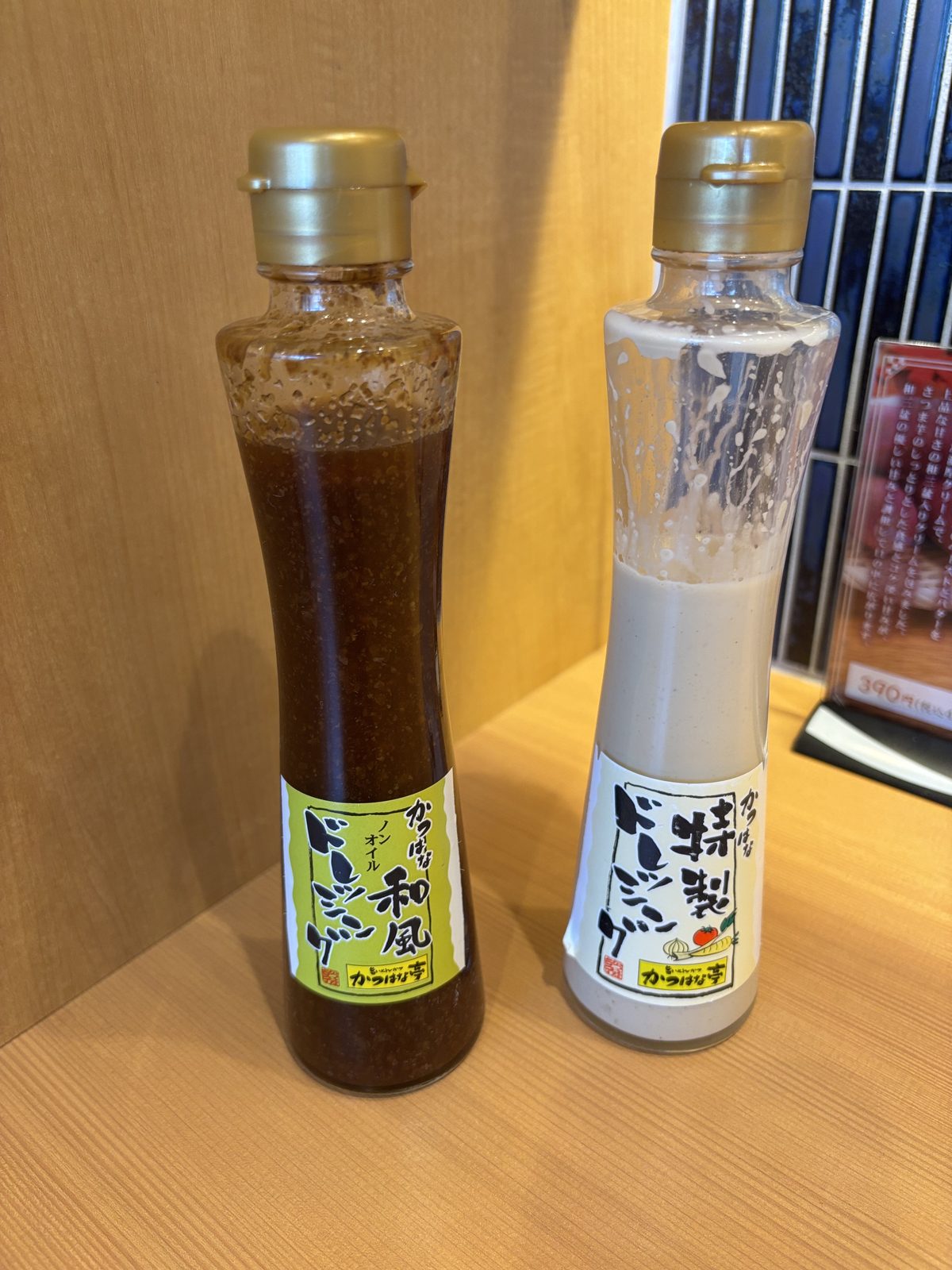
  • Cafés and Kissaten (Japanese Coffee Shops) — Order at the Register First, or Sit Down First?

    Morning in front of a station. In a glass-fronted café, people are lined up at the register and picking up their cups at the end of the counter. Across the street, in a kissaten (喫茶店), a traditional Japanese coffee shop, a staff member carries water and an oshibori (おしぼり, a wet hand towel) to people who’ve taken a seat.

    At cafés and kissaten in Japan, some places have you order at the register first, and others have you sit down and then order. Once you know which kind of place you’re in, you just go with the flow.

    Here are three things to know.

    ・Some places have you order at the register first and pick up your drink at the counter (for example, Starbucks)

    ・At some places, once you sit down, a staff member brings water and an oshibori and comes to take your order (for example, Komeda’s Coffee)

    ・At kissaten in Aichi and Gifu, you can come across モーニング (morning service: toast or other food comes with your drink in the morning)

    1 Walking In — Wait to Be Seated, or Head to the Register?

    When you walk in, stop for a moment and take a look around. Check two things. Is there a line to order at the register? Is a staff member showing people to their seats?

    If there’s a line to order at the register, it’s a place where you order at the register first and pick up at the counter (for example, Starbucks). If a staff member greets you with いらっしゃいませ (irasshaimase, “welcome”) and shows you to a seat, you order at your seat (for example, Komeda’s Coffee).

    For more on telling what kind of place you’re in right at the entrance, see our article “How to Order at a Restaurant in Japan — It Starts at the Entrance: Look for Just 3 Things.”

    Once you know which kind it is, the only thing left to decide is what to drink.

    2 Places Where You Order at the Register First — Just Two Choices

    At Starbucks, for example, you choose your drink and your size at the register, and that’s all there is to ordering. There are four sizes: ショート (Short), トール (Tall), グランデ (Grande) and ベンティ (Venti). When your drink is ready, you pick it up at the pickup counter.

    After you pick it up, you can add milk or sugar yourself. When you order, you only make two choices. Once it’s in front of you, you can fine-tune it to your taste.

    You May Be Asked 店内か、持ち帰りか (tennai ka, mochikaeri ka, “for here or to go?”)

    At the register, you may be asked whether you’ll drink it in the store or take it with you. That’s because the tax differs depending on whether it’s for here or to go, and at some places the price changes too (for example, Starbucks). If you decide beforehand where you’ll drink it, you can answer in a word when you’re asked at the register.

    3 Kissaten Where You Order at Your Seat — Sit Down, and the Staff Come to You

    Entrance of a Komeda's Coffee shop

    At Komeda’s Coffee, for example, a staff member shows you to a seat and brings water and an oshibori to your table. Once you’re seated, someone comes to take your order, and what you ordered is brought to your seat too.

    Once you sit down, all that’s left is to wait. There’s no need to stand at the register reading the menu in a hurry. What Komeda’s Coffee aims to be is “a living room for the town,” where anyone can relax.

    Inside the café: wooden ceiling and window seats

    Many of Japan’s kissaten are old-fashioned places with character, different from newer Western-style cafés. At some, the owner behind a wooden counter makes the coffee one cup at a time, slowly pouring the hot water. At kissaten in Osaka, you can also come across ミックスジュース (mixed juice, a blend of fruit and milk).

    The time you spend waiting at your seat is part of the pleasure of a kissaten.

    4 Morning Service (a Breakfast Set) in Aichi and Gifu — Toast Comes with Your Morning Drink

    Kissaten in Aichi and Gifu Prefectures have a morning treat called モーニング (morning service). When you order a drink in the morning hours, food such as toast, a boiled egg or a salad comes with it, and what you get differs from shop to shop. Not every kissaten in Japan has it.

    Morning set: coffee with toast and a boiled egg

    At some places it comes at the price of the drink alone, and at others you pay a little extra. Some kissaten advertise 1日中モーニング (morning service served all day), so even if you miss the morning, you may still come across it. Some say morning service started in Ichinomiya, and others say Toyohashi, both in Aichi Prefecture.

    The bill for a coffee with the morning set

    Among Japan’s prefectural capitals and government-designated cities, Nagoya ranks first and Gifu City third in spending at kissaten (2023–2025 average).

    Some chain kissaten have morning service too. At Komeda’s Coffee, for example, from opening until 11 a.m., a drink comes with toast (山食パン, a loaf-style bread) or a bread roll (ローブパン), though availability differs by store. On the side, you can choose a boiled egg, egg spread or sweet simmered red beans (おぐらあん).

    You order a coffee, wait a little, and toast and a boiled egg are brought to your seat.

    If you go to Aichi or Gifu, do head to a kissaten in the morning. What comes with your drink is different at every shop: sometimes a salad, sometimes a fried egg. That’s the fun of it. Anywhere else in Japan, try Komeda’s, which was born in Nagoya. Choose the おぐらあん (sweet simmered red beans) and spread it on your toast with butter. That’s an-butter toast (あんバタートースト, red beans and butter on toast), and I really hope you’ll try it. Sweet red beans and butter are a perfect match. It’s a taste you’ll only find in Japan.

    5 Taking a Break — Wi-Fi and Outlets Differ by Store

    Partway through your trip, you’ll want to check a map, or look up where to go next. In Tokyo, public Wi-Fi is often found at places like cafés and stations. What Wi-Fi and outlets you can use varies by store; at Tully’s, for example, the Wi-Fi works at stores with a “tullys_Wi-Fi” sticker on display.

    Find one sticker, and that’s your spot for planning what’s next.

    For now, just this

    When you walk in, look to see whether there’s a line to order at the register or whether you’re shown to a seat.

    At places where you order at the register, choose your drink and size, and pick it up at the pickup counter.

    If you’re asked 店内か、持ち帰りか, say where you’ll drink it.

    At places where you’re shown to a seat, you can order without getting up.

    In Aichi and Gifu, head to a kissaten in the morning and try モーニング (morning service).

    Official sources we checked (12)

    ・Japan National Tourism Organization (JNTO): Take Your Cup Of Coffee With Something Quirky At A Kissaten

    ・Nagoya Meshi Promotion Council (in Japanese)

    ・Statistics Bureau of Japan: Family Income and Expenditure Survey (Two-or-More-Person Households), Rankings by Item for Prefectural Capital Cities and Government-Designated Cities (average of 2023 to 2025) (in Japanese)

    ・Ministry of Finance: Consumption Tax rate hike (October 1, 2019)

    ・Tokyo Convention & Visitors Bureau, GO TOKYO: Wi-Fi Hotspot Guide

    ・Starbucks: How to Order at Starbucks (in Japanese)

    ・Starbucks: Brewed Coffee (in Japanese)

    ・Komeda’s Coffee: The Secret of “Kutsurogi” (Relaxation) (in Japanese)

    ・Komeda’s Coffee: Morning Service (in Japanese)

    ・Komeda’s Coffee: Convenient Services (in Japanese)

    ・Komeda Holdings: Overview of Group Businesses (in Japanese)

    ・Tully’s Coffee: TULLY’S Wi-Fi (in Japanese)

  • Family Restaurants in Japan (Gusto, Saizeriya, Denny’s) — Pour Your Own Drinks, As Many Cups As You Like

    A bright dining room with rows of tables. There are families with children, and people having coffee on their own. On the table, a tablet for ordering. At the back, a corner lined with drinks. This is a Japanese ファミレス (famiresu), short for ファミリーレストラン (family restaurant).

    Entrance of a roadside family restaurant with a Welcome to COCO'S sign
    The entrance of a roadside famiresu (Coco’s).
    Restaurant interior with table and sofa seats
    Inside a family-style restaurant, with table seats and sofa seats in a row.
    Drink bar corner with drink machines, an ice machine, a coffee machine and racks of glasses and cups
    The drink bar corner. Machines for juice and fizzy drinks, ice, a coffee machine, and glasses and cups are all in one place. At Coco’s, for example, a sign above it reads "COCO’S CAFE."

    Known in Japan as “ファミレス,” these are chains you’ll see all over the country, such as Gusto, Saizeriya and Denny’s. They’re places where prices are reasonable and the food often comes out quickly.

    There are three things to look at.

    ・Drinks come from the ドリンクバー (drink bar), a self-serve drink corner. Pay for it, and you can pour your own, as many cups as you like

    ・At many places, you order food on a tablet at the table or on your own smartphone

    ・Places differ in what they do for families with children and what they offer for taking a break. Comparing them is part of the fun

    1 The ドリンクバー (Drink Bar) — Pay for It, and Pour As Many Cups As You Like

    Drink machines on a counter with yellow baskets of upside-down glasses on the shelf below
    Glasses are lined up in the baskets on the lower shelf. Put a glass under the machine for the drink you want, and press the button to pour (Coco’s).

    When it comes to drinks at a famiresu, it’s the ドリンクバー. Pay for it, and you can pick whatever you like from the drinks lined up in the corner and pour your own, as many cups as you like. Some places don’t have a ドリンクバー (for example, some Denny’s locations).

    At Saizeriya, for example, there are carbonated drinks and fruit drinks, hot and iced coffee, and tea in tea bags (the drinks on offer differ somewhat from store to store). Glasses and cups are in the corner, too.

    At some places, the milk and gum syrup (ガムシロップ, liquid sugar) in the corner are for customers who ordered the ドリンクバー (Saizeriya, for example).

    At some places, the ドリンクバー costs less when you order it with food than when you order it on its own (for example, Saizeriya and Denny’s). Take a look at the ドリンクバー section of the menu and compare.

    You don’t have to call the staff every time you want a drink. Coffee after your meal, then one more cup. Choosing at your own pace is the fun of the ドリンクバー.

    Water is in the same corner, too

    Water tap with a round sign marked 水 at the drink bar counter
    A tap with a sign reading 水 (water). Water is in the same corner as the drink bar, and you get it yourself (Coco’s).

    At some famiresu, you get your water yourself, too, from the same corner as the ドリンクバー. At Saizeriya, for example, water is self-service, and paper oshibori (wet hand towels) are at the drink counter as well. At Denny’s, too, お冷 (ohiya, the cold water served at restaurants) and oshibori are in the ドリンクバー corner.

    No need to wait at your seat: when you’re thirsty, you can go and get some yourself right away.

    Menu page showing drink bar prices with a meal, on its own and for children
    The drink bar section of a menu. At Coco’s, for example, it costs less when you order it with a meal or dessert than when you order the drink bar on its own.

    2 Ordering Food — On a Tablet or Your Own Smartphone

    Ordering tablet in English with Start Ordering, Call Staff and Allergen Information buttons
    The ordering tablet at Coco’s, for example. You can switch the screen to English. The "Call Staff" button for calling a staff member is on the same screen.

    You order food from your seat. Many famiresu let you order on a tablet at the table or with a QR code. In the Skylark Group, which includes Gusto, for example, every store of its main brands has an ordering device, so you can order whenever you like.

    At Saizeriya, scan the QR code on the table with your own smartphone, and an ordering screen opens. Even if everyone at the table orders from their own smartphone, it all goes on one bill (伝票).

    At Denny’s, you can order by entering the 5-digit number from the menu into the tablet. Every dish on Denny’s menu has a photo, and menus in several languages are available, too.

    Pick from the photos, type in the number. That’s all it takes to order, even if you can’t read the name of the dish or say it out loud.

    If you’d rather order out loud, call a staff member over. At Saizeriya, for example, you ring the bell on the table.

    Tablet screen with a number keypad and a note that each item has a 3-digit number in the menu book
    The screen for ordering by number. At Coco’s, for example, you enter the 3-digit number shown in the menu.
    Hamburger steak with rice, salad and miso soup
    An example of a meal you can order at a famiresu: hamburger steak with rice and salad, plus miso soup.

    3 With Children — Compare What Each Place Offers

    Famiresu are restaurants designed with children in mind. Many places also have little extras, like toys, coloring pages or menus featuring cartoon characters.

    Gusto, for example, has children’s chairs and diaper-changing tables (except at some stores), and when you order a kids’ set, you get a coin for a capsule toy machine.

    Some places have a ドリンクバー just for kids (Denny’s, for example).

    What’s on offer differs from company to company. If you compare the restaurants’ websites before you go, choosing a place together with your kids becomes even more fun.

    If there’s something you can’t eat

    Tablet screen in English for guests with food allergies, with a QR code for allergen information
    The allergy information screen on the tablet (in English). At Coco’s, for example, you can view allergy information through a QR code. You can also check on the screen in advance what the restaurant can and cannot do for allergies.

    In Japan, restaurants aren’t required to label the allergens in their dishes. Even so, some famiresu companies voluntarily publish allergy information (for example, the Skylark Group and Denny’s). However, the Skylark Group’s allergy information doesn’t cover the drinks at the ドリンクバー. The drink nozzles are shared, too. Please check at the restaurant you’re using, drinks included. You can also look at the company’s information before you go.

    Telling staff what you can’t eat is the topic of the article “Allergy Card for Japan.”

    4 Taking a Break — On Your Own or Together

    A cup of black coffee on a restaurant table
    Bringing a coffee from the drink bar back to your seat, and taking a break.

    Partway through your trip, your smartphone is about to run out of battery. You’d like to sit down for a bit and check your next plans, too. Every Denny’s store has power outlets, and at every Gusto store you can use the in-store Wi-Fi, labeled “Free Wi-Fi.” At a place with a ドリンクバー, you can take a break while refilling your drink.

    I often work at family restaurants. That day, I started with an orange juice, and my second cup was a hot coffee. When you’re switching from something cold to something hot, for example, it’s fine to swap your glass for a cup

    Saizeriya recommends both a casual meal on your own and a way of eating where “everyone chooses together, and everyone shares.” Small plates for sharing out the food are provided, too.

    Order a small amount of each of several different dishes and share them, and you can try many flavors in one meal.

    5 Paying, and Late at Night

    How you pay differs from place to place. Besides the register, some places have self-checkout machines or let you pay at your table (for example, the Skylark Group). At Saizeriya, when you leave, you tap 会計する (“check out”) on the screen you used to order, then tap お支払いへ進む (“proceed to payment”). If you’re not sure, try asking the staff.

    Denny’s is open from early in the morning until late at night. At later hours, some places add a late-night charge, or 深夜料金 (for example, Saizeriya and the Skylark Group).

    If you go in late, check the menu for any note about 深夜料金.

    For now, just this

    Drinks come from the ドリンクバー. Pay for it, and pour your own, as many cups as you like.

    At some places, you get your water yourself, too, from the ドリンクバー corner.

    Order food on a tablet or your own smartphone. Where you can order by number, you can order even if you can’t read the name of the dish.

    With children, compare how each place does things differently.

    Official sources we checked (15)

    ・Japan National Tourism Organization (JNTO): Traveling With Children

    ・National Consumer Affairs Center of Japan, Consumer Hotline for Tourists: I had an allergic reaction caused by a meal at a restaurant. What should I do? (in Japanese)

    ・Sakai City: Providing information on food allergies (in Japanese)

    ・Saizeriya: How to use Saizeriya (facilities, in Japanese)

    ・Saizeriya: How to use Saizeriya (meals, in Japanese)

    ・Saizeriya: Enjoying a meal on your own (in Japanese)
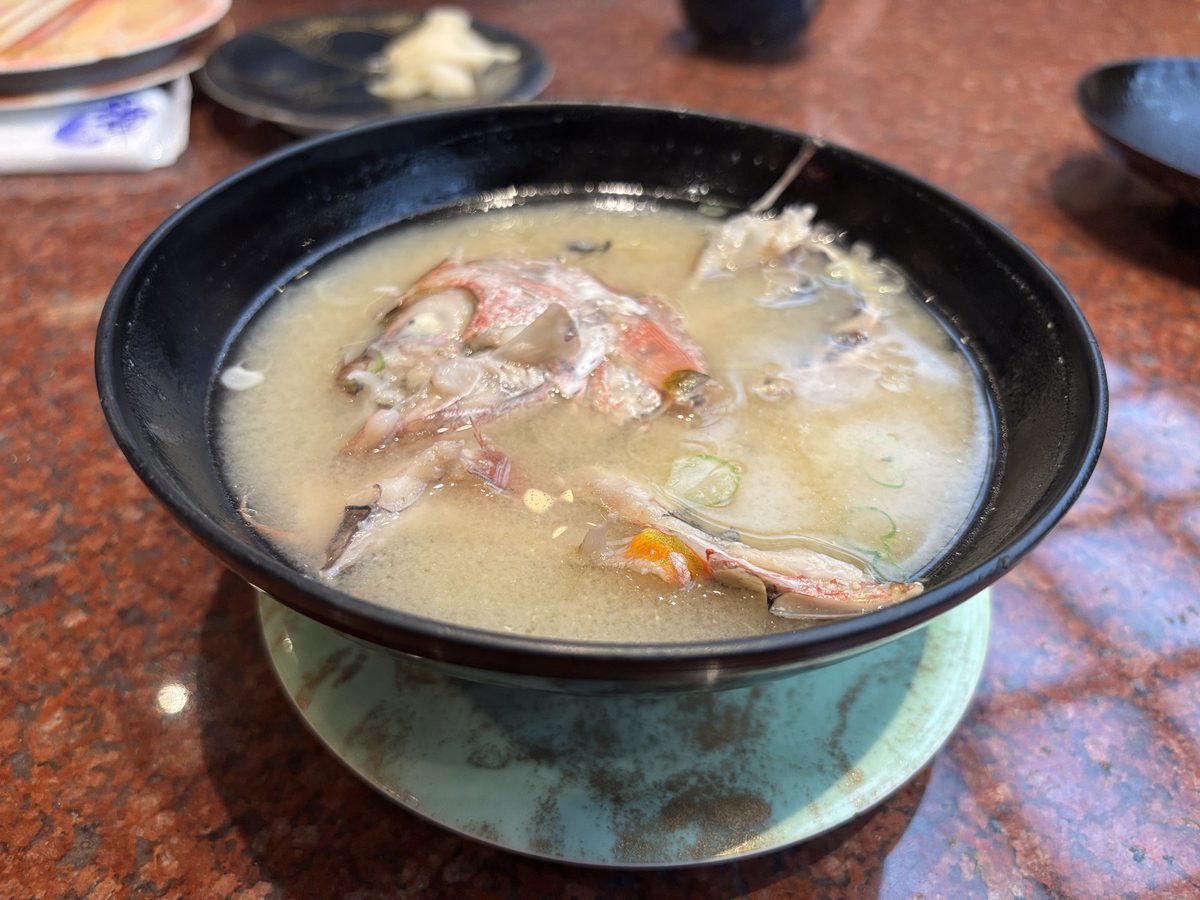
    ・Saizeriya: Set drink bar (in Japanese)
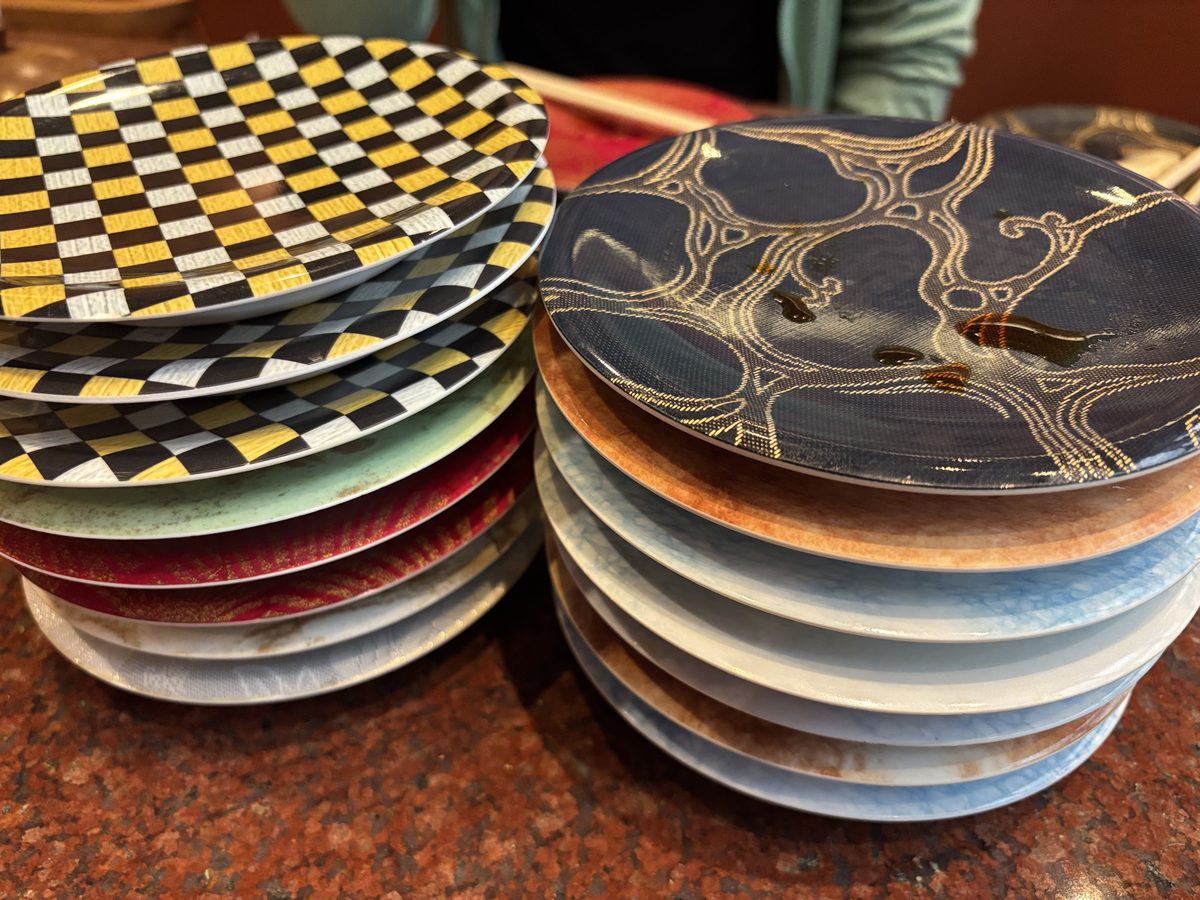
    ・Denny’s: Denny’s Restaurant

    ・Denny’s: MENU (Japanese, English and Chinese, PDF)

    ・Denny’s: Power outlets now in every store!!! (in Japanese)
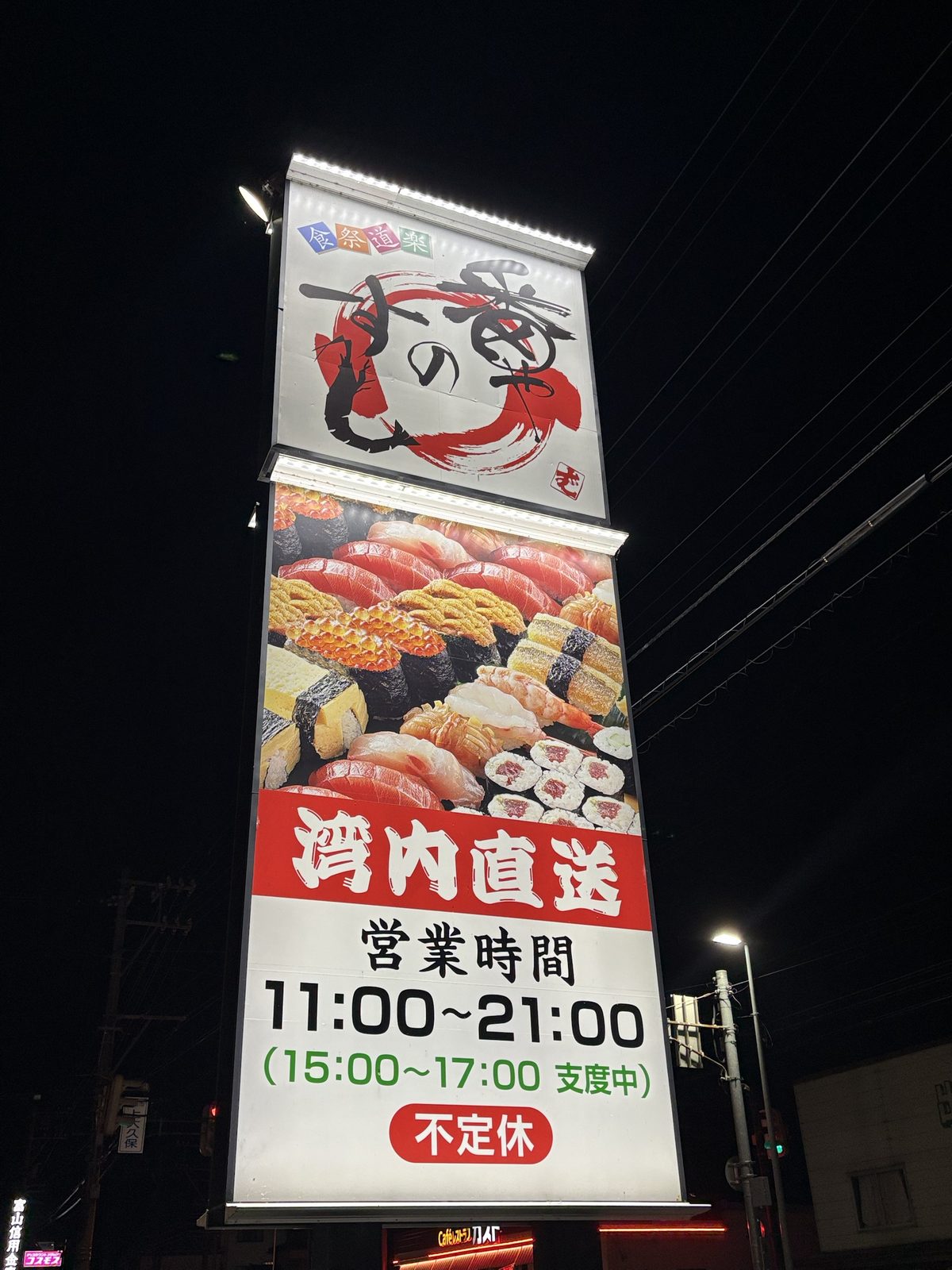
    ・Gusto: Lunch and dinner with your kids, worry-free and happy! (in Japanese)
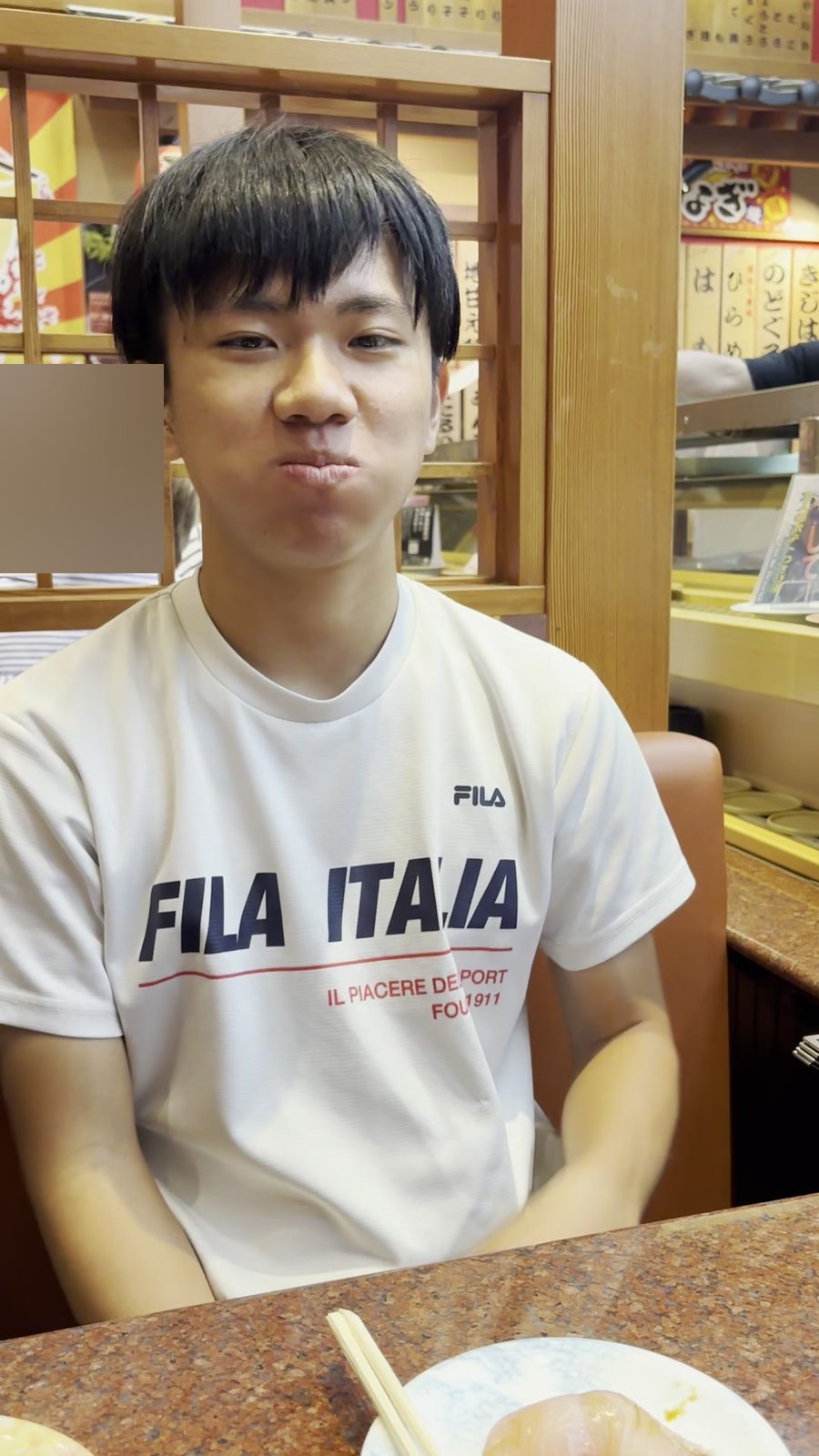
    ・Skylark Group: Free Wi-Fi available (in Japanese)
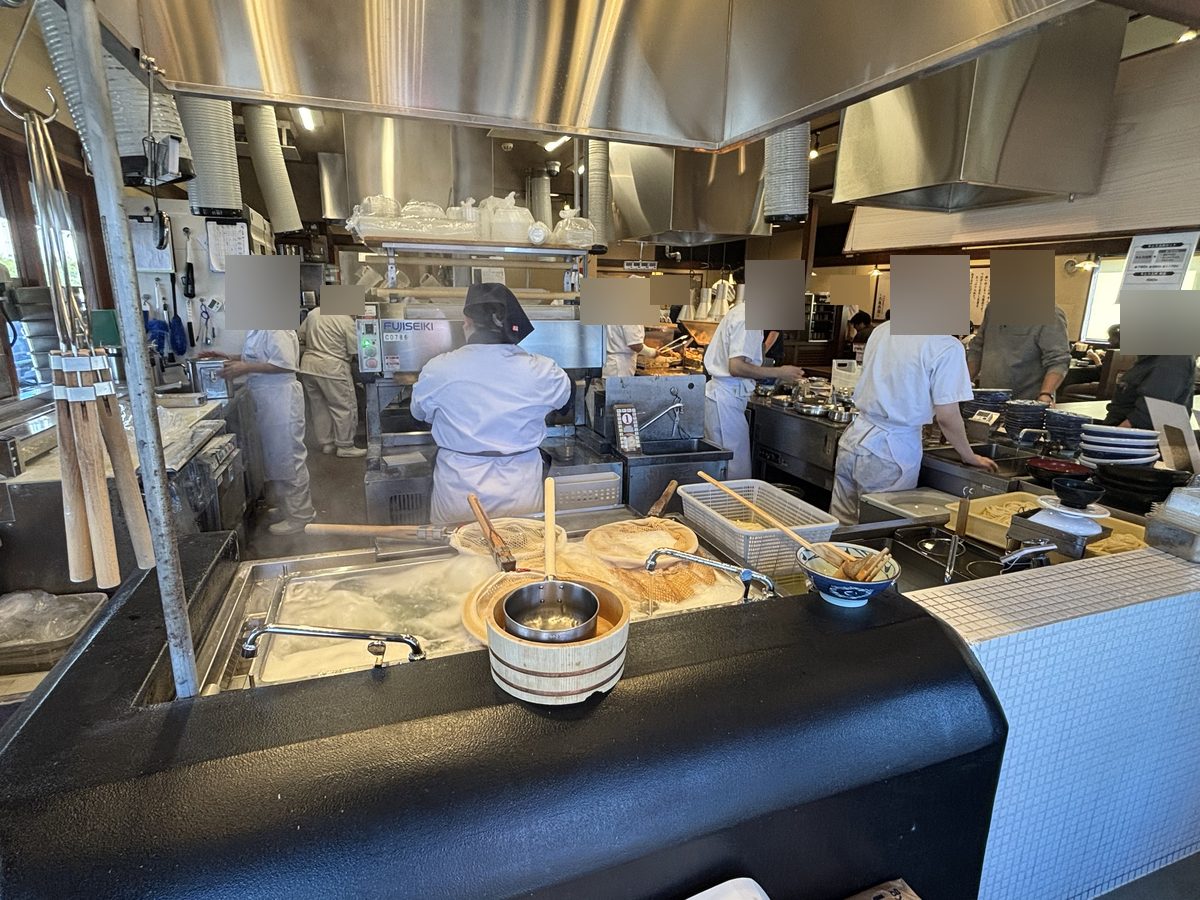
    ・Skylark Group: Frequently asked questions (in Japanese)
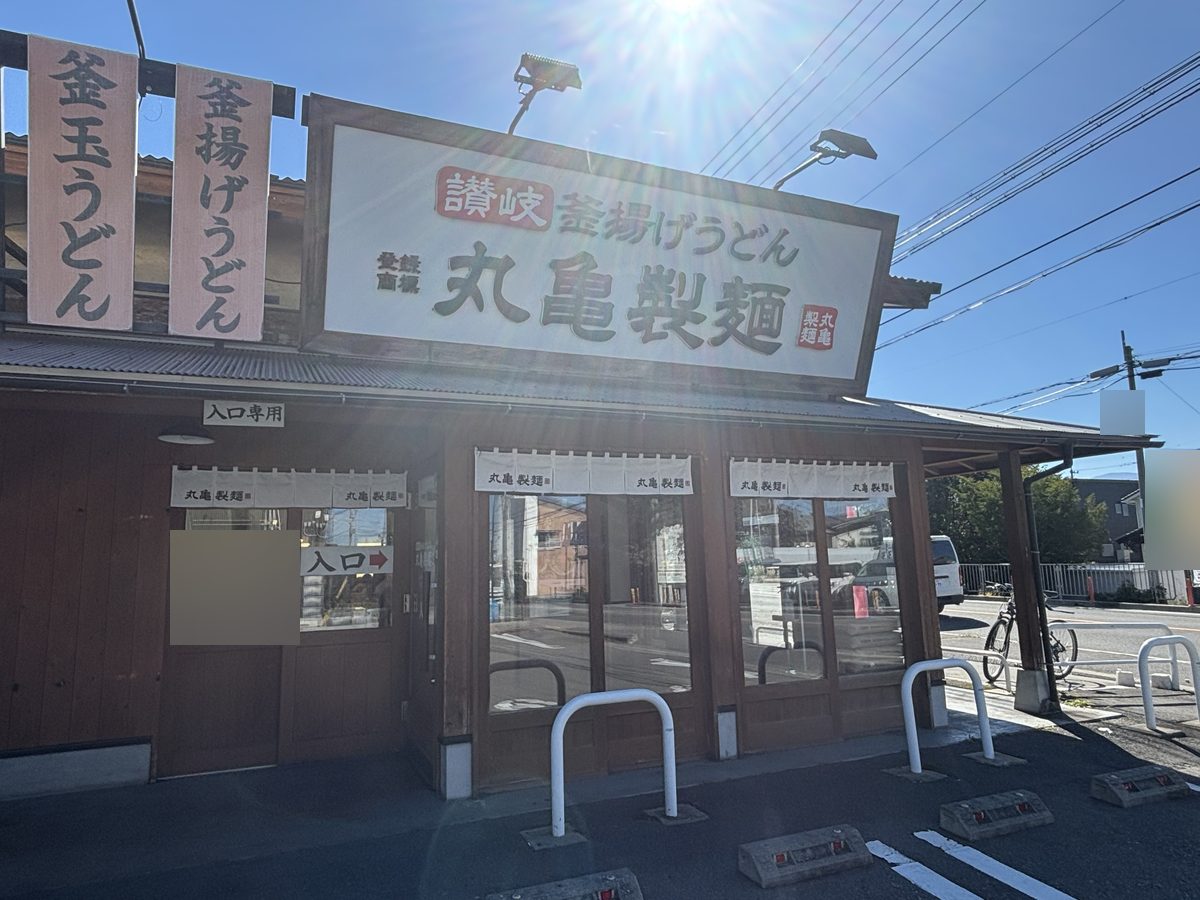
    ・Skylark Group: Allergy information site, points to note (in Japanese)
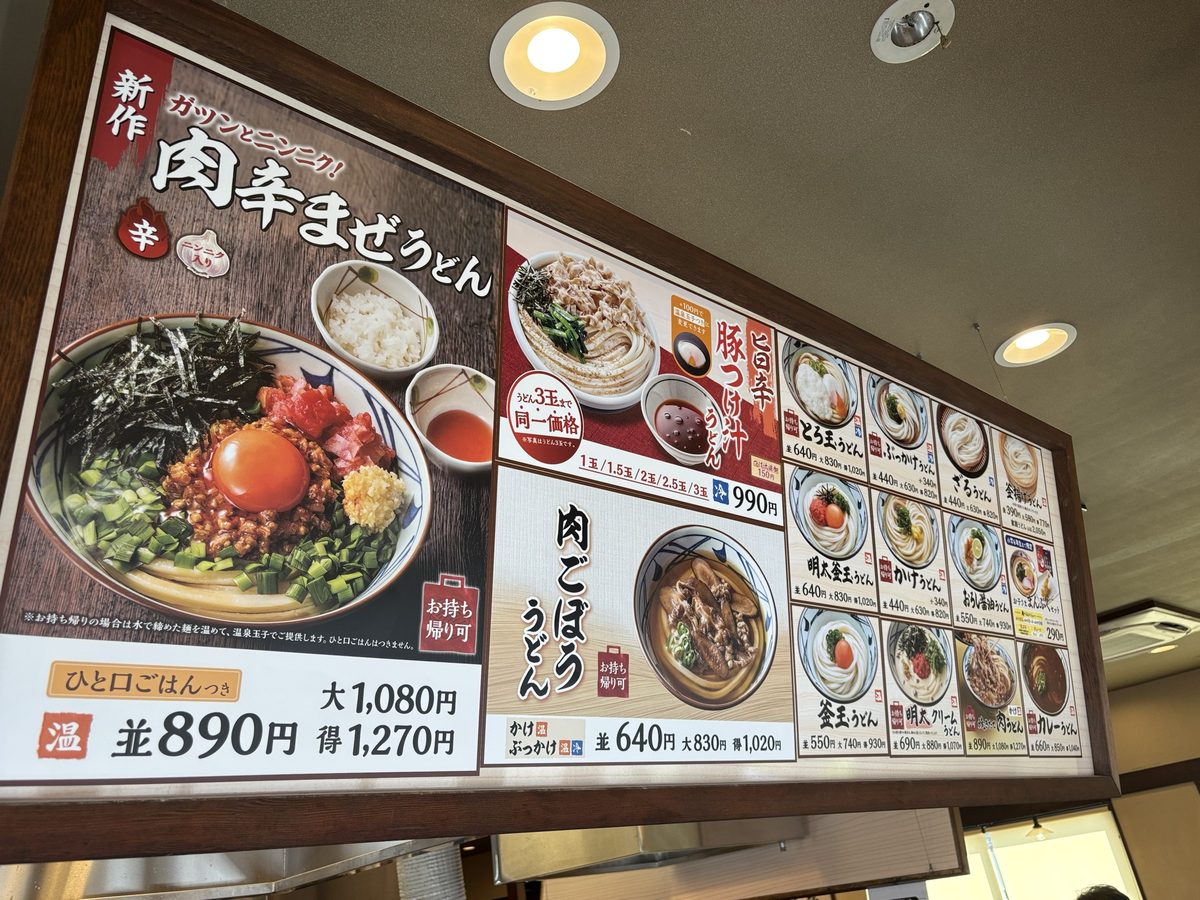
    ・Skylark Holdings: DX (digital transformation, in Japanese)